Contents
AcademyPoster Preparation
Guide
CONSORT for Abstracts Applied to Conference Abstracts: An Item-by-Item Guide Before You Submit a Poster Abstract
CONSORT for Abstracts lists the 17 items a randomised trial abstract should report. This guide applies them to conference and poster abstracts, where space is tightest and omissions are most common.
- Reporting guidelines
- Conference abstracts
- Clinical trials
- Published
- 2008, by the CONSORT Group
- Items
- 17 (one for conference abstracts only)
- Applies to
- Journal and conference abstracts of randomised trials
- Status
- Still referenced by CONSORT 2025
At a glancePoster Preparation
Talk to a Pubrica expertDiscuss your project
Quick answer
- Say “randomised” in the title and give the design, participants, interventions, objective, primary outcome, randomisation and blinding.
- Report numbers randomised and analysed, recruitment status, the primary outcome with effect size and precision, and harms.
- Add the corresponding author’s contact details, trial registration and funding, even when the word count is tight.
What CONSORT for Abstracts is
CONSORT for Abstracts is a reporting checklist that sets out the minimum information an abstract of a randomised trial should contain1. The main CONSORT statement governs the full trial report. The abstract extension, published in 2008, adapts it to the few hundred words of an abstract so that a reader can judge the design and findings without the full paper. It lists 17 items across the title, authors, methods, results and conclusions, plus trial registration and a funding statement1.
The CONSORT extension for abstracts was written for journal and conference abstracts alike, and one item, the corresponding author’s contact details, applies to conference abstracts only1. It is still current: the CONSORT 2025 statement, which replaced CONSORT 2010 for full reports, keeps a structured summary as item 1b and lists the 2008 abstracts extension among its extensions2. We found no updated abstracts checklist when we checked in October 2026.
Why conference and poster abstracts need it
A conference abstract may be the only permanent record of a trial. Studies reviewed by the CONSORT group found that only about half of randomised trials presented at conferences are later published in full1. The same work found frequent gaps: in one sample, only 26% of conference abstracts reported both the size of the effect and its statistical significance, and most trial abstracts reported no harms1.
A poster abstract read at a glance can mislead if it reports a favourable result without the effect size, the denominator or the trial registration. Running the CONSORT abstract guidelines as a conference abstract checklist protects readers, and it pre-empts the most predictable reviewer questions.
The checklist, item by item
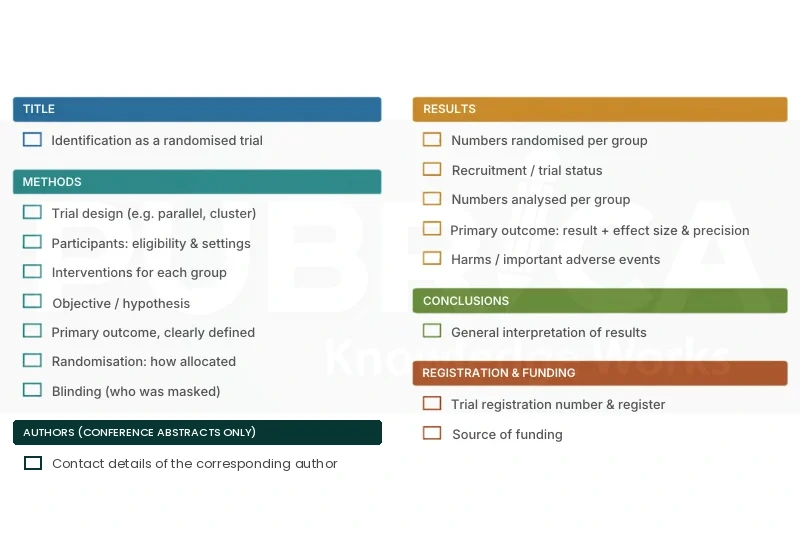
Work through the items in the order they appear in the abstract. In the title, state that the study is a randomised trial. In the methods, give the trial design, the eligibility criteria and setting, the interventions for each group, the objective, the clearly defined primary outcome, how participants were allocated, and who was blinded. In the results, report the numbers randomised and analysed in each group, which is the essence of participant flow. For the primary outcome, give a result for each group with the estimated effect size and its precision, usually a 95% confidence interval, and report important harms. The conclusion gives a general interpretation that weighs benefits against harms1. Each item needs only a short clause.
Submitting a trial to a conference?
Pubrica’s medical-writing team drafts and checks your conference and poster abstracts against every CONSORT for Abstracts item, so your trial reporting is complete and ready to submit.
The items that matter most for conference abstracts
Four items need special care in a poster abstract. The corresponding author’s contact details are required for conference abstracts only, because there may be no full paper to trace1. Recruitment status (ongoing, closed or stopped early) matters because conference abstracts are more likely than full papers to report interim analyses1. Trial registration, with the register name and number, lets readers find the protocol and check for selective reporting. A funding statement naming the source belongs in the abstract itself, not only on the poster1. These are the items most often cut for space, so add them first and trim elsewhere.
Common omissions and how to fix them
The fixes are usually a few words. If the title does not say “randomised”, add it. If the primary outcome is implied, name it and report it for both groups with an effect size and confidence interval, not a p value alone. Replace “significantly improved” with the actual numbers, and state how many were randomised and analysed so the denominators are explicit. Insert the trial registration number and the funding statement even if something less essential has to go. Writing within a structured abstract labelled background, methods, results and conclusions makes each required item easy to find and easy for a reviewer to tick off3.
Check the conference’s own rules
Conference word limits are often tight, and some count the title, authors or registration number. Check the call for abstracts first, then fit the 17 items within it.
The CONSORT for Abstracts checklist
Table 1. The 17 CONSORT for Abstracts items: tick each one before you submit a conference or poster abstract
| Section | Item | What to report |
|---|---|---|
| Title | Title | Identify the study as a randomised trial |
| Authors | Contact details* | Contact details for the corresponding author |
| Methods | Trial design | Parallel, cluster, crossover, factorial, non-inferiority, etc. |
| Methods | Participants | Eligibility criteria and the settings where data were collected |
| Methods | Interventions | The interventions intended for each group |
| Methods | Objective | The specific objective or hypothesis |
| Methods | Outcome | The clearly defined primary outcome |
| Methods | Randomisation | How participants were allocated to interventions |
| Methods | Blinding | Whether participants, care givers and outcome assessors were blinded |
| Results | Numbers randomised | Participants randomised to each group |
| Results | Recruitment | Trial status: ongoing, closed, or stopped early |
| Results | Numbers analysed | Participants analysed in each group |
| Results | Outcome | Result for each group, the estimated effect size and its precision |
| Results | Harms | Important adverse events or side effects |
| Conclusions | Conclusions | General interpretation of the results |
| Other | Trial registration | Registration number and name of the trial register |
| Other | Funding | Source of funding |
* Conference abstracts only. Use the table as a final pass: if any row has no matching clause in your draft, the abstract is not yet complete. For guidance on turning the accepted abstract into a poster, see our step-by-step research poster guide.
Putting it together
Treated as a pre-submission routine, CONSORT for Abstracts turns complete trial reporting into a finite list of 17 items, each covered in a single clause. Draft the abstract in a structured format, run it against Table 1, and repair every missing item, starting with the primary outcome, the effect size, participant flow, the trial registration and the funding statement. Do that before you submit, and your conference or poster abstract reports the trial completely and honestly.
Pubrica team verdict
CONSORT for Abstracts gives conference and poster abstracts a 17-item standard. Draft in a structured format, check every item, and never cut the primary outcome result, the effect size, the registration number or the funding statement to save words.
Frequently asked questions
No. The extension covers both journal and conference abstracts of randomised trials, including poster and oral presentation abstracts. One item, the corresponding author’s contact details, applies to conference abstracts only.
Harms, the effect size with its precision for the primary outcome, and the numbers analysed per group are among the most frequently missing items, along with the trial registration number.
No. CONSORT 2025 replaced CONSORT 2010 for full trial reports. It keeps a structured summary as item 1b and still lists the 2008 abstracts extension among its extensions.
Sources
Sources were checked on 28 October 2026. Requirements and guidance may change after that date; confirm the current version with the issuing body.
- 1Hopewell S, Clarke M, Moher D, et al. CONSORT for reporting randomized controlled trials in journal and conference abstracts: explanation and elaboration. PLoS Med. 2008;5(1):e20. https://pmc.ncbi.nlm.nih.gov/articles/PMC2211558/
- 2Hopewell S, Chan AW, Collins GS, et al. CONSORT 2025 statement: updated guideline for reporting randomised trials. BMJ. 2025;389:e081123. https://doi.org/10.1136/bmj-2024-081123
- 3Nakayama T, Hirai N, Yamazaki S, Naito M. Adoption of structured abstracts by general medical journals and format for a structured abstract. J Med Libr Assoc. 2005;93(2):237–242. https://pmc.ncbi.nlm.nih.gov/articles/PMC1082941/
CONSORT for abstractsconference abstract checklistCONSORT abstract guidelinesposter abstractCONSORT extension abstractsrandomised trial
How to cite this article
Pick your referencing style and copy it. Your university or target journal may vary the punctuation, so check its guide if it has one.
Dr. Charlie. (2026, October 28). CONSORT for Abstracts Applied to Conference Abstracts: An Item-by-Item Guide Before You Submit a Poster Abstract. Pubrica. https://pubrica.com/academy/poster-preparation/consort-for-abstracts-conference-guide/
This article is written to be learned from. Cite it if you are referring to what it says; if you are using the evidence behind it, cite the sources listed above instead.
Next steps
Submitting a trial to a conference?
Pubrica’s medical-writing team drafts and checks your conference and poster abstracts against every CONSORT for Abstracts item, so your trial reporting is complete and ready to submit.
This article is general information for researchers, not legal, regulatory or funding advice. Check the current requirements of your journal, funder, ethics committee or regulator before you act on it.
More in Poster Preparation