Contents
AcademyLiterature Review
Guide
SANRA Scale Self-Assessment: Score Your Narrative Review on the Six SANRA Items Before Submission
The SANRA scale rates a narrative review on six items, each scored 0 to 2. This guide shows how to self-score your own manuscript before submission, read the total, and fix the weak items.
- Narrative review
- Literature review
- Quality appraisal
- Items
- Six, each scored 0, 1 or 2
- Total
- 0–12
- Very poor
- 4 or below (authors’ experience)
- Use for
- Narrative (non-systematic) reviews
At a glanceLiterature Review
Talk to a Pubrica expertDiscuss your project
Quick answer
- Score your review 0, 1 or 2 on each of the six SANRA items and add them up to a total out of 12.
- There are no formal cut-offs, but the developers say 4 or below indicates very poor quality.
- Fix every item scored 0 or 1, then score again before you submit.
What the SANRA scale is
SANRA, the Scale for the Assessment of Narrative Review Articles, is a six-item instrument for judging the scientific quality of a non-systematic review1. Three editors at the general medical journal Deutsches Ärzteblatt developed it between 2010 and 2017, through two earlier seven-item versions, and published the final scale in 20191. Each of its six items is rated 0, 1 or 2, giving a total SANRA score from 0 to 12.
In the authors’ test on 30 consecutive narrative reviews, the intraclass correlation between three raters was 0.77 (95% CI 0.57 to 0.88) and Cronbach’s alpha was 0.681. The raters were the scale’s own authors, so reliability may be lower in less familiar hands. SANRA was built to help editors, reviewers and readers, and the developers also encourage authors to use it when preparing a narrative review1. That makes it a natural self-assessment tool: running your manuscript through the six items before submission turns a vague worry about narrative review quality into a score you can act on.
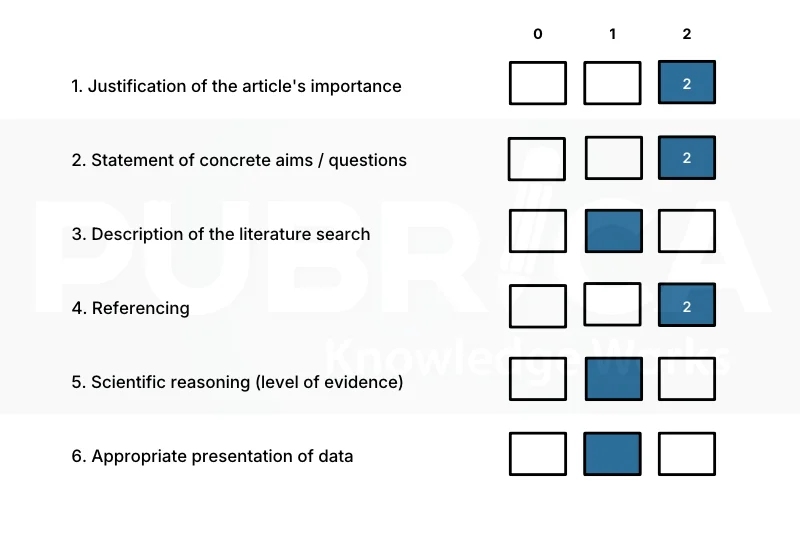
The six SANRA items, explained
The scale assesses six items1:
- Justification of the article’s importance for the readership. Does the review explain why the topic matters now?
- Statement of concrete aims or formulation of questions. Is the purpose explicit rather than implied?
- Description of the literature search. Are the sources, search terms and approach described, even briefly?
- Referencing. Are key statements supported by appropriate, verifiable citations?
- Scientific reasoning. Is the evidence, and its level of evidence, weighed rather than opinion asserted?
- Appropriate presentation of data. Are relevant outcome data reported, with numbers, tables and figures where they help?
Together these items separate a sourced synthesis from an unsupported essay, which is what review appraisal needs to capture. They also mirror long-standing advice on writing narrative reviews: state the purpose, describe how the literature was found, and support claims with sources2.
How the 0–2 scoring works
Each item is scored 0 for a low standard, 2 for a high standard and 1 for anything in between1. The developers publish separate explanations and examples for each item so that scoring is as consistent as possible. Summing the six items gives the SANRA score. When you self-assess, score against those anchors, not against how you hope the manuscript reads. The value of the exercise comes from catching the items you would rather not admit are a 0 or a 1.
Want an expert SANRA review before you submit?
Pubrica’s medical-writing team scores your narrative review against all six SANRA items, strengthens weak sections and prepares the manuscript to your target journal’s standards.
Reading your total score (0–12)
SANRA has no established cut-offs for grades of quality, and its authors advise against comparing scores across different settings. They do give one marker from experience: a score of 4 or below indicates very poor quality1. Beyond that, read the profile as well as the sum. A respectable total can hide a single 0, and a 0 on referencing or the literature search is the kind of weakness reviewers notice first. A useful working target is a high total with no item below 1.
Narrative reviews only
Fixing weak items before submission
The point of self-scoring is repair. For a low score on justification, open with why the topic matters to the journal’s readers now; for aims, turn an implied purpose into one or two explicit questions. Fix a weak literature-search item with a short paragraph naming the databases, search terms and date range you used2. Address thin referencing by sourcing every substantive claim, weak scientific reasoning by stating the level of evidence behind key statements, and poor data presentation by reporting the outcome data that matter, moving comparisons into a table or figure2. Then score the manuscript again and check that no zeros remain.
The SANRA self-assessment worksheet
Table 1. A SANRA self-assessment worksheet: score each of the six items 0, 1 or 2 and total out of 12 (quick guide; use the official SANRA explanations for final scoring)
| SANRA item | 0 (low standard) | 1 | 2 (high standard) |
|---|---|---|---|
| 1. Justification of importance | Not stated | Implied | Clearly argued for the readership |
| 2. Concrete aims or questions | Absent | Vague | Explicit |
| 3. Description of the literature search | None | Mentioned only | Sources, terms and approach given |
| 4. Referencing | Few or unsupported | Partial | Key claims fully sourced |
| 5. Scientific reasoning (level of evidence) | Opinion only | Some evidence | Evidence and its level weighed |
| 6. Appropriate presentation of data | No outcome data | Some data | Relevant endpoint data, clearly shown |
| Total | 0–12 |
Print the worksheet, score your draft, and note one fix for every item below 2. If you want a second opinion, ask a co-author to score the manuscript independently and compare: the items where you disagree are usually the ones a peer reviewer will question. For the next steps after scoring, see our guide on how to publish a literature review.
Putting it together
Used before submission, the SANRA scale turns the goal of “a good narrative review” into six measurable items and one 0–12 score. The workflow is simple and repeatable: score the six items honestly, read the profile as well as the sum, repair every item rated 0 or 1, and score again. That loop raises your narrative review quality on the same criteria an editor using the SANRA checklist will apply.
Pubrica team verdict
SANRA gives authors a quick, published standard for narrative review quality. Self-score the six items, fix every 0 and 1, and submit only when the profile has no weak items.
Frequently asked questions
SANRA has no official pass mark. Its developers say a score of 4 or below indicates very poor quality; aim for a high total with no individual item below 1.
No. SANRA is designed for narrative (non-systematic) reviews. Systematic reviews are reported against PRISMA 2020 and appraised with tools such as AMSTAR 2.
Christopher Baethge, Sandra Goldbeck-Wood and Stephan Mertens, editors at Deutsches Ärzteblatt, developed it and published it in 2019 in Research Integrity and Peer Review.
Sources
Sources were checked on 28 October 2026. Requirements and guidance may change after that date; confirm the current version with the issuing body.
- 1Baethge C, Goldbeck-Wood S, Mertens S. SANRA—a scale for the quality assessment of narrative review articles. Res Integr Peer Rev. 2019;4:5. https://pmc.ncbi.nlm.nih.gov/articles/PMC6434870/
- 2Green BN, Johnson CD, Adams A. Writing narrative literature reviews for peer-reviewed journals: secrets of the trade. J Chiropr Med. 2006;5(3):101–117. https://pmc.ncbi.nlm.nih.gov/articles/PMC2647067/
- 3Shea BJ, Reeves BC, Wells G, et al. AMSTAR 2: a critical appraisal tool for systematic reviews that include randomised or non-randomised studies of healthcare interventions, or both. BMJ. 2017;358:j4008. https://doi.org/10.1136/bmj.j4008
- 4Page MJ, McKenzie JE, Bossuyt PM, et al. The PRISMA 2020 statement: an updated guideline for reporting systematic reviews. BMJ. 2021;372:n71. https://pmc.ncbi.nlm.nih.gov/articles/PMC8008539/
SANRA scaleSANRA narrative reviewnarrative review qualitySANRA checklistSANRA scorescientific quality
How to cite this article
Pick your referencing style and copy it. Your university or target journal may vary the punctuation, so check its guide if it has one.
Dr. Charlie. (2026, October 28). SANRA Scale Self-Assessment: Score Your Narrative Review on the Six SANRA Items Before Submission. Pubrica. https://pubrica.com/academy/literature-review/sanra-narrative-review-self-assessment/
This article is written to be learned from. Cite it if you are referring to what it says; if you are using the evidence behind it, cite the sources listed above instead.
Next steps
Want an expert SANRA review before you submit?
Pubrica’s medical-writing team scores your narrative review against all six SANRA items, strengthens weak sections and prepares the manuscript to your target journal’s standards.
This article is general information for researchers, not legal, regulatory or funding advice. Check the current requirements of your journal, funder, ethics committee or regulator before you act on it.
More in Literature Review