Contents
On this page
AcademyLiterature Review
Guide
How Long Is a Literature Review? Word Limits and Format Rules for Review Articles in Leading Medical Journals Compared
Most review articles in leading medical journals must fit roughly 3,000 to 5,000 words, but the real limit depends on the review type and the journal. This guide compares word, reference and abstract limits from the journals’ own author instructions.
- Literature review
- Review articles
- Journal submission
- Typical main text
- About 3,000–5,000 words
- Narrative review
- 3,500 (Annals) to 5,000 (Lancet Seminar)
- Systematic review
- 3,000 (JAMA) to 4,000 (Annals), plus supplements
- Abstract
- 150 to 400 words, by journal
At a glanceLiterature Review
Talk to a Pubrica expertDiscuss your project
Quick answer
- Most review articles in leading medical journals must fit about 3,000 to 5,000 words of main text.
- Narrative reviews are bound by an editorial word limit; systematic reviews by PRISMA 2020 reporting items.
- Check the reference cap, abstract length and figure limit too, and whether the journal only commissions reviews.
How long is a literature review?
How long is a literature review? For a standalone review article in a leading medical journal, the main text usually has to fit between about 3,000 and 5,000 words. That range comes from the journals’ own author instructions, summarised in Table 1, not from a universal rule567. Three things set the real figure for your manuscript: the type of review, the journal’s specification for that article type, and the reporting standard the review must meet. The right literature review length is a number you look up, not one you guess.
Literature review word count is only one of several limits. Journals also cap the number of references, the abstract length, and the number of tables and figures, and some still set a page limit. Pulling all of those figures from the journal author guidelines before you draft is the most reliable way to control review article length.
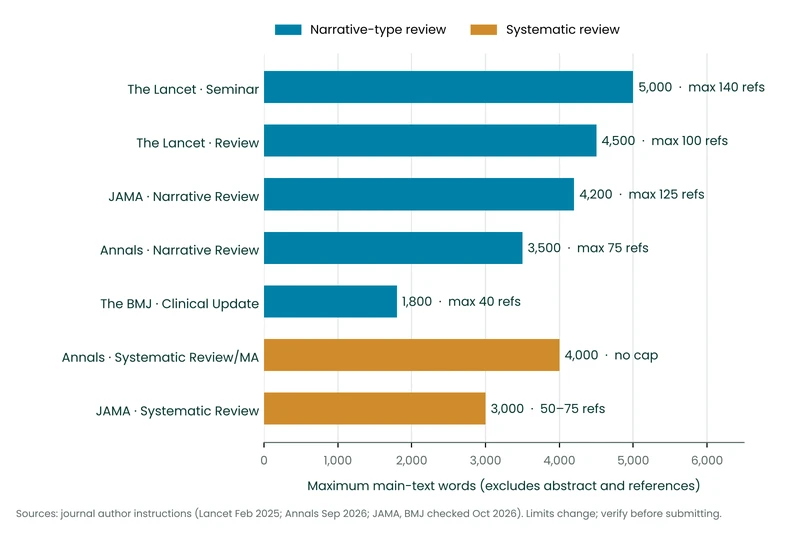
Length by review type: narrative vs systematic
The biggest driver of length is the kind of review. A narrative review surveys a topic selectively and is written as a readable synthesis, so an editorial word limit is what binds it1. A systematic review answers a predefined question with a comprehensive, reproducible search. It is bound by completeness instead: PRISMA 2020 sets 27 items that must be reported, including the search strategy, a flow diagram, risk-of-bias assessment and synthesis methods4. Its length therefore grows with the evidence base, and much of the detail goes into tables and supplementary files.
Both formats are common at the top of the field. A survey of 275 reviews published in NEJM, The Lancet, JAMA, The BMJ and Annals of Internal Medicine (June 2015 to June 2016) found that 27% were systematic reviews and the rest were narrative reviews, with or without some reported methods. Every review in NEJM in that period was narrative3. Naming your review type early tells you which budget you are writing to.
Word limits across leading medical journals
Even for the same review type, the word limit moves from journal to journal. JAMA caps a Narrative Review at 4,200 words with up to 125 references and a three-part structured abstract of up to 400 words. Its Systematic Review format is shorter, at 3,000 words5. The Lancet allows up to 5,000 words and 140 references for a Seminar, and 4,500 words and 100 references for a Review, each with a 150-word unstructured summary6. Annals of Internal Medicine sets 3,500 words and 75 references for a Narrative Review, and 4,000 words for a Systematic Review and Meta-analysis7.
Two caveats matter more than the numbers. First, many flagship reviews are invited: The Lancet commissions its Seminars and Reviews, JAMA requires a presubmission inquiry, and The BMJ commissions all its education content, so an unsolicited manuscript may not be considered568. Second, journals revise their instructions often. Use Table 1 for orientation and the journal’s current page as the rule.
Not sure which review type or word limit fits your study?
Pubrica’s medical-writing team plans, drafts and formats narrative and systematic reviews to your target journal’s word limits, reference caps and reporting standards.
Beyond word count: references, abstract and sections
Length is more than the main text. Reference caps differ widely, from 40 for a BMJ Clinical Update to 140 for a Lancet Seminar, while a systematic review cites every included study and is often uncapped678. Abstract length differs too. JAMA wants up to 400 structured words for a narrative review, Annals wants 275 unstructured words, and Cochrane allows up to 1,000 words but prefers fewer than 700579. Most reviews still follow recognisable sections: an introduction, a methods or search-strategy section, a thematic body and a conclusion. The Lancet, for example, asks every Seminar and Review to include a short “search strategy and selection criteria” section, even when the rest of the review article format is left to the author6.
Check every limit, not just words
Manuscripts are often returned before peer review for breaking a limit other than the word count: too many references, an abstract that is too long or in the wrong structure, or more tables and figures than the article type allows. Note each limit from the instructions before you start writing.
How to stay within the limit
Writing to length is a skill. Draft first and trim second: get the argument down, then cut repetition, compress background, and move detailed evidence into tables, which most journals exclude from the main-text count. Pautasso’s widely cited guidance stresses defining a focused scope early, because an over-broad question is the surest route to an over-long review2. Use a reference manager to track the number of references against the cap, and check the abstract length and any page limit as you go.
Quick-reference comparison table
Table 1. Review article limits in leading medical journals, taken from each journal’s author instructions (checked October 2026; confirm before you submit)
| Journal and article type | Main-text words | Abstract | References | How it reaches the journal |
|---|---|---|---|---|
| JAMA, Narrative Review | Up to 4,200 | Structured, up to 400 words | Up to 125 | Presubmission inquiry required |
| JAMA, Systematic Review | Up to 3,000 | Structured, up to 350 words | 50–75 | Presubmission inquiry required |
| The Lancet, Seminar | Up to 5,000 | 150-word unstructured summary | Up to 140 | Commissioned |
| The Lancet, Review | Up to 4,500 | 150-word unstructured summary | Up to 100 | Commissioned |
| Annals of Internal Medicine, Narrative Review | Up to 3,500 | Unstructured, up to 275 words | Up to 75 | Submitted |
| Annals of Internal Medicine, Systematic Review and Meta-analysis | Up to 4,000 | Structured, up to 275 words | No cap (over 100 may move online) | Submitted; protocol registered first |
| The BMJ, Clinical Update | 1,800 | Not stated | Up to 40 | Pitch first; education content is commissioned |
| Cochrane, systematic review | No single cap | Up to 1,000 words, ideally under 700 | All included studies | Through a Cochrane review group |
The main-text column sets your literature review word count, the reference and abstract columns set two more budgets, and the last column tells you whether to pitch before you write. For the full sequence from outline to submission, see our guide on how to publish a literature review.
Putting it together
Review article length is a constraint to plan for, not a style preference. Classify your review as narrative or systematic, pick the target journal and article type, and copy its word limit, reference cap, abstract length and figure limit into your outline. Then allocate words across the introduction, methods, thematic body and conclusion, and move granular evidence into tables and supplements. Done in that order, “how long is a literature review?” becomes a precise, defensible number for your manuscript.
Pubrica team verdict
There is no single answer to how long a literature review should be: it is the limit your review type and target journal set. Look up the word limit, reference cap and abstract length for the exact article type before you draft, and plan the outline to fit them.
Frequently asked questions
For a standalone review article in a major medical journal, usually 3,000 to 5,000 words of main text. Shorter clinical formats, such as a BMJ Clinical Update at 1,800 words, exist too. Always check the limit for your exact article type.
Often it is longer overall, because PRISMA 2020 requires the full search, a flow diagram and study tables, much of it in supplements. The main-text cap can actually be lower: JAMA allows 3,000 words for a systematic review and 4,200 for a narrative review.
Usually not. Journals such as Annals of Internal Medicine exclude the abstract and references from the main-text count, but they cap the number of references separately.
Sources
Sources were checked on 28 October 2026. Requirements and guidance may change after that date; confirm the current version with the issuing body.
- 1Gülpınar Ö, Güçlü AG. How to write a review article? Turk J Urol. 2013;39(Suppl 1):44–48. https://pmc.ncbi.nlm.nih.gov/articles/PMC4548566/
- 2Pautasso M. Ten simple rules for writing a literature review. PLoS Comput Biol. 2013;9(7):e1003149. https://pmc.ncbi.nlm.nih.gov/articles/PMC3715443/
- 3Faggion CM Jr, Bakas NP, Wasiak J. A survey of prevalence of narrative and systematic reviews in five major medical journals. BMC Med Res Methodol. 2017;17:176. https://pmc.ncbi.nlm.nih.gov/articles/PMC5746017/
- 4Page MJ, McKenzie JE, Bossuyt PM, et al. The PRISMA 2020 statement: an updated guideline for reporting systematic reviews. BMJ. 2021;372:n71. https://pmc.ncbi.nlm.nih.gov/articles/PMC8008539/
- 5JAMA. Instructions for authors: Narrative Review and Systematic Review (accessed 28 October 2026). https://jamanetwork.com/journals/jama/pages/instructions-for-authors
- 6The Lancet. Information for authors, February 2025 edition: Seminars and Reviews. https://www.thelancet.com/lancet/information-for-authors
- 7Annals of Internal Medicine. Information for authors (published 16 September 2026): Narrative Reviews; Systematic Reviews and Meta-analyses. https://www.acpjournals.org/pb-assets/pdf/AnnalsAuthorInfo-1755188286957.pdf
- 8The BMJ. Article types and preparation (accessed 28 October 2026). https://www.bmj.com/about-bmj/resources-authors/article-types
- 9Cochrane. Style manual: abstracts (accessed 28 October 2026). https://www.cochrane.org/authors/handbooks-and-manuals/style-manual/cochrane-review-specific/abstracts
how long is a literature reviewliterature review word countreview article lengthreview article formatliterature review lengthnarrative review
How to cite this article
Pick your referencing style and copy it. Your university or target journal may vary the punctuation, so check its guide if it has one.
Dr. Charlie. (2026, October 28). How Long Is a Literature Review? Word Limits and Format Rules for Review Articles in Leading Medical Journals Compared. Pubrica. https://pubrica.com/academy/literature-review/literature-review-length-word-limits/
This article is written to be learned from. Cite it if you are referring to what it says; if you are using the evidence behind it, cite the sources listed above instead.
Next steps
Not sure which review type or word limit fits your study?
Pubrica’s medical-writing team plans, drafts and formats narrative and systematic reviews to your target journal’s word limits, reference caps and reporting standards.
This article is general information for researchers, not legal, regulatory or funding advice. Check the current requirements of your journal, funder, ethics committee or regulator before you act on it.
More in Literature Review