From Submission to Publication: How Long Does Peer Review Take? A Flowchart of Every Stage
Eleven stages from manuscript submission to publication, who controls each one, indicative durations, and the delays authors can actually prevent.
- Stages
- 11, in four phases
- Peer review itself
- Weeks to months
- Fastest exit
- Desk rejection
- Author-controlled
- Submission, revision, proofs
Quick answer
- A first peer review round averages about 8 weeks in medicine and longer in other fields; the whole journey from submission to publication often takes several months or more.
- Editors, reviewers and the publisher control most stages; authors control submission quality, revision speed and proofs.
- Check the target journal’s published time to first decision before you plan.
01Overview
Authors planning a career step, grant report or conference often ask how long does peer review take. The honest answer is that it varies widely by journal and discipline: the full journey from manuscript submission to publication commonly takes several months and sometimes more than a year [3].
This flowchart breaks the journey into stages, shows who controls each one and gives indicative durations, so authors can plan a realistic publication timeline and avoid delays they can control [1, 2].
02Submission-to-Publication Flowchart
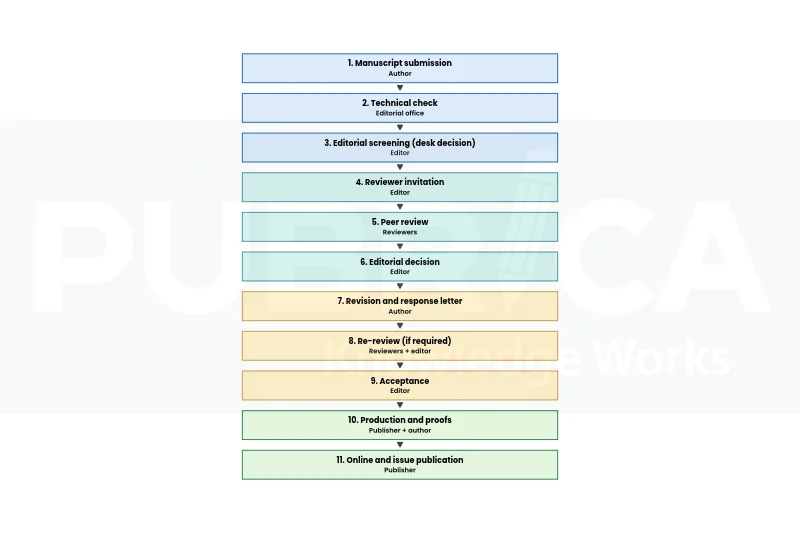
The flowchart groups eleven stages into four phases: submission and screening (stages 1 to 3), peer review (4 to 6), revision and acceptance (7 to 9) and publication (10 and 11). Each box names who controls the stage [1, 4]. Only stages 1, 7 and part of 10 are in the author’s hands.
03How Long Each Stage Takes
The durations below are indicative ranges, not guarantees. They are Pubrica planning ranges, not journal rules. In a large survey of authors, the first review round took about 13 weeks on average, from 8 weeks in medicine to 18 in economics, and a desk rejection about 12 days [5]. Check the target journal’s published metrics, such as time to first decision, where available.
| Stage | Controlled by | Indicative time | Common causes of delay |
|---|---|---|---|
| Technical check | Editorial office | Days | Missing files, formatting, declarations |
| Editorial screening | Editor | Days to 3 weeks | Scope fit, editor workload |
| Reviewer invitation | Editor | 1–4 weeks | Reviewers declining invitations |
| Peer review | Reviewers | 8–18 weeks (field-dependent) | Late reviews, conflicting reports |
| Revision | Author | Set by journal; often weeks | Extra experiments or analyses |
| Re-review | Reviewers + editor | 2–8 weeks | New reviewers, further concerns |
| Production | Publisher + author | 2–8 weeks | Slow proof corrections, licensing |
| Issue publication | Publisher | Weeks to months | Issue backlog |
04Desk Rejection and Editorial Screening
Many manuscripts end at editorial screening. Editors assess scope fit, novelty, methodological soundness and compliance with journal policies before deciding whether to send a paper for peer review [1, 2]. A desk rejection is usually fast, which lets authors move quickly to another journal.
Careful journal selection is the most effective way to avoid a desk rejection.
05Peer Review Models and Their Effect on Timing
The peer review model influences both fairness and speed [2, 4]:
| Model | How it works |
|---|---|
| Single-anonymised | Reviewers know the authors’ identities; authors do not know the reviewers. |
| Double-anonymised | Neither authors nor reviewers know each other’s identity. |
| Open review | Identities, and sometimes reports, are disclosed. |
| Transfer / cascade | Reviews move with the manuscript to a partner journal, which can save time after rejection. |
| Preprint review | Review takes place on a publicly posted preprint. |
07Ethical Limits on Speeding Up Review
Requests to accelerate review must stay within publication ethics. Authors should never suggest reviewers with undisclosed conflicts of interest or use fake reviewer contact details; COPE treats peer review manipulation as serious misconduct [2, 4]. A polite status enquiry to the editorial office is appropriate once a journal’s stated review time has passed.
See understanding COPE publication ethics for how member journals handle these cases.
08Conclusion
There is no single answer to how long does peer review take, but each stage has a predictable range and a clear owner. Planning for months rather than weeks, submitting a complete manuscript, and revising promptly give authors the greatest control over their publication timeline.
Questions
How long does peer review take?
How long from submission to publication?
What is a desk rejection?
Can I ask the journal for an update?
References
- International Committee of Medical Journal Editors. (n.d.). Recommendations for the conduct, reporting, editing, and publication of scholarly work in medical journals. Retrieved November 7, 2026, from https://www.icmje.org/recommendations/
- Committee on Publication Ethics. Core Principles and Code of Conduct for members (replacing the Core Practices, retired at the end of 2024). Accessed 9 November 2026. https://publicationethics.org/
- Björk, B.-C., & Solomon, D. (2013). The publishing delay in scholarly peer-reviewed journals. Journal of Informetrics, 7(4), 914–923. https://doi.org/10.1016/j.joi.2013.09.001
- COPE Council. (2017). Ethical guidelines for peer reviewers (Version 2). Committee on Publication Ethics. https://doi.org/10.24318/cope.2019.1.9
- Huisman J, Smits J. Duration and quality of the peer review process: the author’s perspective. Scientometrics. 2017;113(1):633–650. https://doi.org/10.1007/s11192-017-2310-5
Update log
- Published by Pubrica
How to cite this article
Dr. Charlie. (2026, November 9). From Submission to Publication: How Long Does Peer Review Take? A Flowchart of Every Stage. Pubrica. https://pubrica.com/insights/submission-to-publication-flowchart-peer-review-time/
This article is general information for researchers, not legal, regulatory or funding advice. Check the current requirements of your journal, funder, ethics committee or regulator before you act on it.