Peer Review Checklist for Authors: Score Your Own Research Paper the Way Reviewers Do
Reviewers judge a paper on a handful of visible signals. This checklist, scoring rubric and 30-minute workflow let you find the weak points before they do.

On this page
- Quick answer
- Why a pre-submission review saves more than time
- Reviewers are not neutral, so make the evidence easy to see
- The ten-item peer review checklist for authors
- How to score your paper: the manuscript scoring rubric
- Using AI as a second reader: benefits and limits
- A 30-minute pre-submission review workflow
- Questions
- References
Quick answer
- Score your paper on ten questions reviewers ask, from 0 to 2 each, before you submit.
- A total of 17 to 20 means ready; any 0 on design, statistics or ethics stops submission.
- Complete the reporting guideline yourself: journals endorse CONSORT, PRISMA and STROBE inconsistently [4].
- Use AI as a second reader, not a scorer: single-run AI scores track expert judgement weakly [7].
01Why a pre-submission review saves more than time
Peer review is slow, unpaid and stretched. In 2020, reviewers worldwide spent more than 100 million hours on manuscripts, and US reviewers’ time alone was worth over US$1.5 billion [1]. The load is uneven, too: across 2,329 Elsevier journals, women submitted proportionally fewer papers than men in the first COVID-19 wave while taking on more review work [2].
A busy reviewer reads quickly and relies on visible signals: a clear question, a defensible design and transparent reporting. A structured manuscript self-assessment helps you avoid:
- a desk rejection for scope, format or missing reporting items;
- a first review round spent on presentation problems you could have fixed;
- comments about missing ethics, registration, funding or data statements;
- abstract claims the results do not support.
02Reviewers are not neutral, so make the evidence easy to see
Reviewer bias is measurable. Huber and colleagues sent the same finance paper to reviewers under three conditions. With a Nobel laureate named as author, about 23% recommended rejection; with a junior researcher named, more than 65% did; with no author shown, almost 50% did [3].
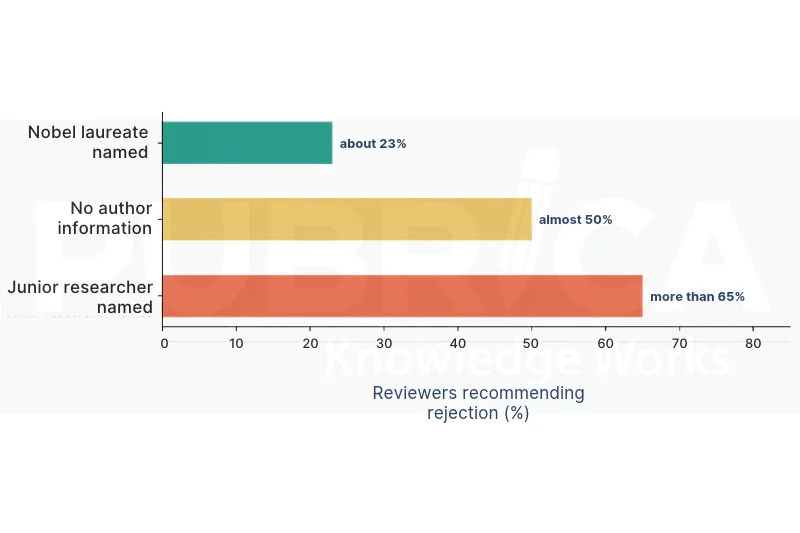
You cannot change your reputation before submission, but you can remove every other reason to reject. State the contribution early, label each figure so it stands alone, and make the methods easy to find.
03The ten-item peer review checklist for authors
Table 1 lists the questions reviewers commonly ask. Score each item 0 (missing or weak), 1 (present but incomplete) or 2 (clear and complete). Be strict: if you would need to explain an answer aloud, it is not yet on the page.
| Item | What the reviewer asks | Score 2 when |
|---|---|---|
| Research question | Is the question specific and important? | The question and the gap appear in the abstract and at the end of the introduction |
| Novelty | What does this add? | The contribution is stated in one sentence and contrasted with prior work |
| Design | Does the design answer the question? | The design is justified and alternatives are acknowledged |
| Methods detail | Could someone repeat this? | Sampling, measures, procedures and software are fully described |
| Statistics | Are the analyses appropriate? | Assumptions, effect sizes and uncertainty are reported, not only p values |
| Reporting guideline | Is the study reported to the relevant standard? | The right checklist (CONSORT, PRISMA, STROBE) is completed and attached |
| Results | Do the results follow the methods? | Every method has a matching result; tables and figures stand alone |
| Discussion and limitations | Are the claims proportionate? | Limitations are specific and conclusions stay within the data |
| Ethics and transparency | Are approvals, conflicts and data access declared? | Ethics, registration, funding, conflicts and data statements are complete |
| References and presentation | Is the paper current and readable? | References are recent and verified; language and format meet journal rules |
Item 6 needs particular care. A review of author instructions at 559 biomedical journals from 11 publishers found that endorsement of reporting guidelines was inconsistent, with no standard way to show adherence [4]. Identify the guideline yourself: CONSORT for randomised trials, PRISMA for systematic reviews and STROBE for observational studies.
04How to score your paper: the manuscript scoring rubric
| Total score | Reading | Next action |
|---|---|---|
| 17 to 20 | Ready for submission | Proofread, prepare the cover letter and submit |
| 12 to 16 | Revisable | Fix every item scored 0, then strengthen items scored 1 |
| 0 to 11 | Not yet ready | Revisit the question, design or analysis before formatting |
Treat the total as a guide, not a verdict. A paper can score 18 and still fail on one fatal flaw, such as a design that cannot answer the question. Any 0 on design, statistics or ethics should stop submission until it is fixed. Re-score after revision to check that the edits worked.
05Using AI as a second reader: benefits and limits
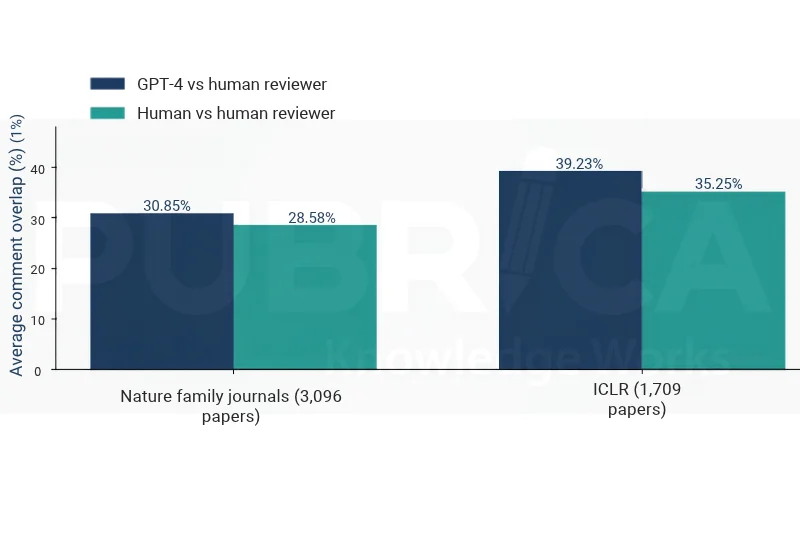
Large language models now produce reviewer-style feedback, and the evidence shows both value and limits. For 3,096 Nature-family papers and 1,709 ICLR papers, GPT-4’s comments overlapped with human reviewers’ points by 30.85% and 39.23%, similar to the overlap between two humans (28.58% and 35.25%). In a study of 308 researchers, 57.4% found the feedback helpful [5].
LLM peer review is already happening: an estimated 6.5% to 16.9% of review text at four AI conferences may have been substantially modified by language models [6]. AI scores are less reliable than AI comments. When ChatGPT-4 scored 51 articles against REF 2021 criteria, a single run correlated with expert assessment at r = 0.281, and the average of 15 runs at r = 0.509 [7].
- Use AI to flag unclear passages and missing reporting items, and to list the questions a sceptical reviewer will ask.
- Do not use AI to set your final score, or upload unpublished data without co-author agreement and the journal’s permission.
Check the target journal’s policy on AI use before you start.
06A 30-minute pre-submission review workflow
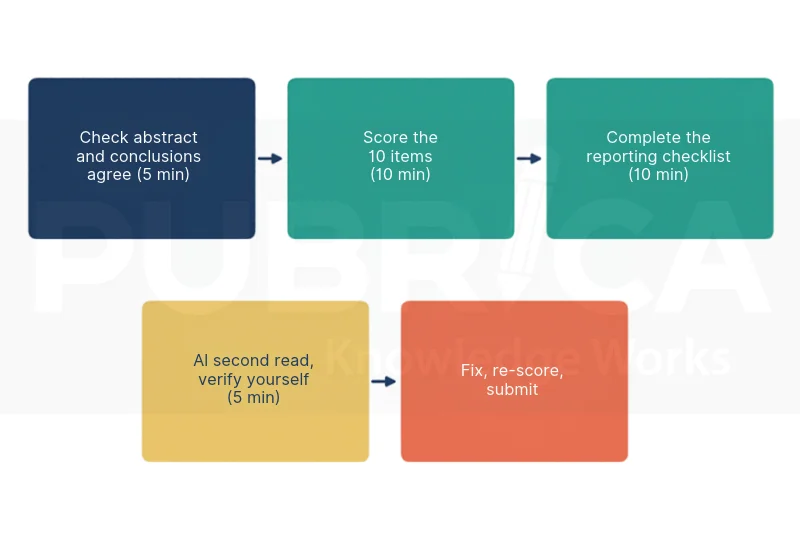
- Read only the abstract and conclusions and confirm they make the same claim (5 minutes).
- Score the ten items in Table 1 (10 minutes).
- Open the relevant reporting checklist and record a page number for each item (10 minutes).
- Run one AI second read for unclear passages and verify every suggestion yourself (5 minutes).
- Fix the weak items, re-score and submit.
Keep the scored checklist with your submission files. If reviewers raise a point you already scored, the record speeds up revision and helps you write a precise response to reviewer comments.
Questions
What is a peer review checklist for authors?
It is a list of the questions reviewers ask about a manuscript, such as whether the design answers the question and whether the right reporting guideline is complete. Authors score their own paper against it before submission to find and fix weak points.
How do reviewers evaluate a research paper?
Most reviewers check the research question, novelty, design, methods, statistics, reporting standard, results, limitations, ethics statements and references. Clear, easy-to-find answers to each make a fair reading more likely.
Can I use ChatGPT to review my paper before submission?
Yes, as a second reader for clarity and missing items, provided the journal allows it and no unpublished data is shared without permission. Do not rely on AI scores: single-run scores agree weakly with expert judgement [7].
References
- Aczel B, Szaszi B, Holcombe AO. A billion-dollar donation: estimating the cost of researchers’ time spent on peer review. Research Integrity and Peer Review. 2021;6:14. https://doi.org/10.1186/s41073-021-00118-2
- Squazzoni F, Bravo G, Grimaldo F, García-Costa D, Farjam M, Mehmani B. Gender gap in journal submissions and peer review during the first wave of the COVID-19 pandemic: a study on 2329 Elsevier journals. PLOS ONE. 2021;16(10):e0257919. https://doi.org/10.1371/journal.pone.0257919
- Huber J, Inoua S, Kerschbamer R, König-Kersting C, Palan S, Smith VL. Nobel and novice: author prominence affects peer review. PNAS. 2022;119(41):e2205779119. https://doi.org/10.1073/pnas.2205779119
- Wang P, Wolfram D, Gilbert E. Endorsements of five reporting guidelines for biomedical research by journals of prominent publishers. PLOS ONE. 2024;19(2):e0299806. https://doi.org/10.1371/journal.pone.0299806
- Liang W, Zhang Y, Cao H, et al. Can large language models provide useful feedback on research papers? A large-scale empirical analysis. NEJM AI. 2024;1(8). https://doi.org/10.1056/AIoa2400196
- Liang W, Izzo Z, Zhang Y, et al. Monitoring AI-modified content at scale: a case study on the impact of ChatGPT on AI conference peer reviews. Proceedings of the 41st International Conference on Machine Learning. PMLR 235:29575–29620; 2024. https://proceedings.mlr.press/v235/liang24b.html
- Thelwall M. Can ChatGPT evaluate research quality? Journal of Data and Information Science. 2024;9(2):1–21. https://doi.org/10.2478/jdis-2024-0013