REDCap Database Build for Clinical Trials: How We Do It for UAE CROs and Hospital Research Units
A clinical trial database is only as good as the specification behind it. This is the sequence our data team follows when building a REDCap database for a CRO or hospital research unit in the UAE, and the checks that catch problems before the first participant is entered.
- Who it is for
- CROs, hospital research units, trial coordinators and data managers in the UAE
- Build order
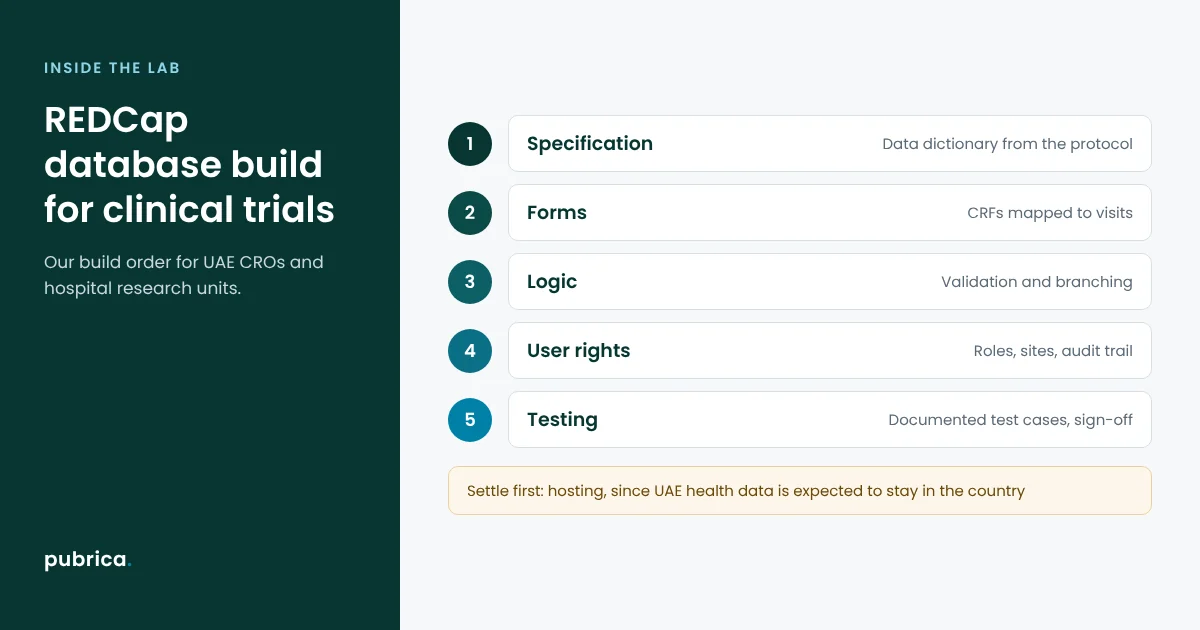
- Specification, forms, logic, user rights, testing, then go-live
- UAE point to settle early
- Where the REDCap server sits: health data is expected to stay in the UAE
- Typical failure
- Building before the protocol’s variables and visits are fixed
On this page
- Quick answer
- Why the build matters more than the software
- Step 1: write the data dictionary before opening REDCap
- Step 2: build the REDCap data collection forms
- Step 3: add data validation and branching logic
- Step 4: set user access permissions by role
- Step 5: test, document and then go live
- UAE rules to settle before the build starts
- Questions
- References
Quick answer
- Start the REDCap database build from a written data dictionary, not from the form builder.
- Turn each case report form into REDCap data collection forms, mapped to the protocol’s visit schedule.
- Add data validation and branching logic, then set user access permissions by role and site.
- Run documented database testing before go-live, and settle UAE hosting and health-data rules first.
01Why the build matters more than the software
REDCap (Research Electronic Data Capture) is a web-based electronic data capture platform developed at Vanderbilt University and used by research institutions worldwide through the REDCap Consortium [1, 2]. It offers longitudinal projects, data validation, branching logic, user rights, data access groups, an audit log and exports to statistics packages [3].
None of that guarantees good clinical trial data management. The same software gives clean data in one study and months of queries in another. In REDCap database development, the difference is the specification, and whether the database was tested against it before go-live.
02Step 1: write the data dictionary before opening REDCap
We read the protocol, case report forms, visit schedule, outcome measures and data management plan, then list every variable in a specification. REDCap accepts a data dictionary as a CSV file, so the specification becomes the build itself rather than a separate document that drifts out of date [3].
| Specification column | Example entry | Why we fix it before building |
|---|---|---|
| Variable name | sbp_v2 (lower case, no spaces, visit suffix) | Names cannot be changed safely once data exist |
| Field type and validation | Integer, range 70–250 mmHg | Out-of-range values are flagged at entry |
| Response coding | 1 = Yes, 0 = No, 9 = Not done | Consistent codes keep exports analysable |
| Branching logic | Show only if [ae_any] = '1' | Irrelevant questions stay hidden |
| Required and identifier flags | Date of birth marked as an identifier | Supports de-identified exports |
| Event or visit | Screening, baseline, week 4, week 12 | Matches the protocol’s visit schedule |
03Step 2: build the REDCap data collection forms
Each case report form becomes an instrument: screening and eligibility, demographics, baseline, follow-up visits, laboratory results, adverse events and study completion. In a longitudinal project the instruments are assigned to events so that, for example, the vital signs form appears at every visit while consent appears once [3].
We keep direct identifiers to the minimum the protocol needs and flag them as identifiers, so exports for analysis can be de-identified. For multi-site studies we set up data access groups, so each hospital sees only its own participants [3].
04Step 3: add data validation and branching logic
Data validation rules check formats and ranges at the point of entry: dates cannot fall before consent, and haemoglobin cannot be entered in the wrong unit. Branching logic shows a question only when it applies, such as adverse-event details only when an event is reported. Calculated fields handle scores and BMI so nobody does arithmetic by hand [3].
Automated checks reduce errors; they do not replace source-data verification or clinical review where the monitoring plan requires them.
05Step 4: set user access permissions by role
Data-entry staff, investigators, monitors and data managers need different user access permissions. We map each role to rights for viewing, editing, exporting, locking records and changing the design, and we keep design rights with the data manager once the project is in production. ICH E6(R3) expects access to computerised systems to be controlled and attributable, with an audit trail of changes [4]. REDCap logs every change, but the sponsor still decides who may do what.
06Step 5: test, document and then go live
| Test area | What we try to break | Pass condition |
|---|---|---|
| Validation rules | Enter values just inside and just outside every range | Every out-of-range value is flagged |
| Branching logic | Walk each answer path, including “No” and “Not done” | Only the expected fields appear |
| Calculated fields | Recalculate BMI or scores by hand for test records | REDCap result matches the hand calculation |
| User rights | Log in as each role, including a site user | Each role sees and edits only what it should |
| Exports | Export test data to the statistics package | Labels, codes and dates import cleanly |
Database testing is recorded test case by test case, with failures fixed and retested. ICH E6(R3) asks for validation of computerised systems proportionate to their risk to participants and results, and FDA guidance sets out expectations for electronic records in clinical investigations for studies that fall under it [4, 5]. After go-live, design changes go through REDCap’s draft mode and our change log, so the database never silently departs from the approved forms.
What we check before go-live
- Every protocol variable appears once, with the agreed name and coding.
- Each visit window and event matches the schedule of assessments.
- Test records pass every validation, branching and calculation case.
- Each user role has been tested by logging in as that role.
- A test export opens cleanly in the analysis software.
- Sign-off is recorded before the project is moved to production.
07UAE rules to settle before the build starts
Federal Law No. 2 of 2019 on the use of ICT in health fields governs health data in the UAE, and Federal Decree-Law No. 45 of 2021 is the general personal data protection law [6, 7]. Under Article 13 of the 2019 law, health data is generally to be stored and processed inside the country unless an exception applies; Ministerial Resolution No. 51 of 2021 sets out exceptions, including scientific research under conditions such as consent and encryption [8].
In practice this makes hosting the first decision in a UAE REDCap database build: an institutional REDCap instance on UAE servers is usually simpler than a cloud project abroad. Emirate-level health authorities and the ethics committee may add their own requirements, so we confirm hosting with the institution’s research governance and information security teams before any form is built. Using REDCap does not, by itself, make a study compliant.
Questions
How long does a REDCap database build take?
It depends on the number of forms, visits and sites. The build is usually faster than the specification and testing stages, which is where the time should go.
Is REDCap compliant with GCP or 21 CFR Part 11?
REDCap provides features such as audit trails and user rights, but compliance depends on how the hosting institution installs, validates and runs it, and on the study’s own procedures.
Can a UAE hospital use a REDCap server outside the UAE?
Only if an exception under the UAE health data rules applies and the conditions are met. Confirm with your institution before choosing hosting outside the country.
References
- Harris PA, Taylor R, Thielke R, Payne J, Gonzalez N, Conde JG. Research electronic data capture (REDCap): a metadata-driven methodology and workflow process for providing translational research informatics support. J Biomed Inform. 2009;42(2):377–381. https://doi.org/10.1016/j.jbi.2008.08.010
- Harris PA, Taylor R, Minor BL, et al. The REDCap Consortium: building an international community of software platform partners. J Biomed Inform. 2019;95:103208. https://doi.org/10.1016/j.jbi.2019.103208
- REDCap. REDCap software overview. Vanderbilt University. https://projectredcap.org/software/
- International Council for Harmonisation. ICH E6(R3) Guideline for Good Clinical Practice. European Medicines Agency; 2025. https://www.ema.europa.eu/en/scientific-guidelines/ich-e6-good-clinical-practice
- US Food and Drug Administration. Electronic Systems, Electronic Records, and Electronic Signatures in Clinical Investigations: Questions and Answers. Guidance for industry; October 2024. https://www.fda.gov/regulatory-information/search-fda-guidance-documents/electronic-systems-electronic-records-and-electronic-signatures-clinical-investigations-questions
- United Arab Emirates Government. Data protection laws. u.ae. https://u.ae/en/about-the-uae/digital-uae/data/data-protection-laws
- United Arab Emirates Government. ICT in the health sector: legislation and policies. u.ae. https://u.ae/en/about-the-uae/whole-of-government-approach/digital-health/ict-in-the-health-sector
- Al Tamimi & Company. Health data transfers outside the UAE (Ministerial Resolution No. 51 of 2021). 2021. https://www.tamimi.com/news/health-data-transfers-outside-the-uae/
Update log
- Published by Pubrica
How to cite this article
Pubrica Clinical Data Team. (2026, October 20). REDCap Database Build for Clinical Trials: How We Do It for UAE CROs and Hospital Research Units. Pubrica. https://pubrica.com/insights/inside-the-lab/redcap-database-build-clinical-trials-uae/
This article is general information for researchers, not legal, regulatory or funding advice. Check the current requirements of your journal, funder, ethics committee or regulator before you act on it.