How Long Does It Take to Write a Research Paper? Stage-by-Stage Workflow from Data Lock to Submission (Flowchart)
There is no published benchmark, so plan in stages. A flowchart from data lock to submission, indicative durations for each stage, three sample scenarios and a way to calculate your own timeline.

- Stages 1–6
- About 7–13 weeks
- Starts at
- Data lock
- Biggest delays
- Late data changes, slow co-author review
- Not included
- Peer review (journal clock)
Quick answer
- Stages 1 to 6, from data lock to submission, add up to roughly 7–13 weeks of authors’ working time.
- A typical multi-author clinical study sits at the upper end (about 10–14 weeks once co-author rounds are included); first manuscripts and multicentre teams often need 14–20 weeks or more.
- These are planning estimates, not published benchmarks, and peer review is a separate clock.
01How long does it take to write a research paper?
How long does it take to write a research paper? There is no single published benchmark, because the answer depends on data readiness, study design, the number of authors, writing experience and the target journal. What you can do is plan the work in stages. This resource gives a stage-by-stage workflow from data lock to submission, with indicative durations, a flowchart and ways to avoid delays.
02Two clocks: writing time and journal time
The research paper writing timeline has two parts. The first is the time authors need to analyse, write, review and submit. The second begins at submission: the time from submission to publication varies widely between journals and disciplines and is largely out of the authors’ hands [1, 2]. This resource covers the first clock and treats peer review as an external stage.
Manuscript writing time is the part you can plan. The journal’s turnaround time, peer review and any revision round are not, so keep them out of your writing estimate and add them separately.
03Factors that shorten or lengthen the timeline
| Factor | Shortens the timeline | Lengthens the timeline |
|---|---|---|
| Data readiness | Locked dataset and final results from the statistical analysis plan (SAP) | Late changes to the dataset or additional analyses |
| Planning | Outline (skeleton) and journal selection agreed early [3] | Journal chosen after drafting; reformatting |
| Team | One lead author; clear roles | Many co-authors across sites and time zones |
| Reporting | Reporting checklist (CONSORT, STROBE) used from the start [4, 5] | Checklist applied only at the end |
| Approvals | Ethics and registration details already documented | Missing approval numbers or registration details |
| Writing experience | Experienced first author or professional writing support | First manuscript; language editing needed |
04Stage-by-stage workflow (flowchart)
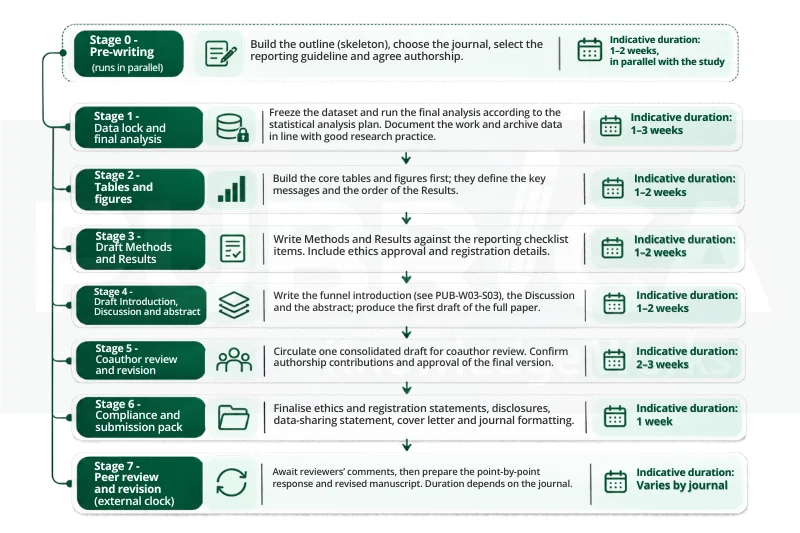
The flowchart and Table 2 show the main stages. Stage 0 runs in parallel with the study; Stage 7 is an external clock.
Adding stages 1–6 gives roughly 7–13 weeks of authors’ working time before submission. Stage 0 should overlap with the study so it does not add to this total.
| Stage | What happens | Indicative duration |
|---|---|---|
| Stage 0: Pre-writing (runs in parallel) | Build the outline (skeleton), choose the journal, select the reporting guideline and agree authorship. | 1–2 weeks, in parallel with the study |
| Stage 1: Data lock and final analysis | Freeze the dataset and run the final analysis according to the statistical analysis plan. Document the work and archive data in line with good research practice. | 1–3 weeks |
| Stage 2: Tables and figures | Build the core tables and figures first; they define the key messages and the order of the Results. | 1–2 weeks |
| Stage 3: Draft Methods and Results | Write Methods and Results against the reporting checklist items. Include ethics approval and registration details. | 1–2 weeks |
| Stage 4: Draft Introduction, Discussion and abstract | Write the funnel introduction (see how to write the introduction), the Discussion and the abstract; produce the first draft of the full paper. | 1–2 weeks |
| Stage 5: Co-author review and revision | Circulate one consolidated draft for co-author review. Confirm authorship contributions and approval of the final version. | 2–3 weeks |
| Stage 6: Compliance and submission pack | Finalise ethics and registration statements, disclosures, data-sharing statement, cover letter and journal formatting. | 1 week |
| Stage 7: Peer review and revision (external clock) | Await reviewers’ comments, then prepare the point-by-point response and revised manuscript. Duration depends on the journal. | Varies by journal |
05Sample timelines by scenario (indicative)
| Scenario | Assumptions | Indicative writing window |
|---|---|---|
| A · Experienced team | Clean, locked data; one lead author; outline ready; target journal chosen | ≈7–9 weeks |
| B · Typical multi-author clinical study | Locked data; 4–6 co-authors; reporting checklist applied during drafting | ≈10–14 weeks |
| C · First manuscript or multicentre team | New authors, several sites, language editing, extra analyses | ≈14–20+ weeks |
Planning estimates only; replace with your own team’s history.
06How to avoid delays
Build the tables and figures first: they fix the key messages and the order of the Results.
Freeze the dataset before drafting Results; late changes force rewrites.
Write Methods and the Introduction while the analysis is running (see how to write the introduction of a research paper).
Agree authorship and contribution statements at the start, using the ICMJE criteria (see authorship criteria for research papers).
Apply the reporting checklist from the first draft, not as a last-minute check [4, 5].
Send co-authors one consolidated version with a fixed review deadline.
Prepare the submission pack (ethics, registration, disclosures, cover letter) while co-authors review.
Add contingency for public holidays and academic vacations.
07How to calculate your own timeline
Fix your target submission date.
Work backwards through Stages 6 to 1 using the durations above as a starting point.
Adjust each stage for team size, data readiness and writing experience.
Add contingency for co-author delays and holidays.
Review progress at each stage gate and update the plan.
Once the paper is submitted, the journal’s clock starts: see our submission-to-publication flowchart for how long peer review takes.
Questions
How long does it take to write a research paper for the first time?
Can I start writing before the analysis is finished?
Does the timeline include peer review?
What is the single biggest cause of delay?
References
- Powell, K. (2016). Does it take too long to publish research? Nature, 530(7589), 148–151. https://doi.org/10.1038/530148a
- Huisman, J., & Smits, J. (2017). Duration and quality of the peer review process: The author's perspective. Scientometrics, 113(1), 633–650. https://doi.org/10.1007/s11192-017-2310-5
- Kotz, D., & Cals, J. W. L. (2013). Effective writing and publishing scientific papers—Part I: How to get started. Journal of Clinical Epidemiology, 66(4), 397. https://doi.org/10.1016/j.jclinepi.2013.01.002
- Hopewell, S., Chan, A.-W., Collins, G. S., et al. (2025). CONSORT 2025 statement: Updated guideline for reporting randomised trials. BMJ, 389, e081123. https://doi.org/10.1136/bmj-2024-081123
- von Elm, E., Altman, D. G., Egger, M., Pocock, S. J., Gøtzsche, P. C., & Vandenbroucke, J. P. (2007). The Strengthening the Reporting of Observational Studies in Epidemiology (STROBE) statement: Guidelines for reporting observational studies. The Lancet, 370(9596), 1453–1457. https://doi.org/10.1016/S0140-6736(07)61602-X
Update log
- Published by Pubrica
How to cite this article
Dr. Charlie. (2026, November 10). How Long Does It Take to Write a Research Paper? Stage-by-Stage Workflow from Data Lock to Submission (Flowchart). Pubrica. https://pubrica.com/insights/flow-chart/how-long-does-it-take-to-write-a-research-paper/
This article is general information for researchers, not legal, regulatory or funding advice. Check the current requirements of your journal, funder, ethics committee or regulator before you act on it.