Fabricated Papers in Systematic Reviews: How They Contaminate Reviews and Meta-Analyses
Most fabricated papers in systematic reviews were never retracted, so a retraction search alone will not find them. Here are the three routes contamination takes, and the trustworthiness assessment that closes the gap.
- How common
- 299 of about 200,000 life-science reviews (0.15%) included a retracted paper-mill article
- Most exposed field
- Oncology: 48 of the 299 contaminated reviews
- The blind spot
- Only 28.7% of suspected paper-mill articles have been retracted
- New tool
- INSPECT-SR, published in the BMJ in September 2026: 21 checks in 4 domains
On this page
Quick answer
- Fabricated papers in systematic reviews enter before retraction, after retraction, or with no retraction at all.
- The third route is the largest, because most suspected paper-mill articles have never been retracted.
- Risk-of-bias tools assume the data are real; a trustworthiness assessment asks whether they are.
- Screen for retractions and trustworthiness, then run a sensitivity analysis without doubtful trials.
01How big is the problem?
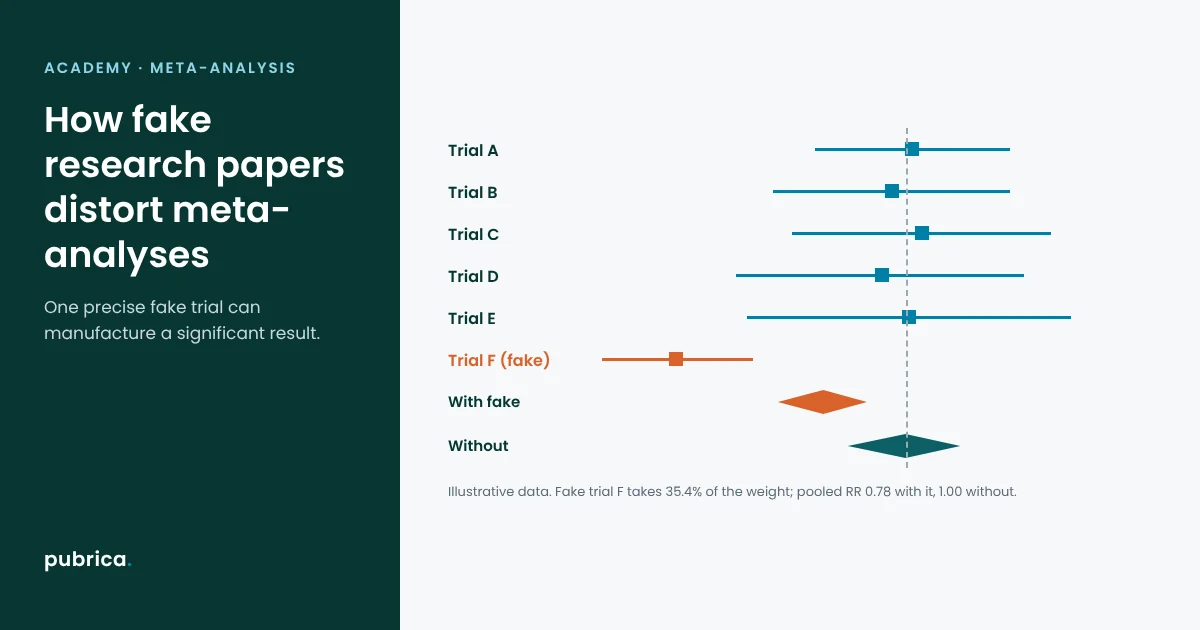
An analysis of about 200,000 life-science systematic reviews published from 2013 to 2024 found 299 (0.15%) that included at least one retracted paper-mill article; oncology was the most affected field, with 48 [1]. A paper mill is an organisation that produces fabricated or manipulated manuscripts for sale. The prevalence is low, but the damage is not proportional to the count: one fabricated trial can move a pooled effect estimate, Inverse-variance weighting gives most weight to the most precise trials, and fabricated data, free of real sampling variation, often look very precise. In a forest plot the warning signs are an outlying trial with a narrow interval, unexplained heterogeneity, or a pooled result that hangs on one study. Our companion article on how fake research papers distort meta-analyses works through an example.
02Three routes into a review
| Route | How it happens | Control that catches it |
|---|---|---|
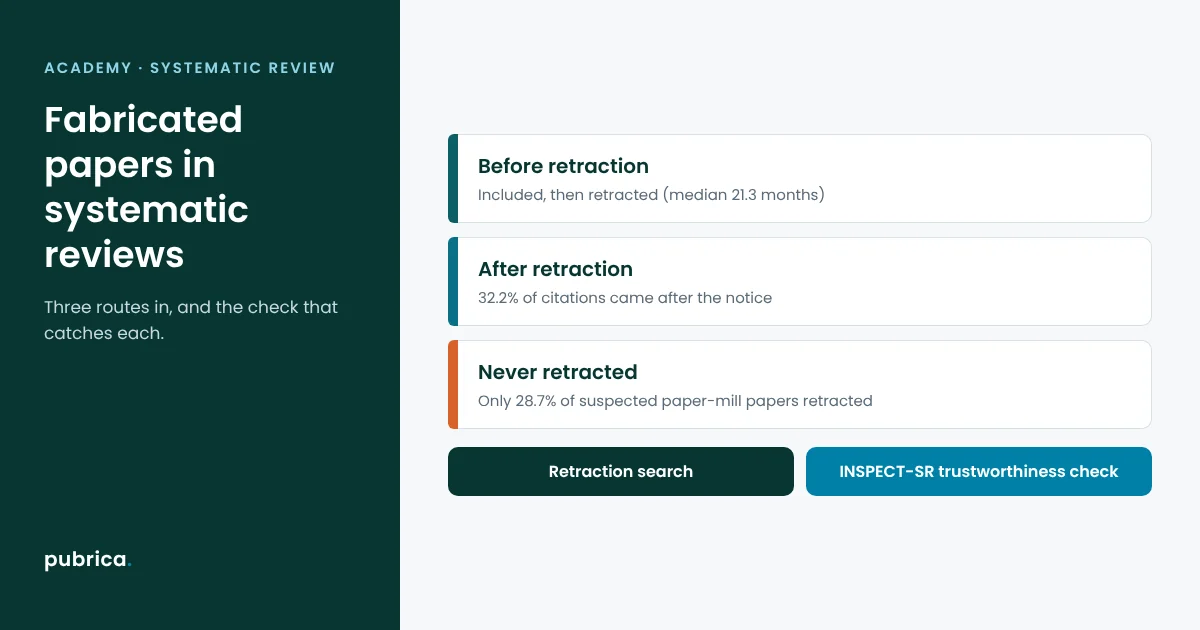
| Included before retraction | The trial is eligible when searched and retracted later; the median time from publication to retraction for trials was 21.3 months [2] | Re-check retraction status before every update |
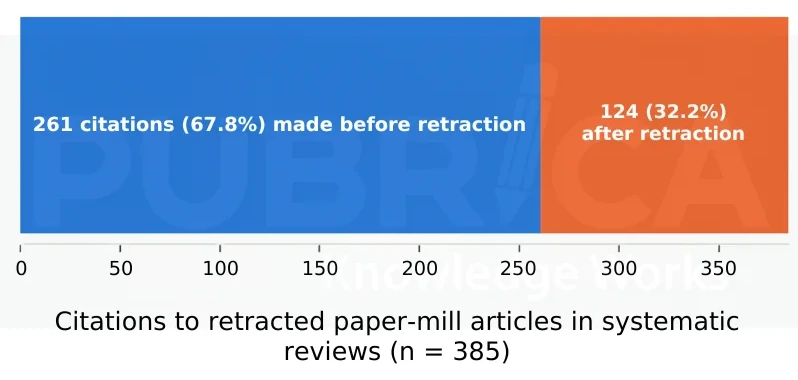
| Cited after retraction | 124 of 385 citations (32.2%) to retracted paper-mill articles came after retraction; 38.3% of reviews containing retracted trials were published after the earliest retraction [1, 2] | Retraction search across several databases |
| Never retracted | Only 28.7% of suspected paper-mill articles had been retracted, so most carry no notice to find [3] | Trustworthiness assessment of the paper itself |
The first two routes are retraction problems, and a disciplined retraction screen handles them. The VITALITY authors advise checking several sources, such as Retraction Watch, Scopus, Web of Science and PubMed, and using citation tools such as SpiderCite [2]. The third route needs a different control, because there is no notice to find.
03Why risk of bias is not trustworthiness
A risk-of-bias tool asks whether a trial’s design and conduct protect against systematic error. It assumes the reported data are real. A fabricated trial can score low risk of bias on every domain, because the fabricator wrote the methods to look sound.
A trustworthiness assessment asks the prior question: are these data genuine? The INSPECT-SR tool, published in its final form in September 2026, gives review teams 21 checks in four domains [4]. It was built from 102 candidate checks, tested on trials in 50 Cochrane reviews, and refined by Delphi consensus [5]. Its developers are explicit that it is not a fraud diagnostic and is used alongside risk-of-bias and GRADE assessments, not in place of them [4, 5].
| Domain | Checks | Example question |
|---|---|---|
| Post-publication notices | 3 | Is there a retraction, expression of concern or correction? |
| Conduct, governance and transparency | 5 | Was the trial prospectively registered, and is ethics approval verifiable? |
| Text and figures | 2 | Are text or images duplicated from other publications? |
| Results in the study | 11 | Are baseline data, sample sizes and statistics internally consistent and plausible? |
04A screening workflow review teams can document
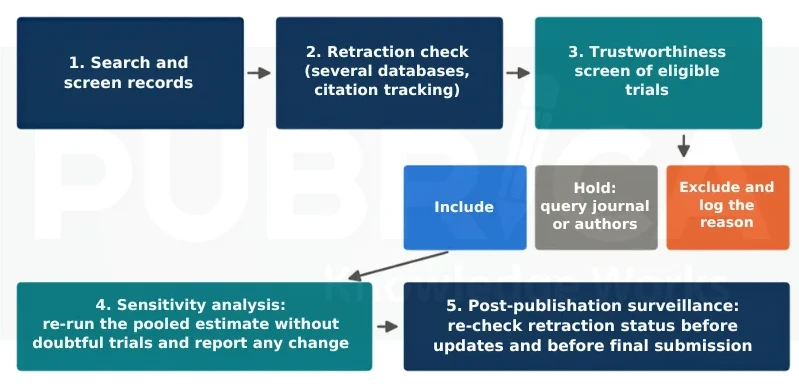
Retraction searches find known problems; trustworthiness checks target unretracted ones. Machine-learning screens can help prioritise: one classifier for cancer papers reached an accuracy of 0.91, which still means some papers are misclassified, so every flag needs human review [6]. Retraction status changes after publication, so we repeat the check at protocol registration, at the final search update and just before submission.
| Finding | Action | What we report |
|---|---|---|
| Retracted before synthesis | Exclude and cite the retraction notice | Reason in the PRISMA flow diagram |
| Retracted after publication of the review | Remove the trial, re-run the analyses and check whether conclusions change [2] | An update or correction stating the change |
| Unresolved trustworthiness concern | Query authors or journal; analyse with and without the study | Both results and the effect on certainty of evidence |
| Flag from a screening tool only | Confirm by human review before acting [6] | The tool used and the outcome of review |
05Which reviews are most exposed
- Small evidence bases. Meta-analyses with 10 studies were 2.63 times as likely to change direction after retracted trials were removed as those with 20 or more [2].
- Harm outcomes. These changed direction in 11.6% of meta-analyses, against 8.0% for benefit outcomes [2].
- Oncology and fundamental research. Flagged papers were over-represented in fundamental cancer research and in gastric, bone and liver cancer [6].
- Low-scrutiny venues. The five reviews that each cited five or more retracted articles were all in journals from questionable publishers [1].
06What the evidence cannot tell you yet
Tang and Cai counted only retracted paper-mill articles, so undetected papers sit outside their numbers [1]. The VITALITY replications covered pairwise meta-analyses of randomised trials, not network meta-analyses or non-randomised studies [2]. And a contaminated review is not automatically wrong: it can include a retracted trial and still reach the same conclusion. That is why a sensitivity analysis without doubtful trials, reported alongside the main result and its certainty of evidence, is the proportionate first response.
Questions
How do fabricated papers get into systematic reviews?
Through three routes: they are included before being retracted, cited after retraction because nobody checked, or never retracted at all. The last is the most common.
What is the difference between risk of bias and trustworthiness?
Risk of bias judges whether a study’s design could distort genuine data. Trustworthiness judges whether the data are genuine in the first place.
What is INSPECT-SR?
A tool published in the BMJ in 2026 that gives systematic reviewers 21 checks in four domains for judging whether a randomised trial is trustworthy enough to include.
Should a review be withdrawn if it included a retracted trial?
Not automatically. Re-run the analysis without the trial; if the conclusion holds, an update or correction is usually enough.
References
- Tang G, Cai H. Citation contamination by paper mill articles in systematic reviews of the life sciences. JAMA Netw Open. 2025;8(6):e2515160. https://doi.org/10.1001/jamanetworkopen.2025.15160
- Xu C, Fan S, Tian Y, et al. Investigating the impact of trial retractions on the healthcare evidence ecosystem (VITALITY Study I): retrospective cohort study. BMJ. 2025;389:e082068. https://doi.org/10.1136/bmj-2024-082068
- Richardson RAK, Hong SS, Byrne JA, Stoeger T, Amaral LAN. The entities enabling scientific fraud at scale are large, resilient, and growing rapidly. Proc Natl Acad Sci USA. 2025;122(32):e2420092122. https://doi.org/10.1073/pnas.2420092122
- Wilkinson J, Bero L, Heal C, et al. INSPECT-SR tool for assessing trustworthiness of randomised controlled trials. BMJ. 2026;394:e100611. https://doi.org/10.1136/bmj-2026-100611
- Wilkinson J, Heal C, Antoniou GA, et al. Protocol for the development of a tool (INSPECT-SR) to identify problematic randomised controlled trials in systematic reviews of health interventions. BMJ Open. 2024;14(3):e084164. https://doi.org/10.1136/bmjopen-2024-084164
- Scancar B, Byrne JA, Causeur D, Barnett AG. Machine learning based screening of potential paper mill publications in cancer research: methodological and cross sectional study. BMJ. 2026;392:e087581. https://doi.org/10.1136/bmj-2025-087581
Update log
- Published by Pubrica
How to cite this article
Pubrica Academy. (2026, October 20). Fabricated Papers in Systematic Reviews: How They Contaminate Reviews and Meta-Analyses. Pubrica. https://pubrica.com/academy/systematic-review/how-fabricated-papers-contaminate-systematic-reviews/
This article is general information for researchers, not legal, regulatory or funding advice. Check the current requirements of your journal, funder, ethics committee or regulator before you act on it.