How Fake Research Papers Distort Meta-Analyses and Systematic Reviews
A meta-analysis weights trials by precision, so a fabricated trial whose results look too clean can dominate the pooled effect. This article measures the distortion, works through one fake trial among six, and shows the checks that expose it.
- Measured impact
- Removing retracted trials changed the direction of 8.4% and significance of 16.0% of 3,902 meta-analyses
- Most fragile
- Small meta-analyses and harm outcomes
- Worked example
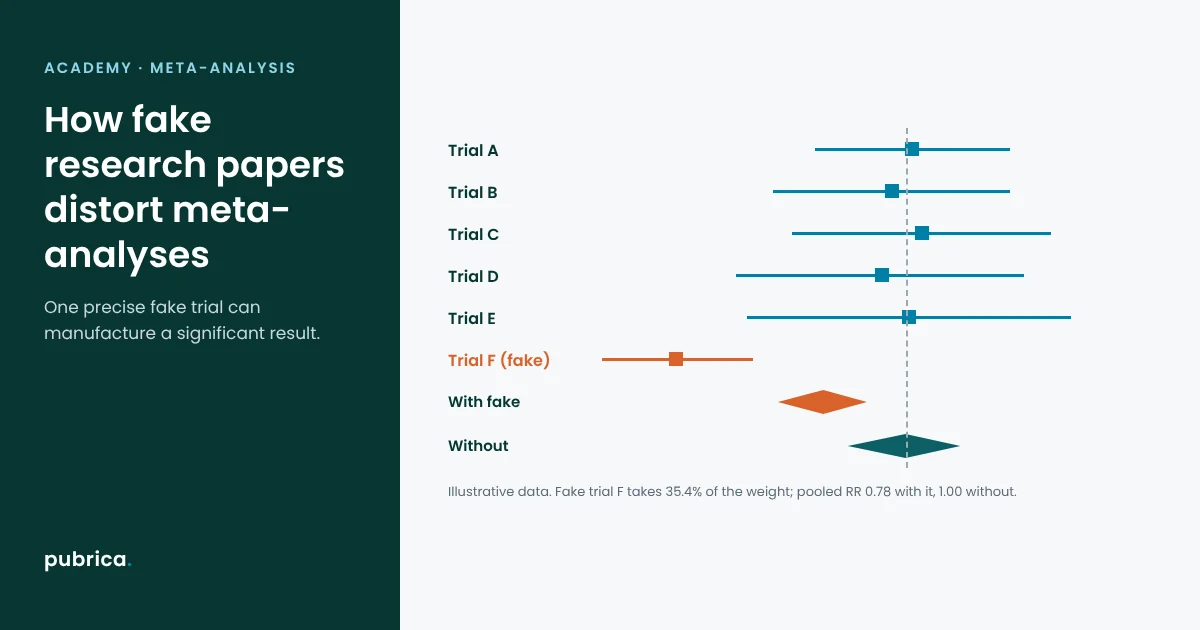
- One fake trial takes 35.4% of the weight and creates a significant benefit
- Fastest test
- Leave-one-out analysis
On this page
Quick answer
- Fake research papers distort meta-analyses mainly through precision: a narrow interval earns a large inverse-variance weight.
- In 3,902 re-run meta-analyses, removing retracted trials changed the direction of the pooled effect in 8.4%.
- Fixed-effect models are the most exposed; random effects reduce but do not remove the distortion.
- A leave-one-out analysis plus a trustworthiness assessment shows whether a conclusion rests on one doubtful trial.
01How large is the distortion?
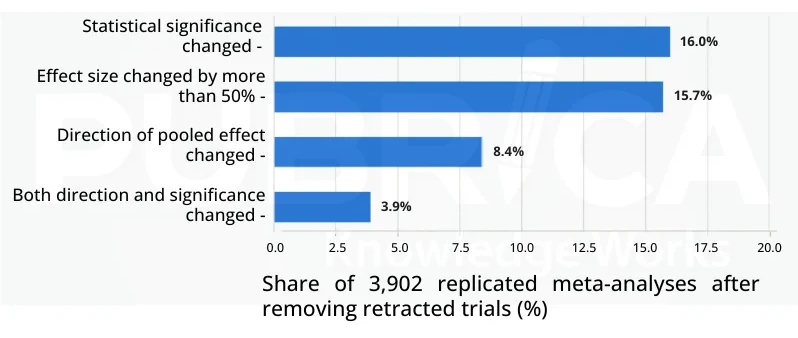
The VITALITY team re-ran 3,902 meta-analyses after removing retracted trials. Statistical significance changed in 16.0%, the effect size moved by more than 50% in 15.7%, and the direction of the pooled effect reversed in 8.4% [1]. Harm outcomes reversed more often than benefit outcomes (11.6% against 8.0%), and meta-analyses with 10 studies were 2.63 times as likely to reverse as those with 20 or more [1].
Not every retracted trial is fabricated: 172 of 1,330 (12.9%) were marked as paper-mill products [1]. The figures measure how fragile a pooled effect is to problematic trials, not the effect of fraud alone.
02Four mechanisms of distortion
| Mechanism | What happens to the pooled effect | Evidence |
|---|---|---|
| Effect inflation | A fabricated trial reports a larger effect than genuine ones and pulls the estimate toward benefit | Effect size changed by more than 50% in 15.7% of re-run meta-analyses [1] |
| Precision inflation | A very narrow interval earns a large inverse-variance weight | 35.4% of the weight in the worked example below |
| Manufactured significance | The pooled interval is pushed away from the null | Significance changed in 16.0% of re-run meta-analyses [1] |
| False discovery from formulaic papers | Mass-produced single-factor analyses without multiplicity correction add spurious associations to observational evidence | 13 of 28 depression associations survived false discovery correction [2] |
The first three act inside one meta-analysis. The fourth acts on the literature that feeds it. In the NHANES database, researchers found a surge of formulaic papers analysing selected subsets without justification, and recommended full-dataset analyses unless a subset is justified [2]. A systematic review that pools several such papers treats repeated tests on one dataset as independent confirmations, so reviewers should check whether near-identical observational studies share a data source.
03Worked example: one fabricated trial among six
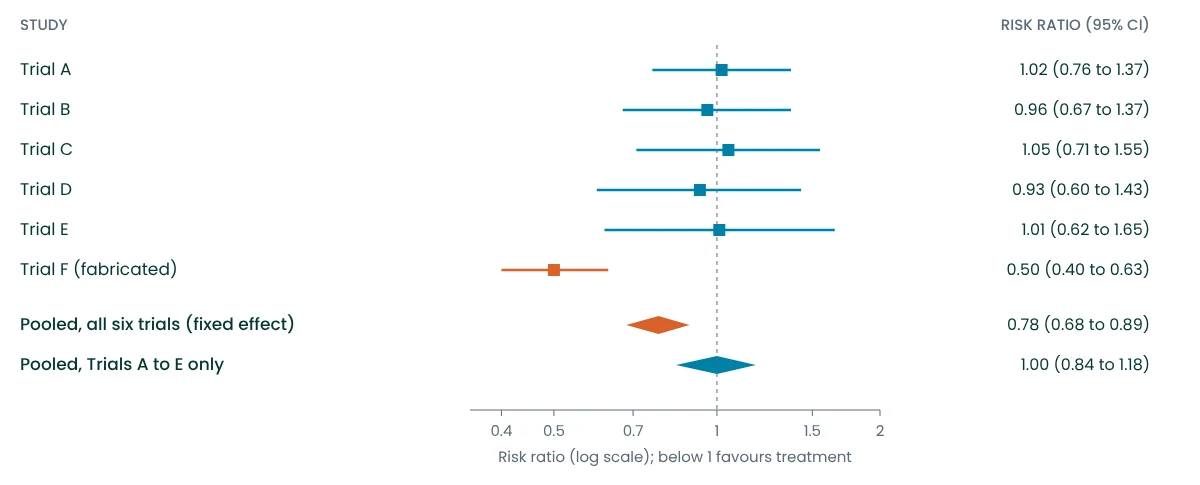
Five genuine trials cluster around no effect, with risk ratios from 0.93 to 1.05. A sixth, fabricated trial reports a risk ratio of 0.50 with a narrow interval. Under fixed-effect pooling it takes 35.4% of the weight and moves the pooled risk ratio to 0.78, a statistically significant benefit that none of the genuine trials shows. Heterogeneity jumps from an I² of 0% to 78%.
| Analysis | Risk ratio (95% CI) | I² | Weight of Trial F |
|---|---|---|---|
| All six trials, fixed effect | 0.78 (0.68 to 0.89) | 78% | 35.4% |
| All six trials, random effects (DerSimonian–Laird) | 0.87 (0.64 to 1.18) | 78% | 19.6% |
| Trials A to E only | 1.00 (0.84 to 1.18) | 0% | Not applicable |
Random-effects pooling cuts Trial F’s weight to 19.6% and widens the interval across 1.0, but the point estimate still sits below the genuine result. Neither model detects the problem; both only change how much it hurts.
04What a leave-one-out analysis shows
| Trial removed | Risk ratio (95% CI) | I² |
|---|---|---|
| None | 0.78 (0.68 to 0.89) | 78% |
| Trial A | 0.73 (0.62 to 0.85) | 79% |
| Trial B | 0.75 (0.65 to 0.87) | 82% |
| Trial C | 0.75 (0.65 to 0.87) | 81% |
| Trial D | 0.77 (0.66 to 0.88) | 82% |
| Trial E | 0.76 (0.66 to 0.88) | 82% |
| Trial F (fabricated) | 1.00 (0.84 to 1.18) | 0% |
Removing any genuine trial leaves a significant benefit between 0.73 and 0.77. Removing Trial F erases it. That asymmetry, with one trial carrying the whole result, is exactly the pattern a leave-one-out analysis exists to expose. It cannot prove fabrication; it tells you which trial to examine first.
05Where distortion risk concentrates
Oncology accounted for 48 of the 299 life-science reviews found to contain a retracted paper-mill article [3], and a machine-learning screen of cancer research found flagged papers over-represented in fundamental research and in gastric, bone and liver cancer [4]. Suspected paper-mill output is doubling every 1.5 years [5]. Reviews in these fields, especially those resting on a handful of trials, need screening before synthesis rather than after peer review.
06Testing whether a conclusion is stable
Our companion article covers how fabricated papers get into systematic reviews. Once they are in, these checks show whether the pooled effect depends on them.
What we run on every meta-analysis
- Leave-one-out analysis, reporting any trial that changes direction or significance.
- Fixed-effect against random-effects results, with any difference explained.
- Investigation of unexplained heterogeneity and narrow-interval outliers.
- An INSPECT-SR trustworthiness assessment of each trial, alongside risk of bias and GRADE [6].
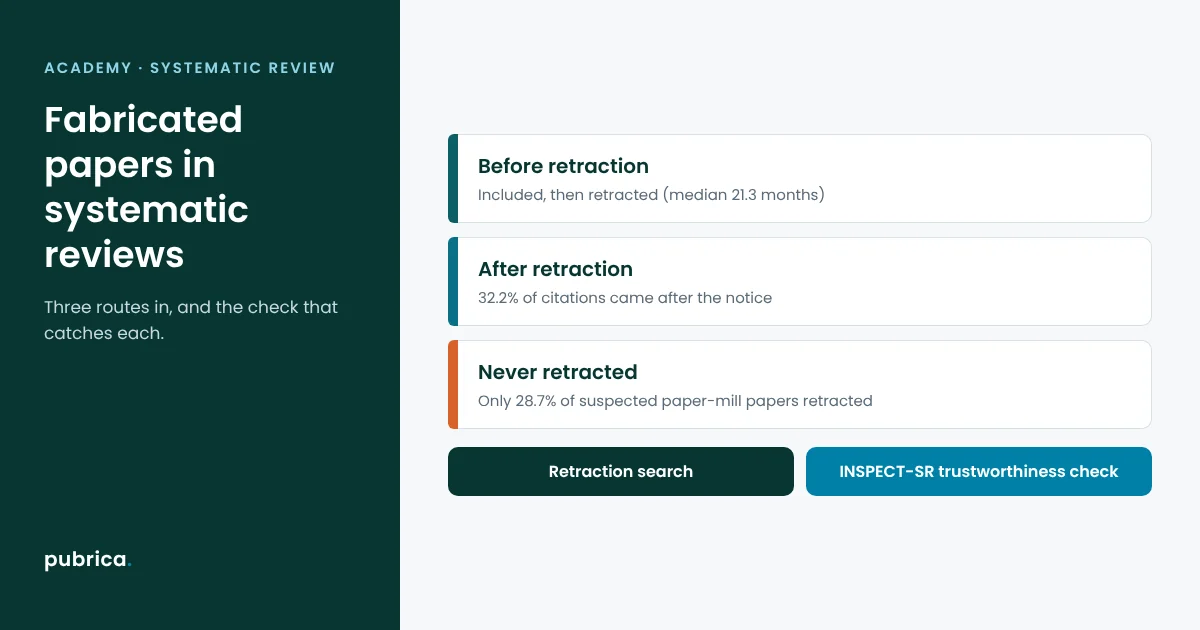
- Retraction status re-checked before submission; the median time to retraction for trials was 21.3 months [1].
- Results with and without doubtful trials, and the effect on certainty of evidence.
Questions
How do fake research papers distort meta-analyses?
They add false effects and false precision. Because meta-analyses weight trials by precision, one fabricated trial with a narrow interval can shift the pooled effect and its significance.
Does a random-effects model protect against fake trials?
Partly. It spreads weight more evenly, which reduces a fake trial’s influence, but the pooled estimate is still pulled toward it.
Can a leave-one-out analysis prove a study is fabricated?
No. It shows which study the result depends on. Whether that study is trustworthy needs a separate assessment, such as INSPECT-SR.
Can removing retracted studies change a meta-analysis conclusion?
Yes. In the VITALITY cohort it reversed the direction of the pooled effect in 8.4% of meta-analyses and changed significance in 16.0%.
References
- Xu C, Fan S, Tian Y, et al. Investigating the impact of trial retractions on the healthcare evidence ecosystem (VITALITY Study I): retrospective cohort study. BMJ. 2025;389:e082068. https://doi.org/10.1136/bmj-2024-082068
- Suchak T, Aliu AE, Harrison C, Zwiggelaar R, Geifman N, Spick M. Explosion of formulaic research articles, including inappropriate study designs and false discoveries, based on the NHANES US national health database. PLoS Biol. 2025;23(5):e3003152. https://doi.org/10.1371/journal.pbio.3003152
- Tang G, Cai H. Citation contamination by paper mill articles in systematic reviews of the life sciences. JAMA Netw Open. 2025;8(6):e2515160. https://doi.org/10.1001/jamanetworkopen.2025.15160
- Scancar B, Byrne JA, Causeur D, Barnett AG. Machine learning based screening of potential paper mill publications in cancer research: methodological and cross sectional study. BMJ. 2026;392:e087581. https://doi.org/10.1136/bmj-2025-087581
- Richardson RAK, Hong SS, Byrne JA, Stoeger T, Amaral LAN. The entities enabling scientific fraud at scale are large, resilient, and growing rapidly. Proc Natl Acad Sci USA. 2025;122(32):e2420092122. https://doi.org/10.1073/pnas.2420092122
- Wilkinson J, Bero L, Heal C, et al. INSPECT-SR tool for assessing trustworthiness of randomised controlled trials. BMJ. 2026;394:e100611. https://doi.org/10.1136/bmj-2026-100611
Update log
- Published by Pubrica
How to cite this article
Pubrica Academy. (2026, October 20). How Fake Research Papers Distort Meta-Analyses and Systematic Reviews. Pubrica. https://pubrica.com/academy/meta-analysis/fake-research-papers-distort-systematic-reviews-meta-analyses/
This article is general information for researchers, not legal, regulatory or funding advice. Check the current requirements of your journal, funder, ethics committee or regulator before you act on it.