Contents
On this page
- Quick answer
- What the SAGER guidelines are and why they exist
- Title and abstract
- Introduction
- Methods: study design, inclusion criteria and measurement
- Results: sex-disaggregated data and subgroup analysis
- Discussion and limitations
- The SAGER checklist at a glance
- Pre-submission sex and gender check
- Frequently asked questions
- Sources
AcademyOriginal Research Article
Guide
SAGER Guidelines Explained: Reporting Sex and Gender in an Original Research Article, Item by Item
The SAGER guidelines give authors a practical framework for reporting sex and gender in study design, analysis, results and interpretation. This guide applies them to an original research article one section at a time, with examples.
- Reporting guidelines
- Sex and gender
- Manuscript writing
- Published
- 2016, by an EASE working group
- Core distinction
- Sex is biological; gender is sociocultural
- Heaviest sections
- Methods and results
- Adoption
- About 9,000 journals (EASE estimate, 2026)
At a glanceOriginal Research Article
Talk to a Pubrica expertDiscuss your project
Quick answer
- State any single-sex restriction in the title and abstract, and say in the introduction whether differences are expected.
- In the methods, explain how sex and gender were determined and justify any exclusion.
- Present sex-disaggregated data, report every sex or gender analysis, and discuss what any gaps mean.
What the SAGER guidelines are and why they exist
The SAGER guidelines (Sex and Gender Equity in Research) are reporting standards that tell authors how to describe sex and gender in a scientific paper. A working group of the European Association of Science Editors developed them and published them in 2016, which is why they are sometimes called the EASE guidelines for sex and gender1. For decades, much research either ignored sex and gender or assumed that findings in one group applied to everyone. That gap in equity in research limits how far results can be generalised and can hide differences in safety and effect1.
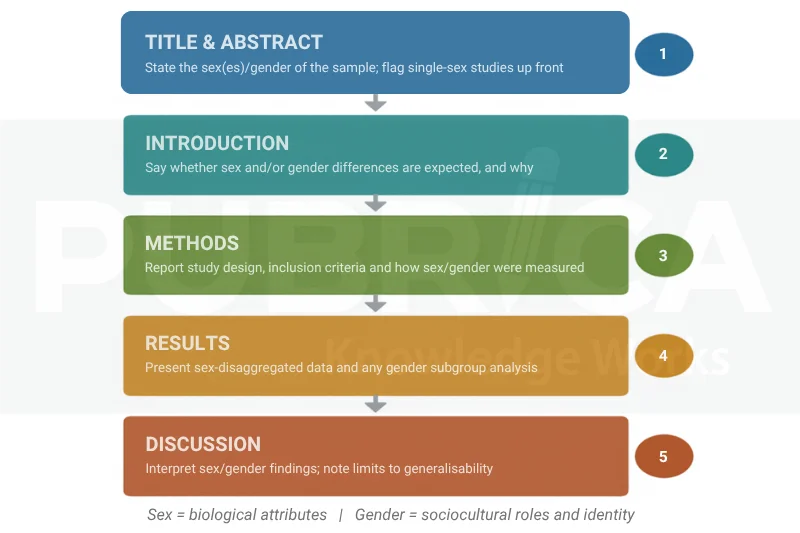
The guidelines rest on one distinction: sex refers to biological attributes, while gender refers to socially constructed roles, behaviours and identities. Use the two terms carefully and do not swap one for the other1. Ten years on, EASE estimates that around 9,000 journals have adopted SAGER, including the Lancet, BMJ, Nature and Cell5. Having the SAGER guidelines explained item by item shows exactly where sex and gender belong in a manuscript.
Title and abstract
SAGER begins at the top of the paper. If a study includes only one sex, or its results apply to only one sex or gender, the title and abstract should say so. That means the sex of animals, cells or tissues, and the sex and gender of human participants1. Write “a cohort of postmenopausal women”, not a neutral label that hides the restriction. A good test: could a reader tell from your abstract alone which population your results apply to?
Introduction
The introduction sets expectations. SAGER asks authors to report, where relevant, whether sex and/or gender differences may be expected in the condition under study1. Ground that expectation in prior evidence. If differences are plausible, the general principle applies: design the research so that it can reveal them1. This item makes sex and gender scientific variables from the outset, which strengthens the rationale for any planned gender analysis.
Preparing a manuscript that must meet SAGER?
Pubrica’s medical writers and biostatisticians structure your study design, prepare sex-disaggregated tables and check your manuscript against the full SAGER checklist before submission.
Methods: study design, inclusion criteria and measurement
The methods section carries the heaviest SAGER load. Report how sex and gender were taken into account in the study design and inclusion criteria, whether both sexes were adequately represented, and the reasons for excluding males or females1. State how sex and gender were determined: self-reported, taken from records or biologically measured. Single-sex studies are allowed, but they must be justified. Add enough detail for another team to reproduce the sampling and see who was represented.
Funders push the same way. Since the 25 January 2016 application deadline, the NIH has expected applicants to factor sex as a biological variable into the design, analysis and reporting of vertebrate animal and human studies3.
Results: sex-disaggregated data and subgroup analysis
Here SAGER makes its most concrete demand. Where appropriate, routinely present sex-disaggregated data, split by sex and, where relevant, by gender. Report sex- and gender-based analyses whether the outcome was positive or negative, so a null subgroup analysis is not quietly dropped. In clinical trials, report withdrawals and dropouts by sex too1.
Disaggregation does not mean every paper needs a formal interaction test. It means the counts and rates are visible so that others can reuse them in pooled analyses. Journals are increasingly enforcing this: in 2024, editors of leading orthopaedic journals published a joint editorial on reporting outcomes by sex and gender4.
Discussion and limitations
The discussion should interpret what the sex and gender findings mean for the results and analyses. If no sex or gender analysis was done, give the reason and discuss how its absence affects interpretation1. A small or single-sex sample limits generalisability, and that belongs in the limitations paragraph, not buried or left out. Honest reporting stops readers extending results to populations that were never studied.
The SAGER checklist at a glance
Table 1. A one-page SAGER checklist to run against any manuscript before submission
| Article section | What SAGER asks you to report | Quick example |
|---|---|---|
| Title and abstract | The sex of animals, cells or tissues and the sex and gender of participants when only one sex is included | “…in male Wistar rats” |
| Introduction | Whether sex and/or gender differences may be expected, with rationale | “Prevalence differs by sex, so…” |
| Methods | How sex and gender shaped the study design and inclusion criteria, how they were determined, and why any sex was excluded | “Gender self-reported at intake” |
| Results | Sex-disaggregated data; sex- and gender-based analyses whatever the outcome; trial withdrawals by sex | Outcomes split by sex in Table 2 |
| Discussion | Implications for interpretation; if no analysis was done, why, and what that means | “Findings may not extend to women” |
Walk your draft section by section against the SAGER checklist before you submit. Editors can do the same: a checklist piloted in Lancet journals turns the guidelines into a quick editorial check during assessment and peer review2. If every section passes, your paper meets current reporting standards and gives readers the transparent sex-disaggregated data that good science depends on.
Pre-submission sex and gender check
Before you submit
- The terms sex and gender are used correctly and consistently.
- Any single-sex restriction is stated in the title and abstract.
- The introduction says whether sex or gender differences are expected.
- The methods explain how sex and gender were determined and justify any exclusion.
- Results tables show sex-disaggregated data, including trial withdrawals.
- Every sex- or gender-based analysis is reported, including null results.
- The discussion addresses implications or explains why no analysis was done.
Pubrica team verdict
Sex and gender reporting under the SAGER guidelines is a short, section-by-section routine: use the terms correctly, flag restrictions early, explain measurement, disaggregate results and be honest about limits. Run the checklist before submission and reviewers will not need to ask.
Frequently asked questions
No law requires them, but many journals and publishers have adopted them, and some ask authors to follow them at submission. Check your target journal’s instructions.
Sex refers to biological attributes, such as chromosomes and hormones. Gender refers to socially constructed roles, behaviours and identities. Report whichever is relevant and be precise about which one you mean.
No. They are acceptable, but you should justify the choice, state it in the title and abstract, and discuss the limit on generalisability.
Sources
Sources were checked on 27 October 2026. Requirements and guidance may change after that date; confirm the current version with the issuing body.
- 1Heidari S, Babor TF, De Castro P, Tort S, Curno M. Sex and Gender Equity in Research: rationale for the SAGER guidelines and recommended use. Res Integr Peer Rev. 2016;1:2 (correction: 2024;9:15). https://pmc.ncbi.nlm.nih.gov/articles/PMC5793986/
- 2Van Epps H, Astudillo O, Del Pozo Martín Y, Marsh J. The Sex and Gender Equity in Research (SAGER) guidelines: implementation and checklist development. Eur Sci Ed. 2022;48:e86910. https://doi.org/10.3897/ese.2022.e86910
- 3National Institutes of Health. Consideration of sex as a biological variable in NIH-funded research (NOT-OD-15-102). 9 June 2015. https://grants.nih.gov/grants/guide/notice-files/not-od-15-102.html
- 4Sex and Gender Research in Orthopaedic Journals Group. Improving how orthopaedic journals report research outcomes based on sex and gender. Arthroscopy. 2024;40(8):2156–2158. https://doi.org/10.1016/j.arthro.2024.04.007
- 5European Association of Science Editors. 10th anniversary celebrations of the publication of the SAGER guidelines. 23 April 2026. https://ease.org.uk/2026/04/10th-anniversary-celebrations-of-the-publication-of-the-sager-guidelines/
SAGER guidelinessex and gender reportingSAGER checklistreporting sex gender researchSAGER guidelines explainedsex-disaggregated data
How to cite this article
Pick your referencing style and copy it. Your university or target journal may vary the punctuation, so check its guide if it has one.
Dr. Charlie. (2026, October 27). SAGER Guidelines Explained: Reporting Sex and Gender in an Original Research Article, Item by Item. Pubrica. https://pubrica.com/academy/original-research-article/sager-guidelines-sex-gender-reporting/
This article is written to be learned from. Cite it if you are referring to what it says; if you are using the evidence behind it, cite the sources listed above instead.
Next steps
Preparing a manuscript that must meet SAGER?
Pubrica’s medical writers and biostatisticians structure your study design, prepare sex-disaggregated tables and check your manuscript against the full SAGER checklist before submission.
This article is general information for researchers, not legal, regulatory or funding advice. Check the current requirements of your journal, funder, ethics committee or regulator before you act on it.
More in Original Research Article