Navigating the 2026 NIHR Evidence Synthesis Programme: Strategic Alignment and Methodological Expectations for Meta-Analysis Teams
NIHR evidence synthesis funding goes to proposals that reduce a real decision uncertainty with methods that fit the evidence. Here is what the 2026 researcher-led call asked for, and the statistical choices a meta-analysis team should be ready to defend.
- Call
- Researcher-led opportunity 2026/361, opened 26 January and closed 18 May 2026
- Out of scope
- Very narrow questions, and proposals limited to rapid reviews, scoping reviews or evidence maps
- Optional
- Economic analysis or modelling, and methodological sub-studies such as a SWAR
- Required
- Inclusive research design and sex and gender considerations, with their costs
On this page
- Quick answer
- Establish programme fit before choosing methods
- Build a reproducible protocol and statistical analysis plan
- Separate heterogeneity estimation from inference
- Treat sparse binary outcomes as a modelling problem
- Connect estimates to real decisions
- Justify network and IPD meta-analysis
- Integrate risk of bias, inclusion and involvement
- Demonstrate feasibility, value and impact
- Questions
- References
Quick answer
- The NIHR Evidence Synthesis Programme funds standalone syntheses of national relevance that reduce a real decision uncertainty.
- Rapid reviews, scoping reviews and evidence maps on their own, and very narrow questions, were out of scope in 2026.
- Reviewers expect a statistical analysis plan that justifies the variance estimator, interval method and handling of sparse data.
- Inclusion, public involvement, feasibility and value for money are assessed alongside the methods.
01Establish programme fit before choosing methods
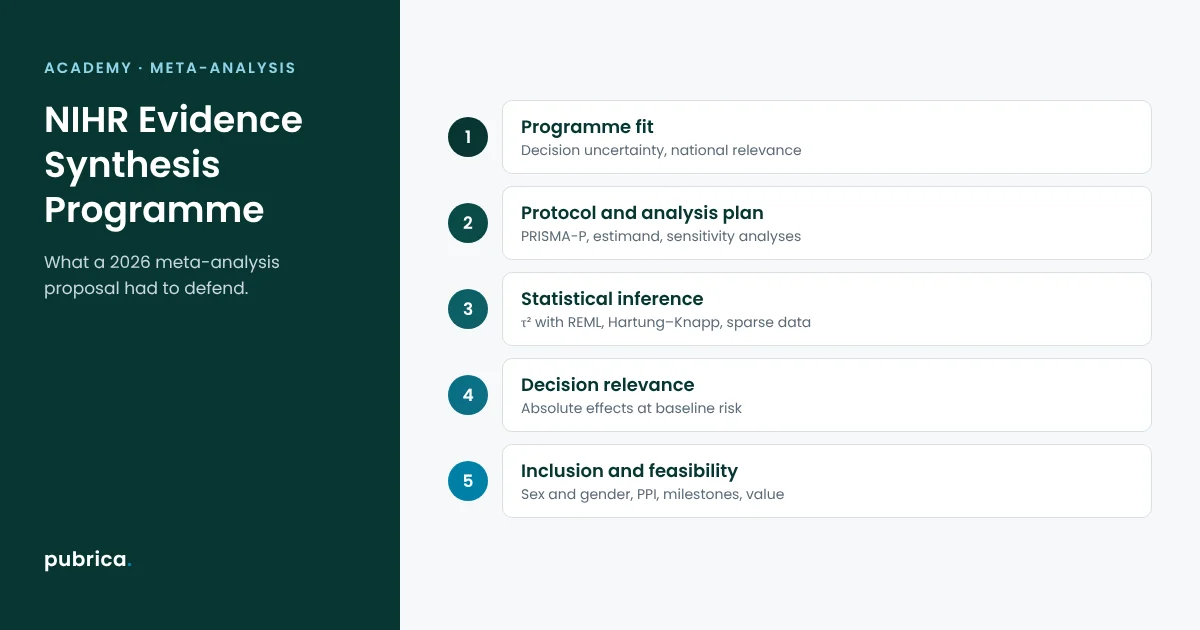
The NIHR Evidence Synthesis Programme (ESP) funds research that systematically identifies, appraises and combines existing evidence on health and social care questions. Its researcher-led opportunity 2026/361 opened on 26 January 2026 and closed on 18 May 2026 [1]. It excluded very narrow questions and proposals limited to rapid reviews, scoping reviews or evidence maps, and allowed an economic analysis or modelling component without requiring one [1]. Future calls may differ, so check the current specification before planning.
Start from the decision, not the method: the population, intervention, comparator, outcomes and who will act on the answer. National relevance has to be shown through implications for policy, practice or services. A NICE evidence gap or a published priority helps, but alignment alone does not secure NIHR funding; the proposal must say what new knowledge the evidence synthesis adds.
02Build a reproducible protocol and statistical analysis plan
Specify eligibility, databases, supplementary searching, screening, extraction, risk-of-bias assessment and synthesis. Structure the protocol with PRISMA-P and plan reporting to PRISMA 2020 [2, 3]; both are reporting guidelines, not methodological justification. The statistical analysis plan should define the estimand, effect measure, model, missing-data strategy and sensitivity analyses, and separate pre-specified from exploratory analyses.
| Decision | What to justify | Common weak answer |
|---|---|---|
| Effect measure and estimand | Target contrast, outcome scale, follow-up | “We will pool odds ratios” with no estimand |
| Between-study variance | Estimator (for example REML) and how uncertain τ² will be with few studies | Reading a small τ² as proof of homogeneity |
| Confidence interval | Normal approximation or a small-sample adjustment such as Hartung–Knapp, with reasons | Promising one adjustment fixes every case |
| Sparse binary outcomes | Model for zero-event and double-zero-event studies | Automatic 0.5 continuity correction |
| Sensitivity analysis | Which assumptions will vary and how changes will be read | A list of analyses with no decision rule |
03Separate heterogeneity estimation from inference
A random-effects meta-analysis assumes true effects vary around a mean, with between-study variance τ². Estimating τ² (for example by REML) and making valid inference about the mean are separate tasks. With few studies, τ² is highly uncertain, and a small estimate does not prove homogeneity.
Conventional intervals treat the estimated variance as known and can under-cover with few studies. The Hartung–Knapp adjustment uses a t-distribution and often performs better, particularly with appreciable heterogeneity [4], but it is not superior in every configuration. Justify the choice rather than promise that one method solves small-sample problems. Treat I² and prediction intervals as descriptions, read alongside study characteristics, not as automatic rules for pooling.
04Treat sparse binary outcomes as a modelling problem
Rare adverse events produce trials with zero events in one or both arms. Under conventional relative-effect methods, double-zero-event studies give no within-study estimate, but likelihood-based models using arm-level data can draw information from them, so neither automatic exclusion nor automatic inclusion is a rule. A continuity correction such as adding 0.5 makes the arithmetic work but adds artificial information; an analysis across the Cochrane Database found that the method chosen can change the results of real meta-analyses [5]. Pre-specify a primary model suited to the data, test the alternatives in sensitivity analyses, and say so when the data are too sparse to support firm estimates.
05Connect estimates to real decisions
| Baseline risk | Risk with intervention | Absolute reduction |
|---|---|---|
| 100 per 1,000 | 80 per 1,000 | 20 per 1,000 |
| 10 per 1,000 | 8 per 1,000 | 2 per 1,000 |
A relative effect means little without baseline risk. State which baseline-risk source applies, how its uncertainty will be handled, and the timeframe for absolute effects. Where a minimum important difference exists, interpret estimates against it, and carry treatment effects and their uncertainty into any economic model. This is what turns a pooled estimate into decision-relevant evidence.
06Justify network and IPD meta-analysis
A network meta-analysis is only as credible as its transitivity assumption: if A-versus-B trials recruit mild disease and B-versus-C trials severe disease, an indirect A-versus-C comparison may be biased when severity modifies the effect. Describe effect modifiers, consistency checks and how sparse networks limit rankings. Individual participant data meta-analysis allows harmonised analyses and covariate interactions, but depends on data access, governance and consistent definitions. Neither is automatically preferred to a well-designed pairwise synthesis.
07Integrate risk of bias, inclusion and involvement
Use risk-of-bias tools suited to each design and assess certainty across risk of bias, inconsistency, indirectness, imprecision and publication bias [6]. The 2026 call required applicants to explain how inclusive research design and sex and gender were considered across the research lifecycle, with the associated costs, and encouraged co-production with practitioners, patients, carers and the public [1].
08Demonstrate feasibility, value and impact
Research proposal feasibility means deliverable within the time, budget and team, not just statistically sound. The call asked for timelines and milestones, value for money and pathways to impact, and encouraged applicants to embed a methodological sub-study, such as a Study Within A Review (SWAR), subject to programme rules [1]. A SWAR needs its own question and measurable outcome, and must not compromise the main synthesis.
What we check before an ESP application goes in
- The decision uncertainty and its users are named in the first paragraph.
- The question is neither very narrow nor a scoping exercise.
- The statistical analysis plan justifies estimator, interval method and sparse-data handling.
- Inclusion and sex and gender considerations are costed.
- Milestones, team expertise and budget match the scale of the review.
Questions
Did NIHR opportunity 2026/361 require economic modelling?
No. An economic analysis or modelling component could be included where relevant, but it was not mandatory.
Should double-zero-event studies always be excluded?
No. Their contribution depends on the effect measure and model; justify the approach and test alternatives in sensitivity analyses.
Does the NIHR prefer network or IPD meta-analysis?
No. The method must fit the question, evidence structure and feasibility; a well-designed pairwise synthesis can be the stronger proposal.
What should I check before a future NIHR submission?
The current call’s remit, eligibility, guidance, inclusion requirements, budget rules and conditions for methodological sub-studies.
References
- National Institute for Health and Care Research. Evidence Synthesis Programme: researcher-led evidence synthesis, funding opportunity 2026/361. 2026. https://www.nihr.ac.uk/funding/evidence-synthesis-programme-esp-researcher-led-evidence-synthesis/2026361
- Moher D, Shamseer L, Clarke M, et al. Preferred reporting items for systematic review and meta-analysis protocols (PRISMA-P) 2015 statement. Syst Rev. 2015;4:1. https://doi.org/10.1186/2046-4053-4-1
- Page MJ, McKenzie JE, Bossuyt PM, et al. The PRISMA 2020 statement: an updated guideline for reporting systematic reviews. BMJ. 2021;372:n71. https://doi.org/10.1136/bmj.n71
- IntHout J, Ioannidis JPA, Borm GF. The Hartung-Knapp-Sidik-Jonkman method for random effects meta-analysis is straightforward and considerably outperforms the standard DerSimonian-Laird method. BMC Med Res Methodol. 2014;14:25. https://doi.org/10.1186/1471-2288-14-25
- Ren Y, Lin L, Lian Q, Zou H, Chu H. Real-world performance of meta-analysis methods for double-zero-event studies with dichotomous outcomes using the Cochrane Database of Systematic Reviews. J Gen Intern Med. 2019;34(6):960–968. https://doi.org/10.1007/s11606-019-04925-8
- Guyatt GH, Oxman AD, Vist GE, et al. GRADE: an emerging consensus on rating quality of evidence and strength of recommendations. BMJ. 2008;336:924–926. https://doi.org/10.1136/bmj.39489.470347.AD
Update log
- Published by Pubrica
How to cite this article
Pubrica Academy. (2026, October 20). Navigating the 2026 NIHR Evidence Synthesis Programme: Strategic Alignment and Methodological Expectations for Meta-Analysis Teams. Pubrica. https://pubrica.com/academy/meta-analysis/nihr-evidence-synthesis-funding-meta-analysis/
This article is general information for researchers, not legal, regulatory or funding advice. Check the current requirements of your journal, funder, ethics committee or regulator before you act on it.