MDCG 2026 Reclassified Your Device: Now Your CER, PMCF Plan and Notified Body Expectations Have Changed
High-Impact Journals
- What MDCG 2026 Changed About Classification and EMDN Codes
- Why Reclassification Is Not Just a Registration Update
- How Higher Classification Changes CER Scope and Depth
- When Equivalence Arguments Break Under Reclassification
- PMCF Plan Changes: What Higher Classification Requires
- Notified Body Expectations at Each Classification Level
- Literature Review Requirements After Reclassification
- State of the Art Reassessment: What Changes with the Class
- Three Reclassification Scenarios Walked Through
- Timeline: Working Backwards from Notified Body Submission
- Pubrica Reclassification Evidence-Impact Matrix
- How Pubrica Would Assess Your Reclassification Evidence Gaps
- Reference
Interesting topics
Medical device manufacturers working under Regulation (EU) 2017/745 (MDR) should not treat a classification reassessment as a simple EUDAMED or registration exercise. The April 2026 revision of MDCG 2021-24 provides updated guidance for applying MDR classification rules, while the EMDN continues to serve as the European nomenclature used for device registration. These are related but distinct regulatory functions. [1,2,3]
When a revised classification analysis changes the device class, the consequences can extend across the clinical evaluation report (CER), equivalence strategy, post-market clinical follow-up (PMCF), state-of-the-art assessment, risk-management interfaces and notified-body conformity assessment. A manufacturer that updates only the classification or EMDN record without reassessing the supporting evidence can therefore discover gaps late in the conformity-assessment process.
This article explains what the 2026 classification and EMDN developments mean in practice, where existing evidence strategies can fail, and how manufacturers can work backwards from notified-body submission to identify and close evidence gaps before they become submission-stage findings.
What MDCG 2026 Changed About Classification and EMDN Codes
MDCG 2021-24 Rev.1 clarifies application of MDR classification rules and updates selected practical examples and tables. The 2026 EMDN workstream separately updates nomenclature through annual revision documents. Manufacturers should therefore review both: (1) the Annex VIII classification rationale and (2) the EMDN/UDI registration assignment. [1,2]
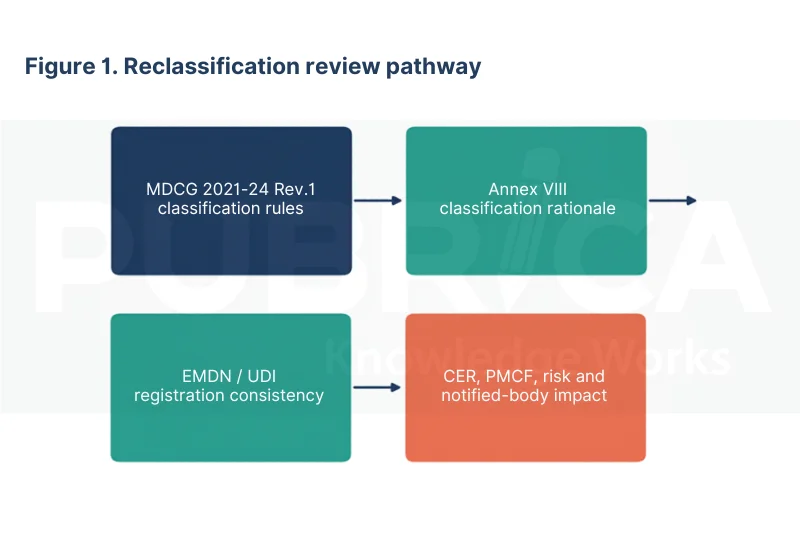
Source: author-prepared illustration based on the cited MDR and MDCG guidance.Reclassification review pathway: MDCG 2021-24 Rev.1 to Annex VIII, then EMDN/UDI, then CER, PMCF and NB impact
Why Reclassification Is Not Just a Registration Update
A higher class can change the conformity-assessment route and the evidence expected by the notified body. MDR Article 52 establishes different conformity pathways by class, while Article 54 creates a Clinical Evaluation Consultation Procedure for certain Class III implantable and Class IIb active devices. [3]
The distinction is critical: an EMDN update alone is a registration consistency check; a changed classification is a regulatory impact assessment; and a higher classification is a CER, PMCF, risk-management and notified-body readiness review.
How Higher Classification Changes CER Scope and Depth
MDR Annex XIV requires the clinical evaluation to be thorough and objective, with depth proportionate to the device’s nature, classification, intended purpose and risks. [3] A higher classification should therefore trigger a structured CER gap review covering indications, claims, clinical benefits, safety endpoints, residual risks, literature, equivalence, PMCF and benefit-risk conclusions.
MDCG 2020-13 confirms that notified-body assessment examines clinical-evaluation planning, literature methodology, equivalence, PMCF, risk-management interfaces and conclusions. [7]
When Equivalence Arguments Break Under Reclassification
Equivalence cannot be defended merely because two devices have the same broad indication. MDR Annex XIV and MDCG 2020-5 require comparison of technical, biological and clinical characteristics. [4]
After reclassification, reassess materials, contact duration, energy, software, anatomical site, population, deployment, operating principles and critical performance. If a difference could affect safety, performance or clinical outcome, it needs an evidence-based assessment. Where equivalence cannot be demonstrated, device-specific evidence may be required. [4,10]
PMCF Plan Changes: What Higher Classification Requires
PMCF continuously updates the clinical evaluation. Annex XIV Part B requires proactive collection and evaluation of clinical data to confirm safety and performance, monitor known and unknown risks, confirm benefit-risk acceptability and identify misuse or off-label use. [3,5]
An upward classification should therefore trigger a PMCF gap review. Check whether current endpoints, follow-up, population, sample, data sources and methods can answer the new clinical questions. MDCG 2020-7 and 2020-8 also require PMCF outputs to connect with the CER, risk management and PMS. [5,6]
Notified Body Expectations at Each Classification Level
MDR conformity assessment becomes more extensive as risk classification increases. Class I generally has limited notified-body involvement except for specified Article 52(7) cases. Class IIa requires notified-body conformity assessment. Class IIb requires broader assessment and technical-documentation review of at least one representative device per generic device group, with special rules for certain implantables. Class III follows the highest-risk conformity routes. [3]
Class | Practical expectation |
Class I | Applicable GSPR and limited NB involvement where required |
Class IIa | Stronger technical/clinical justification and NB assessment |
Class IIb | Deeper technical documentation and clinical scrutiny |
Class III | Highest scrutiny; additional consultation mechanisms may apply |
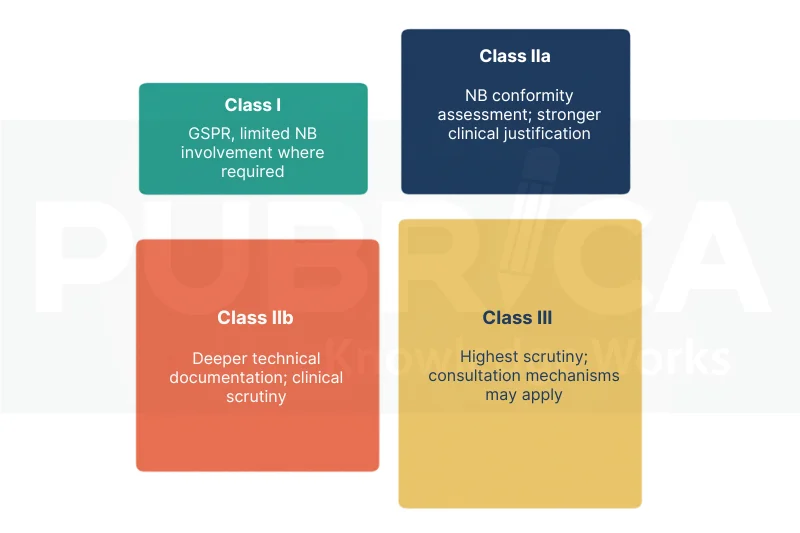
Source: author-prepared illustration based on the cited MDR and MDCG guidance.Class I to Class III evidence-intensity pathway; requirements depend on the specific conformity route.
For certain Class III implantable and Class IIb active devices, Article 54 requires clinical evaluation consultation unless an exception applies. [3,8]
Literature Review Requirements After Reclassification
Do not simply update the publication date. Annex XIV requires systematic identification and appraisal of clinical data, while notified-body assessment covers the literature-search methodology and documentation. [3,7]
Re-run the search where classification changes alter the risk questions. Check databases, search terms, populations, indications, safety outcomes, inclusion/exclusion criteria, evidence quality and contradictory findings. The search strategy and screening trail should remain auditable and aligned with the current intended purpose.
State of the Art Reassessment: What Changes with the Class
State of the art supports benefit-risk and clinical-evaluation conclusions. [3] A higher classification may require stronger benchmarking of current clinical practice, alternatives, performance expectations, safety outcomes and complications. The result should link directly to risk management, CER conclusions and PMCF objectives.
The strongest traceability chain is classification → risk → state of the art → evidence gap → PMCF activity.
Three Reclassification Scenarios Walked Through
- Scenario 1: Class IIa to IIb. Reassess conformity route, CER depth, technical-documentation review, equivalence and PMCF.
- Scenario 2: Implantability interpretation changes. Revisit classification rationale, biological/clinical evidence, risks and PMCF. MDCG 2021-24 Rev.1 clarifies terminology around clinical procedures and implantable devices. [1]
- Scenario 3: EMDN code changes but class does not. Update registration/UDI consistency and confirm that the code matches device identity and intended purpose. Do not expand the CER solely because the nomenclature code changed. [2]
Timeline: Working Backwards from Notified Body Submission
Timing | Key action |
T−16 to T−12 weeks | Confirm classification and EMDN; map affected documents |
T−12 to T−8 | CER gap analysis, literature and equivalence review |
T−8 to T−6 | State-of-the-art and PMCF updates |
T−6 to T−2 | Generate missing evidence; reconcile CER/RMF/PMS/PMCF |
T−2 to submission | Final traceability and notified-body readiness QC |
Source: author-prepared illustration based on the cited MDR and MDCG guidance. T−16-week evidence-readiness timeline from classification decision to notified-body submission.
High-risk devices, clinical investigations or major evidence gaps may require substantially earlier planning.
Pubrica Reclassification Evidence-Impact Matrix
Trigger | Evidence impact | Pubrica output |
Class increase | CER depth and clinical evidence | CER gap map |
Rule interpretation change | Classification rationale | Revised rationale |
Equivalence challenge | Technical/biological/clinical comparison | Equivalence matrix |
Higher clinical risk | PMCF adequacy | Revised PMCF plan |
New risk questions | Literature | Updated review |
EMDN revision | Registration consistency | EMDN/UDI check |
This matrix creates traceability from the regulatory trigger to the evidence response.
How Pubrica Would Assess Your Reclassification Evidence Gaps
Pubrica can assess the impact in six linked checks: (1) Annex VIII classification rationale; (2) EMDN/UDI consistency; (3) CER claims-to-evidence mapping; (4) MDR equivalence criteria; (5) PMCF ability to close evidence gaps; and (6) alignment of CER, risk management, PMS, PMCF and technical documentation.
The objective is not to produce a longer CER. It is to establish a traceable evidence strategy proportionate to classification, intended purpose and risk and defensible during notified-body review.
Get expert support from Pubrica for addressing reviewer comments, preparing point-by-point rebuttals, and strengthening manuscripts for journal resubmission. Prepare your revised manuscript with confidence.
References
- European Commission, Directorate-General for Health and Food Safety. (2026, April 20). MDCG 2021-24 rev.1: Guidance on classification of medical devices. https://health.ec.europa.eu/latest-updates/update-mdcg-2021-24-rev1-guidance-classification-medical-devices-april-2026-2026-04-20_en
- European Commission, Directorate-General for Health and Food Safety. (2026). European Medical Devices Nomenclature (EMDN). https://health.ec.europa.eu/medical-devices-topics-interest/european-medical-devices-nomenclature-emdn_en
- European Parliament & Council of the European Union. (2017). Regulation (EU) 2017/745 on medical devices (consolidated version). EUR-Lex. https://eur-lex.europa.eu/legal-content/EN/TXT/?uri=celex%3A32017R0745
- Medical Device Coordination Group. (2020). MDCG 2020-5: Clinical evaluation—Equivalence. European Commission. https://health.ec.europa.eu/document/download/575a0f79-e3a0-4a96-9ce0-930576c12aa2_en?filename=md_mdcg_2020_5_guidance_clinical_evaluation_equivalence_en.pdf
- Medical Device Coordination Group. (2020). MDCG 2020-7: Guidance on PMCF plan template. European Commission. https://health.ec.europa.eu/document/download/a5cdb303-c782-4010-8723-7d389af678f7_en?filename=md_mdcg_2020_7_guidance_pmcf_plan_template_en.pdf
- Medical Device Coordination Group. (2020). MDCG 2020-8: Guidance on PMCF evaluation report template. European Commission. https://health.ec.europa.eu/document/download/11121036-696a-4589-a311-c5525bd84df3_en?filename=md_mdcg_2020_8_guidance_pmcf_evaluation_report_en.pdf
- Medical Device Coordination Group. (2020). MDCG 2020-13: Clinical evaluation assessment report template. European Commission. https://health.ec.europa.eu/document/download/02f50abc-91db-4ad9-b137-6ffedb690716_en
- European Commission. (2026). Work of the Expert Panels. Directorate-General for Health and Food Safety. https://health.ec.europa.eu/medical-devices-expert-panels/work-expert-panels_en
- Medical Device Coordination Group. (2024). MDCG 2024-2 rev.1: Procedures for the updates of the European Medical Device Nomenclature. European Commission. https://health.ec.europa.eu/document/download/de470384-e8be-45e7-a334-226757f8816d_en?filename=mdcg_2024-2_en.pdf
- Medical Device Coordination Group. (2023). MDCG 2023-7: Guidance on exemptions from the requirement to perform clinical investigations pursuant to Article 61(4)-(6) MDR and on sufficient levels of access to data needed to justify claims of equivalence. European Commission. https://health.ec.europa.eu/medical-devices-sector/new-regulations/guidance-mdcg-endorsed-documents-and-other-guidance_en