Steps in Literature Review: A 10-Stage Process Flowchart from Question to Gap Statement, with Owners per Stage
A flowchart of the ten steps in a literature review and gap analysis, who owns each, where the effort sits and how to write a gap statement the evidence supports.
- Stages
- 10, question to gap statement
- Heaviest stages
- Screening, appraisal, extraction
- Search check
- PRESS 2015 peer review
- Gap framework
- Robinson et al. 2011
Quick answer
- A literature review with gap analysis runs through ten stages, from question to gap statement.
- The review type, chosen at stage 2, sets how formal every later stage must be.
- Screening, appraisal and extraction take the most effort; plan two reviewers for them.
01The ten steps in a literature review
The steps in a literature review with a gap analysis run from a defined question to a written gap statement. Figure 1 shows the literature review process as ten stages with the usual owner of each. The order is a working model; the review types you choose set how formal each stage must be [1].
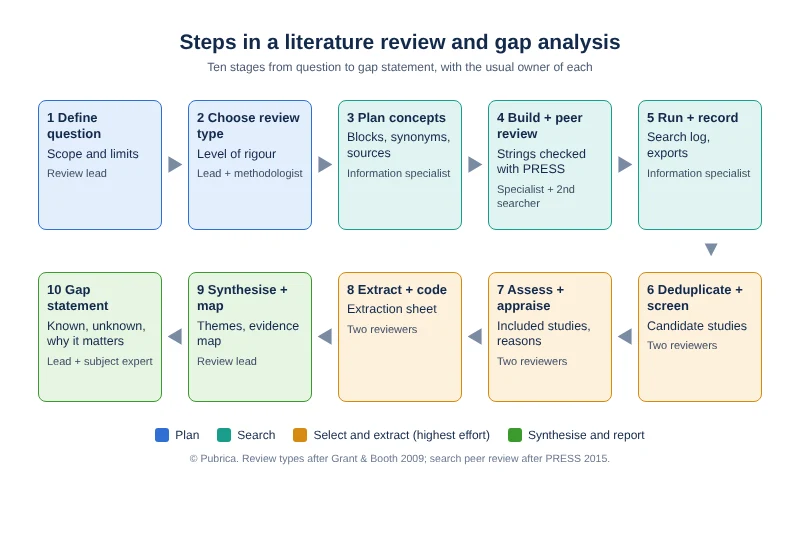
Table 1 adds the output each stage hands to the next. The effort ratings are our planning estimates, relative rather than in hours.
| Stage | Typical owner | Output | Relative effort |
|---|---|---|---|
| 1 Define question and scope | Review lead | Question, scope, inclusion limits | Low |
| 2 Choose review type | Review lead and methodologist | Agreed review type and level of rigour | Low |
| 3 Plan search concepts | Information specialist | Concept blocks, synonyms, sources | Low |
| 4 Build and peer review search strings | Information specialist and second searcher | Strings checked against PRESS 2015 | Medium |
| 5 Run and record searches | Information specialist | Search log, exported records | Low |
| 6 Deduplicate and screen | Two independent reviewers | Candidate studies, flow counts | High |
| 7 Assess and appraise full texts | Two reviewers | Included studies, reasons for exclusion, quality ratings | High |
| 8 Extract and code | Two reviewers | Extraction sheet or coding frame | High |
| 9 Synthesise and map evidence | Review lead | Themes, evidence map | Medium |
| 10 Write the gap statement | Review lead and subject expert | Gap statement with supporting evidence | Medium |
The ratings follow a scoping review of resource use in systematic review production, which found that study selection, data extraction, critical appraisal and project management used the most resources, and literature searching among the least [3]. Plan reviewer time around stages 6 to 8.
02Step 2 decides how formal everything else is
Grant and Booth describe review types by four steps, Search, AppraisaL, Synthesis and Analysis (SALSA), and show how each type handles them [1]. A thesis background, a grant application and a publishable systematic review need different levels of rigour, so agree the type before writing a single search strategy line.
| Review type | Search | Appraisal | Synthesis |
|---|---|---|---|
| Narrative or literature review | May or may not be comprehensive | May or may not be included | Narrative |
| Scoping review | Completeness set by time and scope | No formal appraisal | Tabular, with some narrative |
| Systematic review | Exhaustive and comprehensive | Quality assessment may decide inclusion or exclusion | Narrative with tabular accompaniment |
Our guide to types of literature review compares more formats.
03Steps 3 to 5: plan, check and run the search
Build each concept as a block of subject headings and free-text synonyms, combined with Boolean operators. Before the final run, a second searcher checks the strings against the PRESS 2015 checklist [2]; errors found after the search cost a full re-run. Record every string, date and record count in the search log, and add grey literature sources where the question needs them.
04Steps 6 to 8: screening, appraisal and extraction
Screening and full-text appraisal are done by two reviewers independently, with disagreements resolved by discussion or a third reviewer. Keep counts as you go: for a systematic review they feed the PRISMA 2020 flow diagram [5]. Pilot the extraction sheet on two or three studies before extracting the rest.
05How long each step takes
There is no single published time for a literature review, because review types vary so much in scope [1]. Time depends mainly on how many records the search returns and how many studies are included (Table 2). Agree a stage-by-stage estimate once the record count is known, and revisit it after the first screening batch.
| Stage group | Main time driver | Re-estimate when |
|---|---|---|
| 1–2 Question and type | How settled the question is | The review type is agreed |
| 3–5 Search | Number of databases, registers and languages | Strings pass peer review |
| 6–8 Selection and extraction | Records returned and studies included | The first screening batch is done |
| 9–10 Synthesis and gaps | Heterogeneity of the evidence | Extraction is complete |
06Steps 9 and 10: from evidence synthesis to gap statement
A research gap is a question the evidence cannot yet answer. Robinson and colleagues’ framework classifies why evidence is insufficient: insufficient or imprecise information, biased information, inconsistent results, or not the right information. It then characterises each gap by population, intervention, comparison, outcome and setting [4].
Apply it during evidence synthesis at stage 9, then write the gap statement at stage 10 in plain terms: what is known, what is not, why it matters, and which studies show it. A gap statement that cites no studies is an opinion, not a finding about research gaps.
07Where projects stall
- An unfocused question. A broad question inflates every later stage.
- Unreviewed search strings. Errors found after the search cost a full re-run.
- Screening backlog. Selection is among the heaviest stages; book two reviewers early.
- Gaps asserted without evidence. A gap statement should point back to the studies that show it.
Before submitting a narrative review, score it with our SANRA self-assessment.
Questions
What are the steps in a literature review?
How is a literature review different from a systematic review?
How do we turn findings into a research gap?
References
- Grant MJ, Booth A. A typology of reviews: an analysis of 14 review types and associated methodologies. Health Info Libr J. 2009;26(2):91-108. https://doi.org/10.1111/j.1471-1842.2009.00848.x
- McGowan J, Sampson M, Salzwedel DM, Cogo E, Foerster V, Lefebvre C. PRESS Peer Review of Electronic Search Strategies: 2015 guideline statement. J Clin Epidemiol. 2016;75:40-46. https://doi.org/10.1016/j.jclinepi.2016.01.021
- Nussbaumer-Streit B, Ellen M, Klerings I, et al. Resource use during systematic review production varies widely: a scoping review. J Clin Epidemiol. 2021;139:287-296. https://doi.org/10.1016/j.jclinepi.2021.05.019
- Robinson KA, Saldanha IJ, McKoy NA. Development of a framework to identify research gaps from systematic reviews. J Clin Epidemiol. 2011;64(12):1325-1330. https://pubmed.ncbi.nlm.nih.gov/21937195/
- Page MJ, McKenzie JE, Bossuyt PM, et al. The PRISMA 2020 statement: an updated guideline for reporting systematic reviews. BMJ. 2021;372:n71. https://doi.org/10.1136/bmj.n71
Update log
- Published by Pubrica
How to cite this article
Dr. Charlie. (2026, November 5). Steps in Literature Review: A 10-Stage Process Flowchart from Question to Gap Statement, with Owners per Stage. Pubrica. https://pubrica.com/academy/literature-review/steps-in-literature-review-flowchart/
This article is general information for researchers, not legal, regulatory or funding advice. Check the current requirements of your journal, funder, ethics committee or regulator before you act on it.