
- Services
- Discovery & Intelligence Services
- Publication Support Services
- Sample Work
Publication Support Service
- Editing & Translation
-
Editing and Translation Services
- Sample Work
Editing and Translation Service
-
- Research Services
- Sample Work
Research Services
- Physician Writing
- Sample Work
Physician Writing Service
- Statistical Analyses
- Sample Work
Statistical Analyses
- Data Collection
- AI and ML Services
- Sample Work
AI and ML Services
- Medical Writing
- Sample Work
Medical Writing
- Research Impact
- Sample Work
Research Impact
- Medical & Scientific Communication
- Sample Work
Medical & Scientific Communication
- Medico Legal Services
- Educational Content
- Academic Editorial Services
- Sample Work
Academic Editorial Services
- Educational Editorial Service
-
Education Editorial Services
- Sample Work
Education Editorial Services
-
- Industries
- Subjects
- About Us
- Academy
- Insights
- Contact Us
A Comprehensive Overview of Reporting Guidelines for Biomedical
Literature Reviews
High-Impact Journals
- Importance of Reporting Guidelines in Biomedical Reviews
- Common Reporting Guidelines for Biomedical Literature Reviews
- PRISMA: The Most Widely Used Reporting Guideline
- SANRA for Narrative Literature Reviews
- MOOSE Guidelines for Observational Studies
- Essential Components of a Biomedical Literature Review
- Common Reporting Errors in Biomedical Reviews
- Future Trends in Biomedical Review Reporting
- Conclusion
Interesting topics
A Comprehensive Overview of Reporting Guidelines for Biomedical Literature Reviews
Literature reviews in the biomedical sciences are important for summarising current knowledge, discovering knowledge gaps, and making decisions based on the evidence. The scientific quality of the literature review itself will not be determined just by the scientific value of the data included, but also by the quality of the reporting of the process of literature review, including biomedical literature review and evidence synthesis.
To increase the consistency, transparency, and reproducibility of biomedical literature reviews, there have been established some reporting guidelines. These guidelines will allow the author to structure their manuscript, provide a description of the methodology used, and make it possible for readers to judge the scientific value of the literature review process itself. [1]
1. Importance of Reporting Guidelines in Biomedical Reviews
Reporting guidelines serve to structure the presentation of the results of a study. Among other benefits, they: [2]
- Increase transparency and reproducibility
- Limit reporting bias
- Improve the quality of a manuscript
- Ease the peer review and publishing process
- Benefit from evidence synthesis and interpretation
Most biomedical journals have started requiring compliance with specific reporting guidelines before manuscript submission.
2. Common Reporting Guidelines for Biomedical Literature Reviews
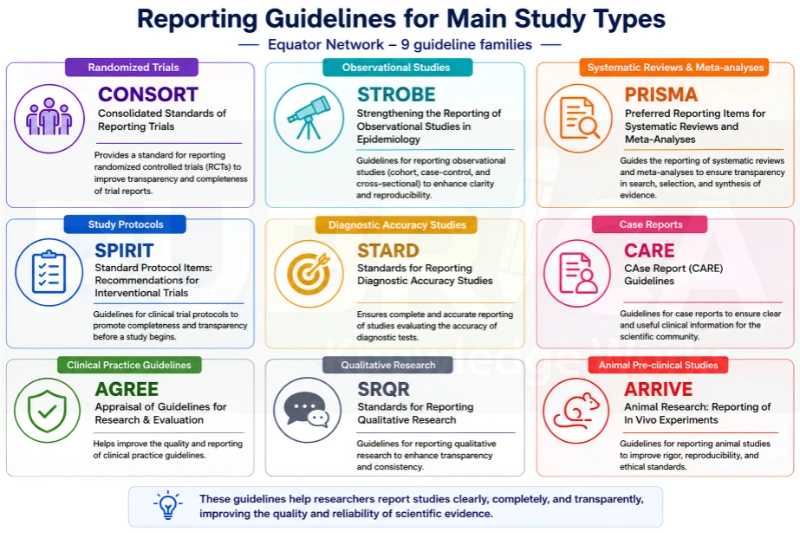
Several reporting frameworks are available depending on the type of literature review being conducted, mainly used in systematic review reporting and research methodology. [3]
| Review Type | Recommended Guideline | Purpose |
| Systematic Review | PRISMA 2020 | Transparent reporting of systematic reviews |
| Scoping Review | PRISMA-ScR | Reporting scoping reviews |
| Narrative Review | SANRA | Improving narrative review quality |
| Meta-Analysis of Observational Studies | MOOSE | Reporting observational meta-analyses |
| Umbrella Review | PRIOR | Reporting overviews of reviews |
| Evidence Quality Assessment | GRADE | Evaluating the certainty of evidence |
Selecting the correct guideline depends on the objectives and methodology of the review.
3. PRISMA: The Most Widely Used Reporting Guideline
The Preferred Reporting Items for Systematic Reviews and Meta-Analyses (PRISMA) is the most used reporting guideline in biomedical research and systematic review reporting. [4]
The aspects covered by PRISMA include:
- Literature search strategies
- Selection of studies
- Selection/inclusion/exclusion criteria
- Risk of bias assessment
- Data extraction methods
- Synthesis of results
PRISMA 2020 consists of a 27-item checklist and a flow diagram of the study selection process.
4. SANRA for Narrative Literature Reviews
Not all biomedical literature reviews use the systematic review approach. Narrative reviews are often employed using SANRA narrative review principles to conduct comprehensive studies on a particular subject. [5]
Scale for the Assessment of Narrative Review Articles (SANRA) assesses:
- Importance of the topic under review
- Transparency in conducting literature search
- Relevance of references
- Logic behind scientific arguments
- Demonstration of data
SANRA enhances the scientific value of traditional narrative reviews.
5. MOOSE Guidelines for Observational Studies
For meta-analysis studies that require the inclusion of observational studies, it is recommended to use the MOOSE guidelines for better research methodology and evidence synthesis. These guidelines include: [6]
- Transparency of study selection
- Evaluation for confounding
- Bias assessment
- Statistics
- Heterogeneity
It increases the robustness of evidence generated from observational research studies.
6. Essential Components of a Biomedical Literature Review
Regardless of the reporting framework used, biomedical literature reviews should include several key elements related to biomedical literature review practice.
Core Reporting Components
Component | Purpose |
Research Question | Defines review objectives |
Search Strategy | Describes database searches |
Eligibility Criteria | Explains study inclusion and exclusion |
Data Extraction | Summarises collected information |
Quality Assessment | Evaluates study validity |
Results Synthesis | Integrates findings |
Discussion | Interprets evidence |
Conclusion | Summarizes implications |
Comprehensive reporting of these components improves transparency and reproducibility.
7. Common Reporting Errors in Biomedical Reviews
Problems that can be observed in writing reports are insufficient searching techniques, inadequate inclusion and exclusion criteria, and the absence of bias evaluation. Also, reports might fail to adequately describe the selection process of the studies, use self-selecting data, and neglect the limitations part of the report. [7]
8. Future Trends in Biomedical Review Reporting
New trends that will have an impact on the future of evidence synthesis include:
- Automated literature search based on Artificial Intelligence
- A living systematic review that keeps itself updated
- Standards of open science reporting
- Increased transparency by registering protocols
- Machine learning in evidence synthesis
These trends are anticipated to increase research transparency and reproducibility even further.
Connect with us to explore how we can support you in maintaining academic integrity and enhancing the visibility of your research across the world!
Conclusion
Biomedical literature reviews require reporting guidelines to ensure quality and reproducibility. The PRISMA, SANRA, MOOSE, and GRADE frameworks are some of the guidelines that ensure systematic presentation of evidence. Reporting guidelines enable researchers to write quality manuscripts. Evidence synthesis and research methodology and publications rely on quality reporting. Researchers must adhere to these reporting guidelines because of the changing nature of biomedical science.
A Comprehensive Overview of Reporting Guidelines for Biomedical Literature Reviews. Our Pubrica consultants are here to guide you. [Get Expert Publishing Support] or [Schedule a Free Consultation]
Frequently Asked Questions (FAQs)
A biomedical literature review is a structured summary of existing research in the biomedical field that helps identify knowledge gaps and support evidence-based decision-making.
Reporting guidelines improve transparency, reduce bias, and ensure that the review process is clearly documented and reproducible.
PRISMA is used for systematic reviews and meta-analyses to ensure clear reporting of search strategy, study selection, and data synthesis.
SANRA is used to assess and improve the quality of narrative literature reviews by focusing on clarity, relevance, and scientific logic.
MOOSE stands for Meta-analysis Of Observational Studies in Epidemiology, used for reporting meta-analyses involving observational studies.
These are predefined rules used to decide which studies are included or excluded in a literature review.
Bias refers to systematic errors in study selection, data analysis, or reporting that can distort the results of a review.
Evidence synthesis is the process of combining findings from multiple studies to draw overall conclusions.
References
- Calderon Martinez, E., Ghattas Hasbun, P. E., Salolin Vargas, V. P., García-González, O. Y., Fermin Madera, M. D., Rueda Capistrán, D. E., Campos Carmona, T., Sanchez Cruz, C., & Teran Hooper, C. (2025). A comprehensive guide to conduct a systematic review and meta-analysis in medical research. Medicine, 104(33), e41868. https://doi.org/10.1097/MD.0000000000041868
- Johansen, M., & Thomsen, S. F. (2016). Guidelines for Reporting Medical Research: A Critical Appraisal. International scholarly research notices, 2016, 1346026. https://doi.org/10.1155/2016/1346026
- O’Leary, J. D., & Crawford, M. W. (2013). Review article: reporting guidelines in the biomedical literature. Canadian journal of anaesthesia = Journal canadien d’anesthesie, 60(8), 813–821. https://doi.org/10.1007/s12630-013-9973-z
- Page, M. J., McKenzie, J. E., Bossuyt, P. M., Boutron, I., Hoffmann, T. C., Mulrow, C. D., Shamseer, L., Tetzlaff, J. M., Akl, E. A., Brennan, S. E., Chou, R., Glanville, J., Grimshaw, J. M., Hróbjartsson, A., Lalu, M. M., Li, T., Loder, E. W., Mayo-Wilson, E., McDonald, S., McGuinness, L. A., … Moher, D. (2021). The PRISMA 2020 statement: An updated guideline for reporting systematic reviews. PLoS medicine, 18(3), e1003583. https://doi.org/10.1371/journal.pmed.1003583
- Baethge, C., Goldbeck-Wood, S., & Mertens, S. (2019). SANRA-a scale for the quality assessment of narrative review articles. Research integrity and peer review, 4, 5. https://doi.org/10.1186/s41073-019-0064-8
- Brooke, B. S., Schwartz, T. A., & Pawlik, T. M. (2021). MOOSE Reporting Guidelines for Meta-analyses of Observational Studies. JAMA surgery, 156(8), 787–788. https://doi.org/10.1001/jamasurg.2021.0522
- Shamsi, M., Mirzaei, M., Vaziri, S., & Mozaffari, H. R. (2020). Common mistakes in reporting systematic reviews and meta-analyses. Health promotion perspectives, 10(2), 97. https://doi.org/10.34172/hpp.2020.17