

Significance of Manuscript Peer Review in Scientific Research
Significance of Manuscript Peer Review in Scientific Research
The significance of manuscript peer review in scientific research cannot be overstated. Peer review is a critical quality control mechanism that ensures the integrity and validity of scientific publications. It plays a vital role in maintaining the credibility and advancement of scientific knowledge.

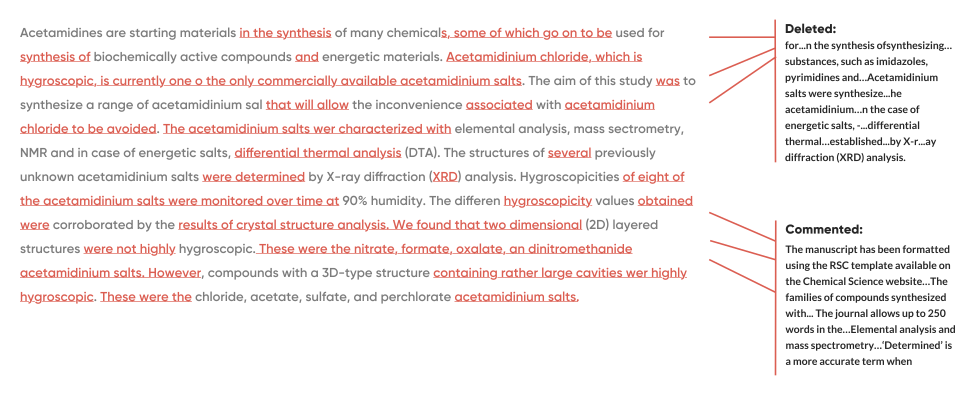
- Firstly, peer review is a filter for the rigorous evaluation of research manuscripts. Experts in the field, known as peers, evaluate the submitted manuscripts for their scientific merit, methodology, logical coherence, and adherence to ethical guidelines. This process helps identify and eliminate errors, biases, or unsupported claims, thereby enhancing the overall quality of published research.
- Secondly, peer review fosters scientific collaboration and knowledge exchange. Reviewers provide constructive feedback and suggestions for improvement, which can help authors refine their work. This iterative process allows researchers to address shortcomings, strengthen their arguments, and ensure clarity in their findings. Additionally, reviewers’ critical insights can inspire further research avenues and shape future scientific endeavors.
- Furthermore, peer review upholds the credibility and reputation of scientific publications. By subjecting manuscripts to rigorous evaluation by independent experts, the peer review process enhances the trustworthiness of published research. It safeguards against fraudulent or flawed research, preventing the dissemination of inaccurate or misleading information.
In conclusion, manuscript peer review is of utmost significance in scientific research. It ensures the quality and integrity of published work, facilitates collaboration and knowledge exchange, and upholds the credibility of scientific publications. The process benefits authors by improving their manuscripts and serves the scientific community and society at large by advancing knowledge and promoting evidence-based decision-making.
Connect with us to explore how we can support you in maintaining academic integrity and enhancing the visibility of your research across the world!
Conclusion:
Tablet manufacture is shown significantly increase the likelihood of tablet defects through breakage of tablets. Increasing tablet tensile strength provides some resistance to defects upon impact. The remedies are change the solvent system, change the binder, reduce drying temperature and use a smaller particle size, improperly mixed dye especially during direct compression. Mix it properly and reduce size if it is of a larger size to prevent segregation. Tablets are widely used dosage forms but defects in aesthetic appearance may lead to rejection of their administration by patient. Be careful during manufacturing process. The cost vs benefit equation mainly focuses on the pharmaceutical innovations which will be an integral part to address this challenge. The adequacies of drug benefit programs and policies that foster investment in newer medicines pay way for the new pharmaceutical environment.
References
Kelly J, Sadeghieh T, Adeli K. Peer Review in Scientific Publications: Benefits, Critiques, & A Survival Guide. EJIFCC. 2014 Oct 24;25(3):227-43. PMID: 27683470; PMCID: PMC4975196.