Contents
On this page
- Quick answer
- What is a statistical analysis plan? SAP vs protocol
- Statistical analysis plan components for clinical trials
- Estimands, intercurrent events and missing data
- Sample size, interim analyses and safety
- Programming specifications and ADaM traceability
- What reviewers flag in a statistical analysis plan
- When to finalise a statistical analysis plan
- Statistical analysis plan template and QC checklist
- Conclusion
- Frequently asked questions
- Sources
AcademyBiostatistics and Statistical Programming Services
Guide
What Goes in a Statistical Analysis Plan, and What Reviewers Flag
A review-ready statistical analysis plan turns protocol commitments into analyses that can be reproduced before unblinding. Here are the components, a worked example and the gaps reviewers flag most.
- Biostatistics
- Clinical trials
- Statistical analysis plan
- Finalise
- Before unblinding
- Estimand attributes
- Five, per ICH E9(R1)
- Content framework
- 55 items (Gamble et al.)
- Top reviewer flag
- Vague or post-hoc methods
At a glanceBiostatistics and Statistical Programming Services
Explore biostatistics and statistical programming servicesDiscuss your project
Quick answer
- The protocol says what the trial measures; the SAP says exactly how it will be analysed.
- Define estimands, populations, models, missing-data and multiplicity rules before unblinding.
- Link every derived variable to its ADaM source and output table.
What is a statistical analysis plan? SAP vs protocol
A statistical analysis plan (SAP) translates protocol commitments into analyses that can be reproduced before unblinding. The protocol describes objectives, design, eligibility and endpoints; the SAP specifies estimands, analysis populations, models, missing-data procedures and reporting rules. That is the core of SAP vs protocol: protocol amendments change how the trial is run, while SAP amendments change how it is analysed, and both need documented approval.
Throughout this article, a hypothetical antihypertensive trial, with change in systolic blood pressure from baseline to Week 12 as the primary endpoint, illustrates each decision. The protocol names the outcome and time point; the SAP states the change score, population, covariates and contrast.
Statistical analysis plan components for clinical trials
The statistical analysis plan components below are those reviewers check first.
Objectives, hypotheses and populations. State the objectives, endpoint hierarchy, treatment comparison, significance level, power and assumptions, and align the hypothesis with the primary estimand. Define populations operationally: under intention-to-treat (ITT), participants are analysed as randomised; a full analysis set (FAS) may approximate ITT with justified exclusions; the per-protocol set applies predefined adherence criteria; the safety set usually includes dosed participants, analysed by treatment received. Define protocol deviations before unblinding.
Endpoint analyses. Specify each endpoint’s method, treatment effect, covariates, contrast, assumptions and reporting (Table 1). For the Week 12 example, ANCOVA models baseline-adjusted change and reports the adjusted mean difference with its confidence interval. A mixed model for repeated measures (MMRM) includes treatment, visit, their interaction and baseline; prespecify the covariance structure and a fallback if the model fails to converge, rather than choosing a structure after seeing results.
Table 1. Statistical analysis plan example: endpoint types and what the SAP must specify
| Endpoint | Possible method | Essential SAP specifications |
|---|---|---|
| Continuous | ANCOVA | Change, baseline covariate, adjusted mean difference and confidence interval |
| Repeated continuous | MMRM | Treatment, visit, interaction, covariance structure and convergence |
| Binary | Logistic regression | Outcome coding, covariates, odds ratio and sparse-data strategy |
| Time-to-event | Cox model | Event, censoring, time origin, hazard ratio and proportional hazards |
| Count | Poisson or negative binomial | Distribution, exposure offset, overdispersion and rate ratio |
Estimands, intercurrent events and missing data
An SAP in clinical trials must say how post-randomisation events affect the treatment effect. ICH E9(R1) describes an estimand through five attributes: population, treatment, variable (endpoint), handling of intercurrent events and population-level summary3.
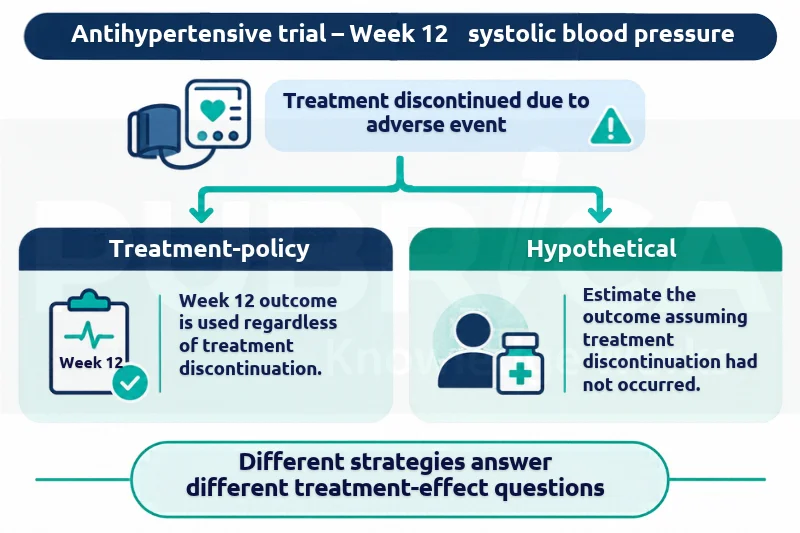
Suppose a participant stops treatment because of an adverse event before Week 12. Under a treatment-policy strategy, the Week 12 value is used regardless of discontinuation. Under a hypothetical strategy, the analysis estimates the outcome as if discontinuation had not occurred (Figure 1). The two answer different clinical questions, so the SAP should justify its choice.
Discontinuation is an intercurrent event; a missing Week 12 measurement is a missing-data problem. For repeated measures, MMRM is a common primary analysis under a missing-at-random assumption. If multiple imputation is used, document the imputation model, variables and pooling. Sensitivity analyses, such as delta adjustment or a tipping-point analysis, should test departures from the primary assumption13.
Get a review-ready statistical analysis plan
Pubrica supports SAP development and review, estimand consultation, sample-size calculations, missing-data planning, programming specifications, TLF development and statistical QC.
Sample size, interim analyses and safety
Align the sample-size calculation with the primary estimand and analysis. For continuous endpoints, state the target difference, standard deviation, significance level, power, allocation ratio and expected dropout; for time-to-event endpoints, the target hazard ratio, required events, accrual and follow-up. For interim analyses, define timing, information fraction, stopping boundaries and how alpha is spent, plus data monitoring committee access to unblinded data2. For safety, define treatment-emergent adverse events, the coding dictionary and version, the observation period and denominators2.
Programming specifications and ADaM traceability
Define analysis datasets and derivations. ADSL holds subject-level information such as treatment and population flags; Basic Data Structure (BDS) datasets support parameter- and visit-level analyses through variables such as PARAMCD, AVISIT, BASE and CHG. For the Week 12 change, trace the source assessment, baseline selection and CHG derivation to the model and the output table. Our guide to SDTM vs ADaM works through a baseline example, and TLFs in clinical trials shows how outputs map back to the SAP.
What reviewers flag in a statistical analysis plan
Vague or post-hoc specifications. “Appropriate tests will be applied” cannot be executed. Name the model, covariates, contrast and diagnostics, and define subgroups before comparative results are seen (Table 2)1.
Protocol–SAP discrepancies. Reconcile endpoints, assessment times, populations or sample-size assumptions that differ, decide whether a protocol amendment is needed, and keep dated approvals.
Weak missing-data, multiplicity or sensitivity strategies. Excluding participants with missing outcomes can bias results. Where there are several confirmatory endpoints, define the testing families and control the overall Type I error rate (family-wise error rate) with a prespecified method, such as Bonferroni, Holm, fixed-sequence (hierarchical) testing or gatekeeping4.
Incomplete programming and QC rules. Unclear derivations, visit windows, censoring or denominators produce inconsistent results. Specify independent programming and checks across the SAP, ADaM, TLF shells and clinical study report.
Table 2. Vague SAP wording that reviewers flag, and a more defensible version
| Weak specification | More defensible specification |
|---|---|
| Missing data will be handled appropriately. | State the assumption, method, model variables and sensitivity analyses. |
| Appropriate tests will be used. | Name the endpoint model, contrast, covariates and diagnostics. |
| Outliers will be assessed. | Define criteria; do not delete observations automatically. |
| Subgroups will be analysed. | Define variables, cut-offs and interaction tests. |
When to finalise a statistical analysis plan
ICH E9 expects the SAP to be finalised before the blind is broken, with the dates of finalisation and unblinding recorded2. Gamble and colleagues recommend writing it early, before data are collected, with the blind review as the last chance to amend it1. A blind review may reveal data-quality issues, but it must never be used to choose methods based on treatment differences. Record every amendment with its rationale and date.
Statistical analysis plan template and QC checklist
A statistical analysis plan template is only useful when every decision is explicit. Use Table 3 as a final check. Gamble and colleagues’ 55-item recommendations give a content framework rather than a regulatory checklist1; SPIRIT 20255 and CONSORT 20256 guide the protocol and the report, and neither replaces a full SAP.
Table 3. Statistical analysis plan template: quality-control checklist
| Quality check | What to verify |
|---|---|
| Objectives and endpoints | Definitions, hierarchy, estimand alignment and assessment times |
| Populations and deviations | ITT, FAS, PP, safety set and exclusion rules |
| Estimands | Five attributes and intercurrent-event strategies |
| Sample size | Effect, variability, power, significance, allocation and attrition |
| Endpoint analyses | Model, contrast, covariates, assumptions and diagnostics |
| Missing data | Primary assumption, method, alternatives and interpretation |
| Multiplicity and interim looks | Testing family, error control, timing and boundaries |
| Safety and subgroups | Event definitions, coding, denominators and interaction tests |
| Programming and outputs | ADaM derivations, software, TLF specifications and QC |
| Governance | Version, amendments, approvals and responsibilities |
Conclusion
A well-specified statistical analysis plan makes a trial’s analysis transparent and reproducible. Prespecifying estimands, models, missing-data strategies, multiplicity control and programming rules answers most reviewer questions before unblinding, rather than after.
Pubrica team verdict
Reviewers question what the SAP leaves open. Name every model, population, estimand strategy and derivation before unblinding, and keep a dated record of each change.
Frequently asked questions
A document that prespecifies a trial’s analyses: populations, estimands, methods, missing-data procedures, multiplicity control and reporting rules.
Translate protocol objectives into hypotheses, populations, estimands, endpoint models, sample-size assumptions, missing-data and multiplicity strategies and programming specifications, then approve it before unblinding.
Usually for vague methods, protocol inconsistencies, unsupported missing-data assumptions, weak sensitivity analyses, multiplicity errors or thin programming detail.
Sources
Sources were checked on 31 October 2026. Requirements and guidance may change after that date; confirm the current version with the issuing body.
- 1Gamble C, Krishan A, Stocken D, et al. Guidelines for the content of statistical analysis plans in clinical trials. JAMA. 2017;318(23):2337–2343. https://doi.org/10.1001/jama.2017.18556
- 2International Council for Harmonisation. E9: Statistical principles for clinical trials. 1998. https://www.fda.gov/media/71336/download
- 3International Council for Harmonisation. E9(R1): Addendum on estimands and sensitivity analysis in clinical trials. 2019. https://www.fda.gov/media/148473/download
- 4US Food and Drug Administration. Multiple endpoints in clinical trials: guidance for industry. 2022. https://www.fda.gov/media/162416/download
- 5Chan AW, Boutron I, Hopewell S, et al. SPIRIT 2025 statement: updated guideline for protocols of randomised trials. BMJ. 2025;389:e081477. https://doi.org/10.1136/bmj-2024-081477
- 6Hopewell S, Chan AW, Collins GS, et al. CONSORT 2025 statement: updated guideline for reporting randomised trials. BMJ. 2025;389:e081123. https://doi.org/10.1136/bmj-2024-081123
statistical analysis planstatistical analysis plan componentsSAP in clinical trialsSAP vs protocolstatistical analysis plan templatestatistical analysis plan example
How to cite this article
Pick your referencing style and copy it. Your university or target journal may vary the punctuation, so check its guide if it has one.
Dr. Charlie. (2026, October 31). What Goes in a Statistical Analysis Plan, and What Reviewers Flag. Pubrica. https://pubrica.com/academy/biostatistics-and-statistical-programming-services/statistical-analysis-plan-clinical-trial/
This article is written to be learned from. Cite it if you are referring to what it says; if you are using the evidence behind it, cite the sources listed above instead.
Next steps
Get a review-ready statistical analysis plan
Pubrica supports SAP development and review, estimand consultation, sample-size calculations, missing-data planning, programming specifications, TLF development and statistical QC.
This article is general information for researchers, not legal, regulatory or funding advice. Check the current requirements of your journal, funder, ethics committee or regulator before you act on it.
More in Biostatistics and Statistical Programming Services