Microbiota-supportive diets and hyperlipidemia: The mediating role of systemic inflammation
Poster presentation Sample Work
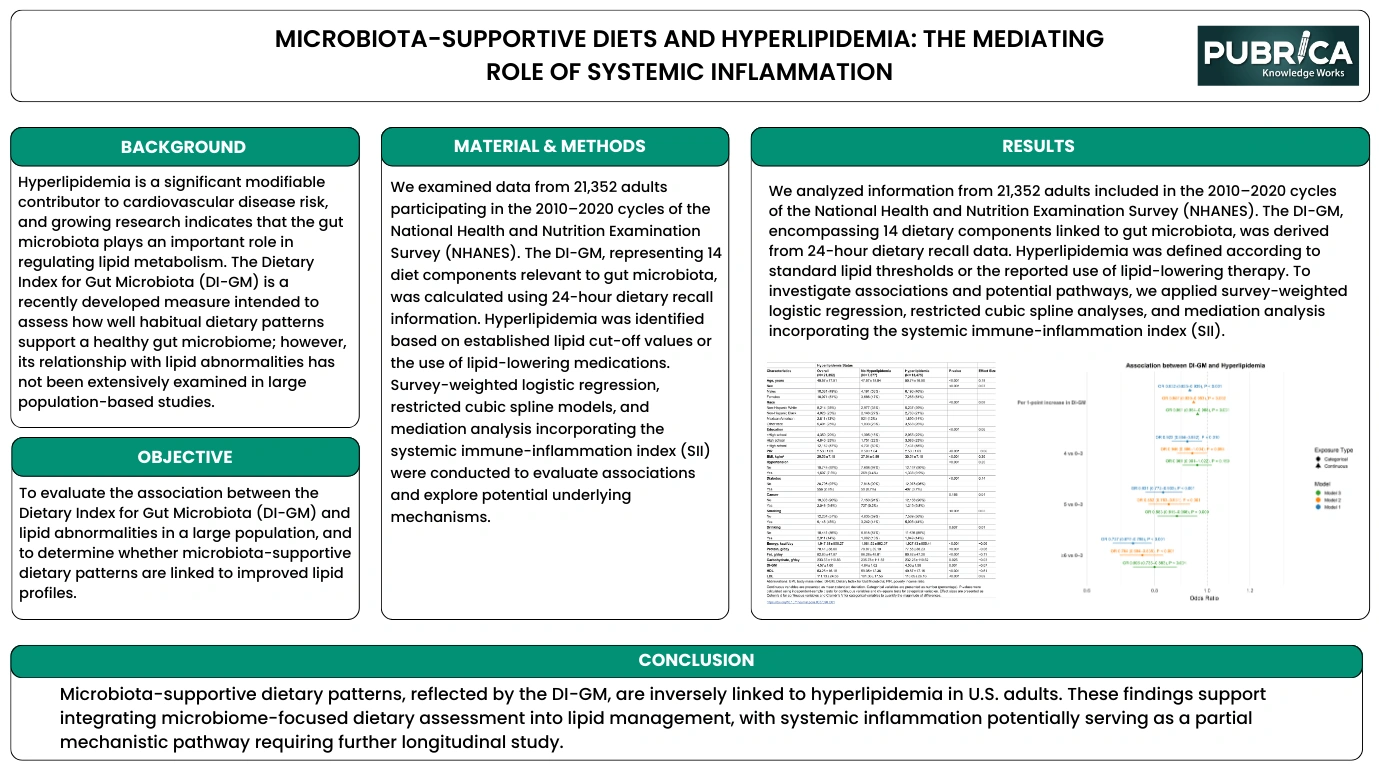
This poster presents a nationally representative cross-sectional analysis exploring the association between microbiota-supportive dietary patterns, measured by the Dietary Index for Gut Microbiota (DI-GM), and hyperlipidemia among U.S. adults. It visually summarizes adjusted risk estimates, dose–response relationships, and the potential mediating role of systemic inflammation to clarify underlying mechanisms. The aim is to concisely highlight the clinical and public health relevance of integrating microbiome-focused dietary assessment into lipid management and cardiovascular risk prevention strategies.
Diet, gut microbes and blood lipids: the hypothesis on display
Raised blood lipids are among the most modifiable contributors to cardiovascular risk, and diet is a first-line target for lowering them. A growing body of research suggests that the gut microbiota takes part in lipid metabolism, for example through bile acid handling and the production of short-chain fatty acids from dietary fibre. If that is so, dietary patterns that support a healthy microbiome might be associated with better lipid profiles, and low-grade systemic inflammation is one plausible link between the two.
This poster tests that idea in a large population sample. Its Background panel introduces the Dietary Index for Gut Microbiota (DI-GM), a recently developed score of how well habitual diet supports the gut microbiome, and notes that its relationship with lipid abnormalities had not been extensively examined in large population-based studies. The Objective panel then states two aims: to evaluate the association between DI-GM and lipid abnormalities, and to determine whether microbiota-supportive diets are linked to improved lipid profiles.
A national survey poster organised around one forest plot
The sample is a wide-format conference poster suited to nutrition, cardiology, lipidology or public health meetings. The left column stacks Background above Objective, the middle column is given entirely to Material & Methods, and the wide right column pairs a results paragraph with two visuals: a baseline characteristics table comparing participants with and without hyperlipidaemia, and a forest plot titled "Association between DI-GM and Hyperlipidemia". A full-width conclusion bar spans the foot of the board.
The forest plot is the poster's centrepiece. It presents odds ratios for a one-point increase in DI-GM and for higher score categories (4, 5 and 6 or more) compared with a reference of 0–3, each estimated under three progressively adjusted models distinguished by colour, with continuous and categorical exposures marked by different symbols. Estimates sit to the left of the line of no effect, consistent with the inverse association described in the conclusion.
What the Dietary Index for Gut Microbiota captures
The poster describes DI-GM as a score built from 14 dietary components relevant to the gut microbiota, calculated here from 24-hour dietary recall data. In general terms, such indices award points for foods and nutrients associated with a favourable microbial profile, such as fibre-rich and fermented foods, and subtract or withhold points for components associated with unfavourable profiles, such as processed and red meat or high-fat diets. A higher score therefore represents a more microbiota-supportive pattern.
Hyperlipidaemia was defined using established lipid cut-off values or reported use of lipid-lowering medication, a pragmatic definition common in survey research because it captures treated as well as untreated cases. The data come from 21,352 adults in the 2010–2020 cycles of the National Health and Nutrition Examination Survey (NHANES), a nationally representative programme combining interviews, examinations and laboratory testing in the United States.
Survey weights, spline curves and an inflammation index
The methods panel names three analytic steps, each answering a different question:
- Survey-weighted logistic regression estimates the odds of hyperlipidaemia across DI-GM levels while accounting for NHANES's complex sampling design, so that results reflect the US adult population rather than only the sample.
- Restricted cubic spline models examine whether the association changes shape across the range of DI-GM scores, rather than assuming a straight-line relationship; the page describes this as a dose–response analysis.
- Mediation analysis tests how much of the association might operate through the systemic immune-inflammation index (SII), a composite derived from platelet, neutrophil and lymphocyte counts on a routine blood count.
The conclusion reports that microbiota-supportive dietary patterns were inversely linked to hyperlipidaemia in US adults, and that systemic inflammation may be a partial mechanistic pathway requiring longitudinal study. It suggests integrating microbiome-focused dietary assessment into lipid management.
Cross-sectional evidence and the language of mediation
Cross-sectional studies are reported against the STROBE statement, and the poster covers the core items of setting, participants, exposure and outcome definitions, and statistical approach. Its conclusion is appropriately hedged, describing inflammation as a potential partial pathway. That caution matters: diet, inflammation and lipids were measured at the same time, so the data cannot establish their order, and mediation estimates from cross-sectional data indicate consistency with a pathway rather than proof of it. A single 24-hour recall may also misclassify habitual diet.
Authors reusing this design should also consider one presentational point. The results paragraph largely restates the methods; adding the headline adjusted odds ratio and the proportion mediated in the text would let delegates take away the key numbers without decoding the forest plot. Pubrica's poster preparation service works on this balance of text and figure, biostatistics support covers survey-weighted and mediation analyses, and a simplified abstract can explain the findings to non-specialist readers. This poster sample is not dietary or medical advice.
Questions about this sample
What data source does the poster use?
It analyses 21,352 adults from the 2010 to 2020 cycles of the US National Health and Nutrition Examination Survey (NHANES). Diet was assessed from 24-hour dietary recall, and hyperlipidaemia was defined by established lipid thresholds or reported use of lipid-lowering medication.
What is the systemic immune-inflammation index used in the mediation analysis?
The systemic immune-inflammation index is a marker calculated from routine blood count values, combining platelet, neutrophil and lymphocyte counts. The poster uses it to test whether part of the association between a microbiota-supportive diet and lower odds of hyperlipidaemia could operate through reduced systemic inflammation.
How should the forest plot on the poster be read?
Each point is an odds ratio with its confidence interval for hyperlipidaemia, shown for a one-point DI-GM increase and for score categories compared with the lowest group, under three adjustment models. Points to the left of the vertical line at 1 indicate lower odds with higher DI-GM scores.
Does the poster show that changing diet lowers cholesterol?
No. The study is cross-sectional, so it shows an inverse association between DI-GM and hyperlipidaemia at one point in time rather than an effect of changing diet. The conclusion calls for longitudinal research, and intervention trials would be needed to test whether improving DI-GM scores improves lipid levels.

Give yourself the academic edge today
Each order includes
- On-time delivery or your money back
- A fully qualified writer in your subject
- In-depth proofreading by our Quality Control Team
- 100% confidentiality, the work is never re-sold or published
- Standard 7-day amendment period
- A paper written to the standard ordered
- A detailed plagiarism report
- A comprehensive quality report
Enquire Now