Vertical Transmission of Gut Dysbiosis from Mothers with Gestational Diabetes to Infants
Poster presentation Sample Work
The establishment of the infant gut microbiome begins at birth and is strongly influenced by maternal microbial transfer. Disruptions in this early colonization process can have lasting effects on metabolic and immune health. Gestational Diabetes Mellitus (GDM) alters maternal gut microbial composition, potentially modifying vertical microbial transmission to the infant. Understanding these early microbiome changes is critical for identifying metabolic disease risk in early life.
How mothers seed the infant gut, and where gestational diabetes enters
The infant gut is colonised rapidly after birth, and a substantial share of the earliest microbes comes from the mother through delivery, close contact and feeding. Because this early community influences how the immune system and metabolism develop, factors that alter the maternal microbiome may be passed on. Gestational diabetes mellitus (GDM), defined as glucose intolerance first recognised in pregnancy, is associated with shifts in the maternal gut microbiota, and this poster asks whether those shifts are transmitted to the infant during the first six weeks of life.
The poster's Abstract panel frames the hypothesis clearly: GDM may disrupt normal vertical transfer and so increase the infant's metabolic risk. Its stated objective is to assess how maternal GDM affects infant gut microbiome development and the transfer of GDM-associated microbes.
A microbiome poster pitched at perinatal and metabolic audiences
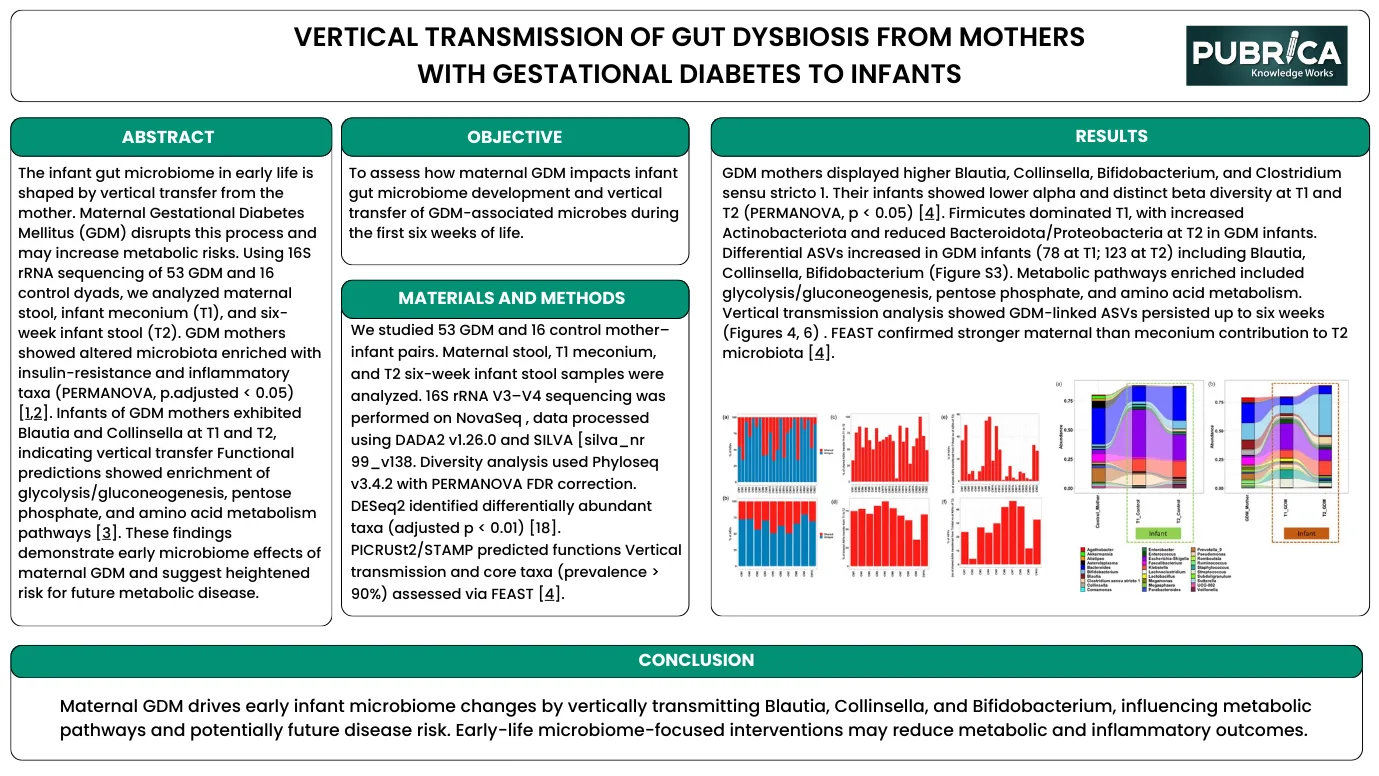
This sample is a horizontal scientific poster for a conference in maternal–fetal medicine, paediatrics, diabetes or microbiome research. Unlike posters that open with a background section, it leads with a compact abstract, so a delegate who reads only the left column still gets the design, main findings and interpretation. The middle column carries the objective and an unusually technical methods panel; the wide right column holds the results text above a set of multi-panel figures; and a full-width conclusion bar closes the page.
The figures combine six small bar-chart panels (labelled a to f) with two alluvial-style abundance plots that trace genus-level composition from mother to infant meconium to six-week stool, one for control dyads and one for GDM dyads, with the infant time points boxed for emphasis.
Decoding the sequencing workflow in the methods panel
The methods panel lists a full bioinformatic pipeline in a few lines. For readers outside microbiome science, each component has a specific role:
- Samples: maternal stool, infant meconium (T1) and six-week infant stool (T2) from 53 GDM and 16 control mother–infant pairs.
- 16S rRNA V3–V4 sequencing on a NovaSeq platform, which profiles bacteria by a marker gene rather than sequencing whole genomes.
- DADA2 and the SILVA database to resolve amplicon sequence variants (ASVs) and assign taxonomy.
- Phyloseq with PERMANOVA to compare community diversity between groups, with false discovery rate correction.
- DESeq2 to identify differentially abundant taxa at an adjusted p below 0.01.
- PICRUSt2 and STAMP to predict functional pathways from the 16S data.
- FEAST to estimate how much of the infant community derives from maternal or meconium sources, with core taxa defined at over 90% prevalence.
Listing software versions, as this panel does, supports reproducibility, a point microbiome reviewers routinely check.
Diversity, shared taxa and source tracking in the results
The Results panel reports that GDM mothers had higher levels of Blautia, Collinsella, Bifidobacterium and Clostridium sensu stricto 1. Their infants showed lower alpha diversity (fewer or less evenly distributed taxa) and distinct beta diversity (different overall composition) at both T1 and T2, with PERMANOVA p below 0.05. Firmicutes dominated at T1, and GDM infants showed more Actinobacteriota and fewer Bacteroidota and Proteobacteria at T2.
Differentially abundant ASVs increased in GDM infants, 78 at T1 and 123 at T2, including Blautia, Collinsella and Bifidobacterium. Predicted functions enriched in this group included glycolysis and gluconeogenesis, the pentose phosphate pathway and amino acid metabolism. Vertical transmission analysis indicated that GDM-linked ASVs persisted to six weeks, and FEAST attributed a stronger maternal than meconium contribution to the T2 community. The conclusion states that maternal GDM drives early infant microbiome change through transmission of these genera and suggests that microbiome-focused interventions early in life may reduce later metabolic and inflammatory outcomes.
Careful claims and legible figures in microbiome reporting
Microbiome studies have their own reporting guideline, STORMS, which asks authors to describe sampling, sequencing, bioinformatics and statistics in detail and to interpret findings cautiously. Two cautions apply when reading this poster. First, functional pathways from PICRUSt2 are predictions inferred from marker genes, not measurements of gene expression or metabolites. Second, the design is observational with an unbalanced comparison (53 versus 16 dyads), so wording such as "drives" is stronger than association alone can support; a full paper would typically address delivery mode, feeding and antibiotic exposure as potential confounders.
On the design side, the six small bar panels carry axis labels too small to read at poster distance, so authors adapting this layout may choose two or three enlarged panels. Pubrica's poster preparation service balances data density against legibility, a graphical abstract can turn the mother-to-infant transfer into a single visual, and scientific editing can calibrate causal language before submission. This page is a poster sample and does not offer medical advice on gestational diabetes or infant care.
Questions about this sample
What do T1 and T2 refer to on the poster?
T1 is the infant's meconium, the first stool passed after birth, and T2 is infant stool collected at six weeks. Comparing these with maternal stool lets the authors track which bacteria appear in the infant early and whether GDM-associated taxa persist through the first six weeks of life.
Which bacteria does the poster link with maternal gestational diabetes?
GDM mothers showed higher Blautia, Collinsella, Bifidobacterium and Clostridium sensu stricto 1. Blautia, Collinsella and Bifidobacterium were also found among the differentially abundant variants in their infants at both time points, which the authors interpret as evidence of vertical transmission.
What is FEAST and why is it used here?
FEAST is a source-tracking method that estimates what proportion of a microbial community comes from candidate sources. In this poster it was used to compare maternal and meconium contributions to the six-week infant microbiome, and it indicated a stronger maternal contribution.
Are the metabolic pathway findings directly measured?
No. The pathways, including glycolysis and gluconeogenesis, pentose phosphate and amino acid metabolism, were predicted from 16S rRNA data using PICRUSt2 and compared with STAMP. They indicate likely functional potential rather than measured gene activity or metabolite levels, which would require metagenomic or metabolomic analysis.

Give yourself the academic edge today
Each order includes
- On-time delivery or your money back
- A fully qualified writer in your subject
- In-depth proofreading by our Quality Control Team
- 100% confidentiality, the work is never re-sold or published
- Standard 7-day amendment period
- A paper written to the standard ordered
- A detailed plagiarism report
- A comprehensive quality report
Enquire Now