Liraglutide Weight Loss in Treated Hypothyroidism
Poster presentation Sample Work
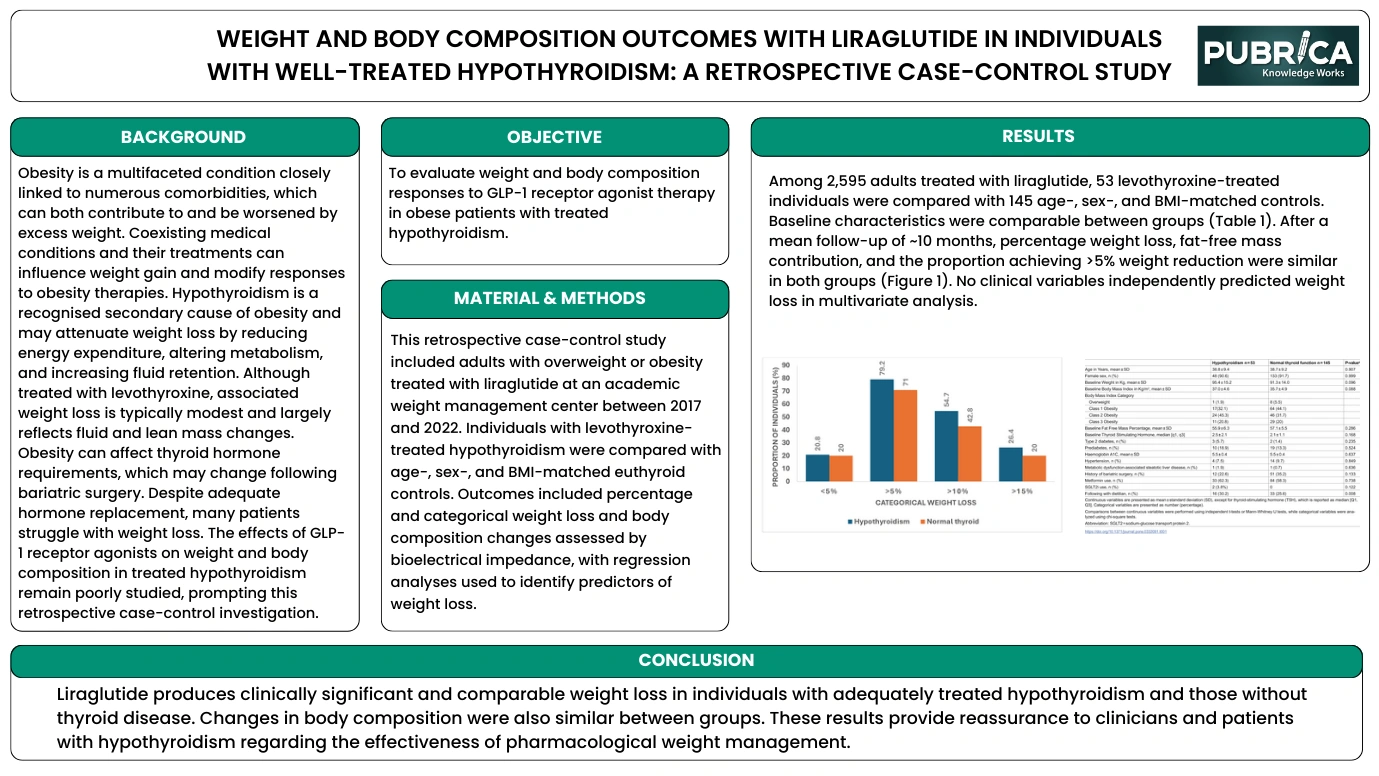
A one-page poster for a retrospective case-control comparison
This sample is a wide-format conference poster summarising a retrospective case-control study of liraglutide for weight management in adults with obesity and levothyroxine-treated hypothyroidism. It is designed for an endocrinology, diabetes or obesity meeting, where delegates typically spend a minute or two at each board, and its purpose is to answer one practical question quickly: do people with adequately treated hypothyroidism lose as much weight on a GLP-1 receptor agonist as people without thyroid disease?
The layout uses a full-width title banner, three content columns and a full-width conclusion bar. Teal section headers separate Background, Objective, Material & Methods, Results and Conclusion, and the results column holds both a grouped bar chart and a baseline characteristics table.
Thyroid replacement, energy balance and GLP-1 receptor agonists
The Background panel sets out the clinical reasoning with care. Hypothyroidism is a recognised secondary cause of weight gain, and the poster notes that it may attenuate weight loss by reducing energy expenditure, altering metabolism and promoting fluid retention. Weight loss after starting levothyroxine is usually modest and reflects mainly fluid and lean mass changes, and many patients struggle with weight even when hormone replacement is adequate. The relationship also runs the other way: obesity can affect thyroid hormone requirements, which may change after bariatric surgery.
GLP-1 receptor agonists such as liraglutide reduce appetite and food intake and are widely used in obesity management. Whether treated hypothyroidism modifies their effect has been little studied, which is the gap the poster's objective addresses: to evaluate weight and body composition responses to GLP-1 receptor agonist therapy in patients with obesity and treated hypothyroidism.
What each column of the poster reports
Methods column. Adults with overweight or obesity treated with liraglutide at an academic weight management centre between 2017 and 2022 were eligible. Those with levothyroxine-treated hypothyroidism were compared with age-, sex- and BMI-matched euthyroid controls. Outcomes were percentage and categorical weight loss and changes in body composition measured by bioelectrical impedance, with regression analysis to identify predictors of weight loss.
Results column. From 2,595 adults treated with liraglutide, 53 levothyroxine-treated individuals were compared with 145 matched controls, with comparable baseline characteristics (Table 1). After a mean follow-up of about ten months, percentage weight loss, the contribution of fat-free mass to weight lost and the proportion achieving more than 5% weight reduction were similar between groups, and no clinical variable independently predicted weight loss in multivariable analysis. The bar chart shows the proportion of each group reaching weight-loss thresholds:
| Weight loss | Hypothyroidism (%) | Normal thyroid (%) |
|---|---|---|
| <5% | 20.8 | 20 |
| >5% | 79.2 | 71 |
| >10% | 54.7 | 42.8 |
| >15% | 26.4 | 20 |
Conclusion bar. Liraglutide produced clinically meaningful and comparable weight loss, with similar body composition changes, in both groups, which the authors present as reassurance for clinicians and patients.
Interpreting matched controls and a "no difference" finding
Retrospective case-control studies are reported against the STROBE statement, and several STROBE items are visible even in this condensed format: the setting and dates, eligibility, the matching variables, the source population size, outcome definitions and the analytic approach. Matching on age, sex and BMI reduces confounding by the factors most likely to influence weight loss, and bioelectrical impedance adds information on whether weight lost was fat or lean tissue.
Readers should also recognise the limits of the design. A finding of similar outcomes in 53 cases and 145 controls indicates no detectable difference rather than formal equivalence, and the bar chart's numerically higher proportions in the hypothyroidism group at each threshold would need a larger sample to interpret. Single-centre, retrospective data may also be affected by treatment adherence and missing follow-up. A poster has little room for such caveats, but a short limitations line or a QR code linking to fuller methods can supply them.
Adapting the layout for a clinical database or audit poster
The design suits any study drawing a comparison group from routine clinical data. Useful features to reuse include the one-sentence objective placed high in the middle column, a results paragraph that states the sample size and main comparison before any figure, and a chart showing categorical thresholds that clinicians recognise (5%, 10% and 15% weight loss). The baseline table is set in very small type, so authors adapting the format may prefer to show only key variables on the poster and provide the full table as a handout.
Pubrica's poster preparation service handles layout, figure design and text condensation for conference boards, and biostatistics support can advise on matching and regression approaches for retrospective comparisons. Results can later be expanded into a full paper with physician manuscript writing. This page presents a poster sample and is not prescribing advice on weight management medicines.
Questions about this sample
How many patients does the poster compare?
From 2,595 adults treated with liraglutide at an academic weight management centre between 2017 and 2022, the study compared 53 people with levothyroxine-treated hypothyroidism against 145 euthyroid controls matched for age, sex and BMI. Baseline characteristics were comparable between the two groups, as summarised in the poster's Table 1.
How was body composition measured in the study?
The Methods panel states that body composition changes were assessed using bioelectrical impedance. This allowed the authors to compare the contribution of fat-free mass to total weight lost, which the Results panel reports as similar in patients with treated hypothyroidism and in matched controls.
What does the bar chart on the poster show?
It shows the proportion of each group reaching categorical weight loss thresholds. More than 5% weight loss was achieved by 79.2% of the hypothyroidism group and 71% of controls; more than 10% by 54.7% and 42.8%; and more than 15% by 26.4% and 20% respectively.
Does the poster show that liraglutide works better in hypothyroidism?
No. Although proportions in the chart are numerically higher in the hypothyroidism group, the poster reports that weight loss outcomes were similar between groups and that no clinical variable independently predicted weight loss. Its conclusion is one of comparable effectiveness, not superiority.

Give yourself the academic edge today
Each order includes
- On-time delivery or your money back
- A fully qualified writer in your subject
- In-depth proofreading by our Quality Control Team
- 100% confidentiality, the work is never re-sold or published
- Standard 7-day amendment period
- A paper written to the standard ordered
- A detailed plagiarism report
- A comprehensive quality report
Enquire Now