Contents
InsightsManuscript Editing
Workflow
The Manuscript Editing Workflow, Mapped: Who Does What, and How Long Each Stage Takes
Eight stages from intake to delivery, the editorial roles behind them and indicative durations, so you can plan your submission date around the editing process.
- Manuscript editing
- Flowchart
- Turnaround time
- Stages
- 8, from intake to delivery
- Editor-side time
- About 3.5–8 working days
- Author review
- 2–5 working days, your clock
- Final say
- Always the author
At a glanceManuscript Editing
Explore manuscript editingDiscuss your project
Quick answer
- The editing process runs in eight stages: intake, assessment and style sheet, first pass, second pass, author review, revisions, quality check and final proofread, then delivery.
- Editors own the editing passes; the author owns the content and approves every change.
- The editor-side stages take about 3.5–8 working days in total; author review adds 2–5 days that depend on you.
Overview
A clear editing process shows authors what happens to their manuscript, who is responsible at each point and where their own input is needed. The manuscript editing workflow below maps eight stages, the roles involved and indicative durations, so you can plan submission dates with realistic turnaround time.
The stages follow common editorial practice, including the editing and proofreading steps described in the AMA Manual of Style1. For what happens inside the editing passes, see copyediting a research manuscript; to start a project, see our manuscript editing service.
The Editing Process at a Glance
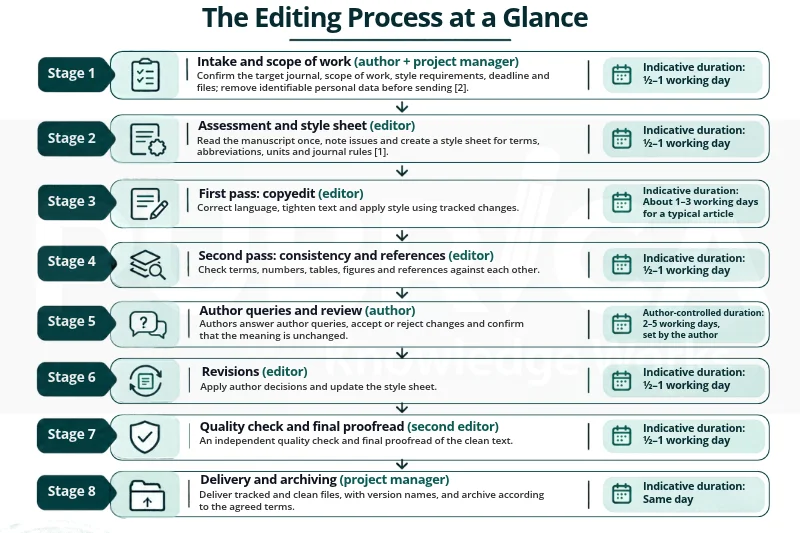
Table 1. Stages, owners and indicative durations
| Stage | Owner | What happens | Indicative duration |
|---|---|---|---|
| 1. Intake and scope of work | Author + project manager | Confirm the target journal, style requirements, deadline and files; share only the data the editor needs and remove patient identifiers where you can2 | ½–1 working day |
| 2. Assessment and style sheet | Editor | Read the manuscript once, note issues and set up a style sheet for terms, abbreviations, units and journal rules | ½–1 working day |
| 3. First pass: copyedit | Editor | Correct language, tighten text and apply the style in tracked changes | About 1–3 working days for a research article of typical length |
| 4. Second pass: consistency and references | Editor | Check terms, numbers, tables, figures and references against each other | ½–1 working day |
| 5. Author queries and author review | Author | Answer queries, accept or reject changes and confirm the meaning is unchanged | 2–5 working days, set by the author |
| 6. Revisions | Editor | Apply the author’s decisions and update the style sheet | ½–1 working day |
| 7. Quality check and final proofread | Second editor | An independent check and final proofread of the clean text | ½–1 working day |
| 8. Delivery and archiving | Project manager | Deliver the tracked-changes file (clean copy on request) with clear version names; archive under the agreed terms | Same day |
Added together, the editor-side stages take about 3.5–8 working days; with 2–5 days of author review, a typical project runs about one to three weeks end to end. These are planning ranges, not guarantees: the confirmed timeline is set when the scope of work is agreed. Package delivery times are listed on our manuscript editing service page.
Who Does What: Editorial Roles
Table 1. Typical editorial roles in a manuscript editing project.
| Role | Responsibilities | Decisions they own |
|---|---|---|
| Author | Provides the final text, answers queries, approves changes and checks the meaning | Content, data and conclusions |
| Project manager | Scopes the job, sets the schedule and handles files and communication | Timeline and delivery |
| Copyeditor (subject and language editor) | Edits language, consistency, style and references | Wording within the author’s meaning |
| Second editor / proofreader (independent reviewer) | Independent quality check and final proofread | Final corrections of residual errors |
Need your manuscript copyedited to journal style?
Pubrica’s editors copyedit research manuscripts for language, consistency, journal and AMA style, references and tables, with every change in tracked changes for you to accept or reject. Authors keep control of the content and conclusions, and no editing service can guarantee acceptance.
How Long Each Stage Takes
Table 2. Factors that change the length of editing stages.
| Factor | Shortens the stage | Lengthens the stage |
|---|---|---|
| Length and complexity | Short, single-topic paper | Long paper with many tables and references |
| Condition of the draft | Final, consistent text | Several drafts or unresolved sections |
| Authors involved | One corresponding author | Many co-authors commenting separately |
| Style requirements | One clear journal style | Unclear or conflicting instructions |
| Deadline | Flexible | Rush request with limited editors |
The author review stage is usually the least predictable because it depends on the author’s schedule. Authors should also read the paper once more and check the journal’s requirements before submission3.
Keeping Control of Changes
Work in tracked changes so every edit can be accepted or rejected; ask for a clean copy as well if you need one.
Name versions clearly (for example, v1 original, v2 edited, v3 author-approved) for version control.
Answer author queries in one pass, in the document, rather than in separate emails.
Keep the final decision on meaning with the authors; editors suggest, authors approve.
Confidentiality in the Workflow
Manuscripts can contain unpublished data and, in case reports or datasets, personal health data. Share only what the editor needs, remove identifiers where possible, and read our guide on GDPR Article 9 and manuscript editing for what to check2. Pubrica’s editors work under confidentiality terms agreed at scoping.
Conclusion
A mapped editing process gives authors clear roles and realistic timing: most stages sit with the editors, while the author review stage depends on you. Plan the deadline around that stage, agree the scope of work first, and keep versions clean. Ready to start? Contact our manuscript editing service.
Pubrica team verdict
Most of the time an editing project loses is in the author review stage, so book that time in your calendar before the manuscript goes out.
Frequently asked questions
Sources
Sources were checked on 12 November 2026. Requirements and guidance may change after that date; confirm the current version with the issuing body.
- 1JAMA Network Editors. (2020). AMA manual of style: A guide for authors and editors (11th ed.). Oxford University Press. https://doi.org/10.1093/jama/9780190246556.001.0001
- 2Regulation (EU) 2016/679 of the European Parliament and of the Council of 27 April 2016 on the protection of natural persons with regard to the processing of personal data and on the free movement of such data, and repealing Directive 95/46/EC (General Data Protection Regulation). (2016). Official Journal of the European Union, L 119, 1–88. https://eur-lex.europa.eu/eli/reg/2016/679/oj
- 3Kotz, D., & Cals, J. W. L. (2014). Effective writing and publishing scientific papers, part XI: Submitting a paper. Journal of Clinical Epidemiology, 67(2), 123. https://doi.org/10.1016/j.jclinepi.2013.10.004
editing processmanuscript editing workflowediting stageseditorial rolesturnaround timequality check
How to cite this article
Pick your referencing style and copy it. Your university or target journal may vary the punctuation, so check its guide if it has one.
Dr. Charlie. (2026, November 12). The Manuscript Editing Workflow, Mapped: Who Does What, and How Long Each Stage Takes. Pubrica. https://pubrica.com/insights/manuscript-editing/manuscript-editing-workflow/
This article is written to be learned from. Cite it if you are referring to what it says; if you are using the evidence behind it, cite the sources listed above instead.
Next steps
Need your manuscript copyedited to journal style?
Pubrica’s editors copyedit research manuscripts for language, consistency, journal and AMA style, references and tables, with every change in tracked changes for you to accept or reject. Authors keep control of the content and conclusions, and no editing service can guarantee acceptance.
This article is general information for researchers, not legal, regulatory or funding advice. Check the current requirements of your journal, funder, ethics committee or regulator before you act on it.
More in Manuscript Editing