UK Clinical Trials Regulations 2026: Your 12-Month Results Clock Now Collides With Your Publication Plan
High-Impact Journals
- What changed on 28 April 2026
- The clock runs from the global end of trial
- Ongoing trials: the 27 July 2026 cut-off
- The UK window is looser than ICMJE
- Will posting registry results block your paper?
- Lay summaries: who writes and who tests
- A deferral is not a pause
- The Pubrica T-12 Results Sequencing Map
- Five failure points to check now
- Plan your results and publication timeline
- FAQ
- References
Interesting topics
If your trial ends after 28 April 2026, you have twelve months from the global end of trial to post a results summary and offer participants a lay summary. Your journal paper has no such deadline, and its timing is not under your control. Most guidance explains the new duty. This article explains how it interacts with your manuscript, ICMJE checks and close-out plan.
What changed on 28 April 2026
The Medicines for Human Use (Clinical Trials) (Amendment) Regulations 2025 (SI 2025/538) came into force on 28 April 2026 and rewrote regulation 25 of the 2004 Regulations [1]. For clinical trials of investigational medicinal products (CTIMPs), the sponsor must:
- Register the trial in a public registry by the earlier of first recruitment or 90 days after approval (reg 25(1)).
- Publish a results summary within 12 months of the end of the trial (reg 25(2)).
- Offer a lay summary of the results to “relevant persons”, such as participants and their legal representatives, in the same period (reg 25(2)).
Failing to meet these duties without an approved deferral is an offence [1].
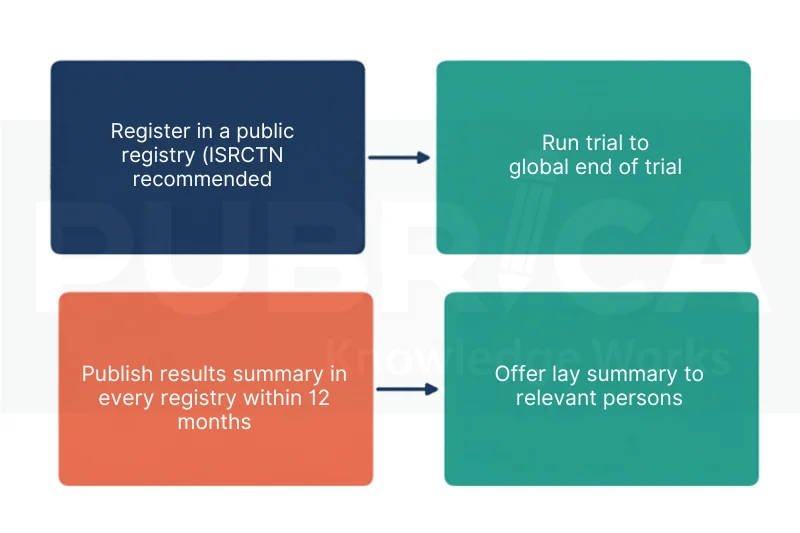
Source: Pubrica illustration based on SI 2025/538 and HRA guidance [1, 2].
The clock runs from the global end of trial
The HRA measures the 12 months from the global end of trial, not from the end of UK recruitment, last patient last visit or database lock [2]. For a multinational study, the UK deadline therefore depends on when the last site anywhere closes. For example, if UK sites close in late 2026 but the last overseas site closes in March 2027, the UK results are due by March 2028, not late 2027. Record the formal end-of-trial date in the trial master file and calculate the deadline from it.
Ongoing trials: the 27 July 2026 cut-off
Trials already running on 28 April 2026 follow transitional rules [3]:
| Trial status on 28 April 2026 | Registration | Results summary | Lay summary |
|---|---|---|---|
| Ended before that date | New duties do not apply | Not required | Not required |
| Ongoing (old-rules trial) | Within 90 days, i.e. by 27 July 2026 | Required, in the same registry | Encouraged, not required |
| Applied for on or after that date | reg 25(1) | Required | Required |
Phase 1 trials receive an automatic deferral if the sponsor registers the required minimum information by the deadline [3]. An old-rules trial that missed 27 July is out of compliance now. Register it and document the corrective action.
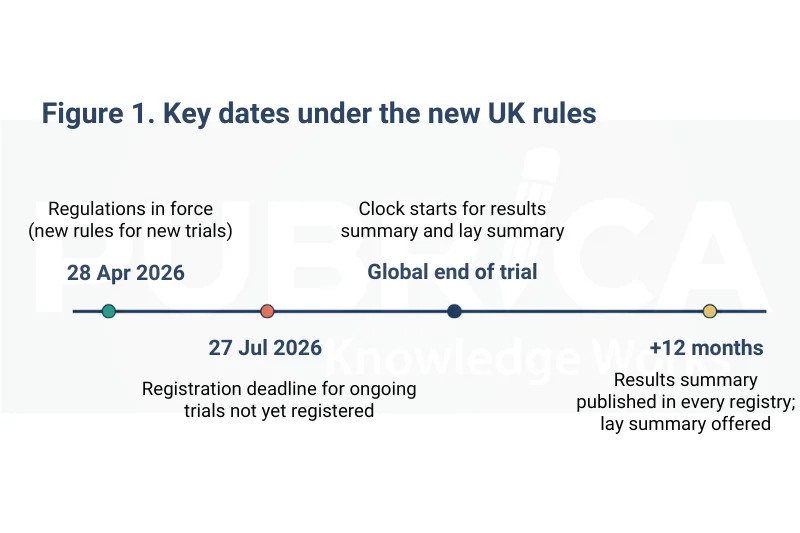
Source: Pubrica illustration based on SI 2025/538 and the transitional arrangements [1, 3].
The UK window is looser than ICMJE
The UK allows registration up to 90 days after approval, provided recruitment has not started. ICMJE journals require registration “at or before the time of first patient consent for enrollment” as a condition of considering the paper [4]. In practice the two coincide only if you register before recruitment begins. Register at approval and you satisfy both.
Will posting registry results block your paper?
Usually not. ICMJE does not treat results posted in a qualifying registry as prior publication “if results are limited to a brief structured abstract or tables” [4]. The ISRCTN results format matches that carve-out. It has four sections only: participant flow, baseline characteristics, outcome measures and adverse events [5]. Two practical consequences follow:
- Keep the registry summary tabular. Discussion, interpretation and new figures belong in the paper.
- A journal article alone does not meet the UK duty, so the registry summary must exist even if the paper is published first [5].
ICMJE journals also require a data-sharing statement in trial reports [4]. Draft it alongside the registry tables so the two say the same thing.
Lay summaries: who writes and who tests
The regulation requires a summary “written in a manner that is understandable to laypersons” [1]. It is a separate deliverable with its own drafting, review and distribution steps. Assign it to a named medical writer and have it checked for accuracy by the trial statistician. Test it with patient representatives before release. Plan how it reaches “relevant persons” (by post, through the site, or by a link given at consent), because the duty is to offer it, not just to post it.
A deferral is not a pause
Deferrals of up to 30 months are available, and waivers only in exceptional cases [1]. A deferral moves the posting date; it does not move your database lock, analysis or manuscript. Keep drafting on the normal timetable so the deferred posting is ready on time.
The Pubrica T-12 Results Sequencing Map
Work back from the legal deadline. The months below are Pubrica planning targets, not legal requirements.
| Month after global end of trial | Milestone | Check |
|---|---|---|
| M0 | Global end of trial confirmed | Date recorded; deadline calculated |
| M+2 | Database lock and top-line results | Primary outcome matches registry and protocol |
| M+4 | Registry results tables drafted | Four ISRCTN sections; tables only |
| M+6 | Manuscript submitted | Registry ID and data-sharing statement included |
| M+8 | Lay summary user-tested | Statistician sign-off; patient review |
| M+11 | Registry results posted; lay summary offered | Proof of submission kept for every registry |
| M+12 | Legal deadline | Evidence pack filed; HRA final report confirms publication |
The map separates the two outputs. The registry summary and lay summary finish on a fixed timetable, and the manuscript proceeds through peer review on its own.
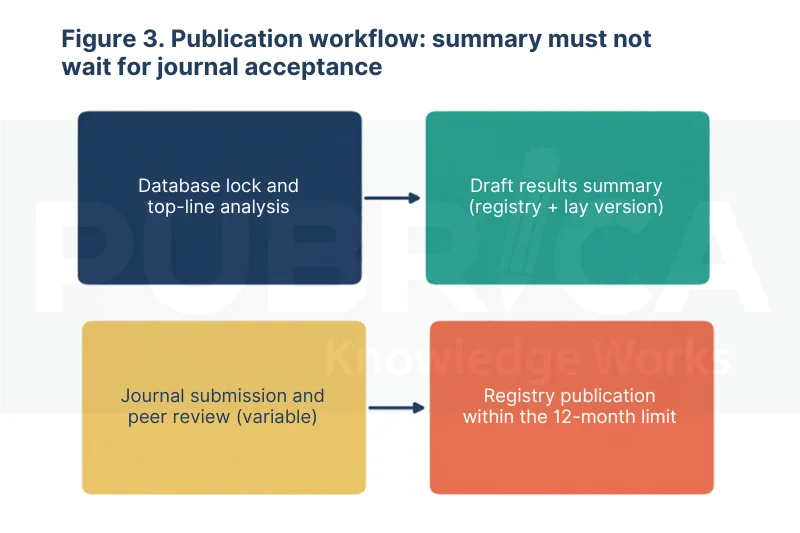
Source: Pubrica illustration. The registry summary does not wait for journal acceptance.
Five failure points to check now
- The deadline is counted from the UK end of trial instead of the global end.
- The registry summary waits for journal acceptance.
- A trial was registered after first consent, which is UK-compliant but fails ICMJE.
- The trial is listed in two registries, but results are posted in only one. The HRA expects results in each registry where the trial is registered [2].
- Nobody owns the lay summary, so it is written in month 11 and never tested.
Plan your results and publication timeline
If your trial ends after 28 April 2026, send us your global end-of-trial date and target journal. Pubrica’s medical writers will return a back-planned schedule for registry tables, lay summary and manuscript, and can draft all three. Explore Pubrica’s publication support.
Need your registry results, lay summary and manuscript planned against the 12-month deadline? Pubrica’s medical writers build the schedule and can draft all three.
Frequently Asked Questions
When must clinical trial results be published in the UK?
Under the 2026 rules, the sponsor must post a results summary in the public registry within 12 months of the global end of trial. In the same period it must offer participants a lay summary. Deferrals of up to 30 months are available on application.
Does posting results on ISRCTN count as prior publication?
No, for ICMJE journals, provided the posting is limited to a brief structured abstract or tables. ISRCTN results use four tabular sections, so a standard posting does not block your paper. Check each target journal’s own policy as well.
Do trials ongoing on 28 April 2026 need a lay summary?
No. Ongoing old-rules trials had to register by 27 July 2026 and must still post a results summary, but the lay-summary duty does not apply to them. Sponsors are encouraged to provide one anyway.
References
- The Medicines for Human Use (Clinical Trials) (Amendment) Regulations 2025, SI 2025/538, reg 25. https://www.legislation.gov.uk/uksi/2025/538
- Health Research Authority. Publishing trial results (research transparency requirements). Updated 28 April 2026. https://www.hra.nhs.uk/planning-and-improving-research/policies-standards-legislation/clinical-trials-investigational-medicinal-products-ctimps/clinical-trial-regulations-reform/guidance-on-changes-to-the-clinical-trials-regulations/research-transparency-requirements-for-clinical-trials/publishing-trial-results/
- MHRA/GOV.UK. Clinical trials for medicines: Clinical Trials Regulations transitional arrangements. https://www.gov.uk/guidance/clinical-trials-for-medicines-clinical-trials-regulations-transitional-arrangements
- ICMJE. Clinical trial registration (Recommendations, updated January 2026). https://www.icmje.org/recommendations/browse/publishing-and-editorial-issues/clinical-trial-registration.html
- ISRCTN. Guidance: results summaries. https://www.isrctn.com/page/guidance