Desk Rejection in 2026: A 5-Gate Pre-Submission Audit for German Research Teams
High-Impact Journals
- Desk rejection is a design verdict, not a language verdict
- What reviewers reject next
- The German context: DEAL and DFG
- CONSORT 2025 and SPIRIT 2025
- AI disclosure is now a gate
- The Pubrica 5-Gate Desk-Rejection Risk Audit
- Running the audit
- When an audit is not worth it
- Before you submit to your DEAL journal
- FAQ
- References
Interesting topics
A desk rejection usually arrives within days and rarely gives a reason. Many teams respond by sending the manuscript for language editing. The evidence suggests that is the wrong fix. This article sets out what editors actually reject and gives a five-gate audit to run before you submit.
Desk rejection is a design verdict, not a language verdict
Meyer and colleagues analysed 369 desk-rejected manuscripts at Academic Medicine [1]. An ineffective study question or design was cited in 92%, suboptimal data collection in 49% and a misaligned topic in 37%. Unclear writing appeared in only 24%, and most rejected papers had three or more problems. In a separate series of 898 rejection reports, the median time to a desk rejection was 3 days, against 42 days for rejection after peer review [2]. An editor can reach a design verdict quickly. Polished English does not change it.
What reviewers reject next
Papers that pass the desk face a different filter. In Bordage’s analysis of reviewer comments, the leading problems were inappropriate or poorly described statistics (11.2% of negative comments) and overinterpretation of results (8.7%) [3]. Overinterpretation is common. Boutron and colleagues found spin in more than 68% of abstracts of randomised trials with non-significant primary outcomes [4]. A pre-submission check that ignores statistics and spin misses what reviewers look for first.
The German context: DEAL and DFG
DEAL changes the cost of resubmission, not the risk of it. DEAL agreements with Elsevier, Springer Nature and Wiley cover hybrid open access for eligible corresponding authors. Publish-and-read fees are €2,550, €2,600 and €2,200–3,150 per article respectively, and gold APCs are discounted by 20% [5]. The APC is often covered. The real cost of a desk rejection is time.
The DFG rewards fewer, stronger papers. Since March 2023, DFG proposals list at most ten publications, and reviewers may not consider the journal impact factor or h-index [6]. The DFG Code (v1.2, January 2025) asks authors to choose the publication medium “with due regard for its quality and visibility” (Guideline 15) and sets authorship rules (Guideline 14) [7].
CONSORT 2025 and SPIRIT 2025
CONSORT 2025, published on 14 April 2025, replaces CONSORT 2010. It has a 30-item checklist with seven new items, three revised and one deleted, plus a new open-science section covering registration, protocol access and data sharing [8]. SPIRIT 2025 applies the same logic to protocols, with 34 items [9]. Editors now expect the report, protocol and registry entry to agree on the primary outcome and analysis plan. A mismatch is visible at triage.
AI disclosure is now a gate
Disclosure is rarely done voluntarily. In a manual check of 200 computer-science preprints from February 2024, only two disclosed LLM use [10]. The rules are now explicit:
- ICMJE (January 2026): describe AI use in the cover letter and in the manuscript. Put writing assistance in the acknowledgments and analysis use in the methods. Chatbots cannot be authors [11].
- DFG (statement of 21 September 2023): disclose which generative models were used, for what purpose and to what extent. Tools used only for grammar, spelling or translation need not be documented [12]. Journal rules may be stricter, so follow the stricter one.
- Publishers: Elsevier requires a separate declaration of generative AI use in manuscript preparation. Springer Nature asks for LLM use to be documented in the Methods, with AI-assisted copy-editing exempt [13, 14].
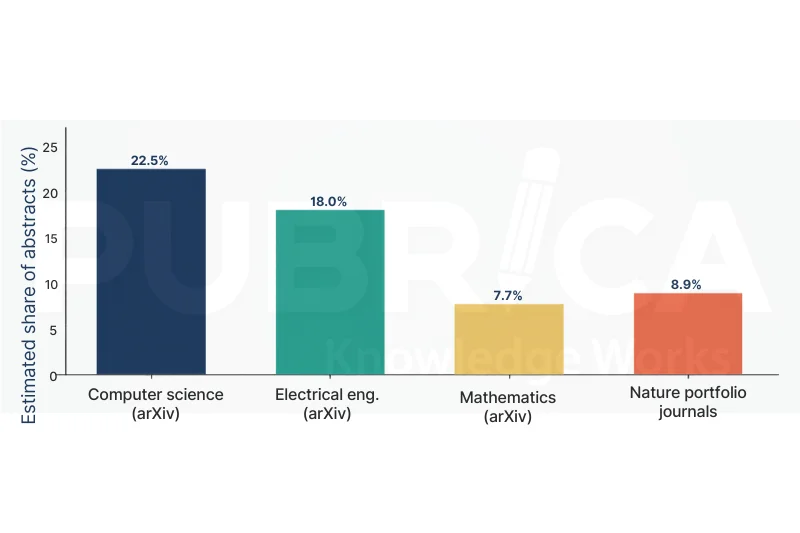
Estimated share of abstracts with LLM-modified content, by field, as reported by Liang et al. [10]. Estimates, not counts of individual papers.
The Pubrica 5-Gate Desk-Rejection Risk Audit
Score each gate red, amber or green. Any red gate means do not submit.
| Gate | Question | Red if… |
|---|---|---|
| G1 Fit and novelty | Does the paper match what the target journal published in the last 24 months, and is it covered by DEAL? | The topic is outside the journal’s recent content |
| G2 Design | Does the design, with this comparator, primary outcome and sample size, answer the question in the title? | The conclusion needs a design the study does not have |
| G3 Reporting | Is the right EQUATOR checklist (CONSORT 2025, SPIRIT 2025, STROBE, PRISMA 2020) complete, with page numbers? | Items are missing or the primary outcome differs from the registry |
| G4 Statistics and spin | Does the analysis follow the plan, and do the abstract’s conclusions follow from the primary outcome? | Secondary or subgroup results are presented as the main finding |
| G5 Policy and integrity | Are AI use, registration ID, data-sharing statement and CRediT roles in place? | AI use undisclosed, or trial registered after first enrolment |
Running the audit
Give each gate one owner and one evidence file:
- G1: the target journal’s contents from the last 24 months, with three comparable papers named.
- G2: one sentence stating what the study can and cannot show. If it cannot be written plainly, the paper is not ready.
- G3: the completed checklist with page numbers, with the registry entry and protocol side by side.
- G4: the statistical analysis plan beside the results, and the abstract’s conclusion checked against the primary outcome only.
- G5: the disclosure statement, data-sharing statement and CRediT table, checked against the journal’s instructions.
An amber gate means fix it before you submit; a red gate means rethink the claim or the journal. Score the gates again after the fixes. Run G2 and G4 with someone who did not write the paper, because authors are the least reliable judges of their own design and conclusions.
When an audit is not worth it
If G2 is red because the design cannot answer the question, no editing will fix it. The honest options are to narrow the claim or change the target journal. A case report or a pilot study needs a different checklist (CARE or the CONSORT pilot extension), so confirm the right one before starting.
Before you submit to your DEAL journal
Did any gate come back amber? Send us your manuscript and target journal. Pubrica’s PhD- and MD-qualified reviewers return a gate-by-gate audit, a completed reporting checklist and a reviewer-style report. See Pubrica’s pre-submission review.
Run the 5-gate audit before you submit. Pubrica’s reviewers return a gate-by-gate report, a completed reporting checklist and a reviewer-style critique.
Frequently Asked Questions
What is a desk rejection?
A desk rejection is an editor’s decision to reject a manuscript without sending it for external peer review, usually within days. In an analysis of 369 desk rejections, 92% cited an ineffective study question or design, and most papers had three or more problems.
Do I need to disclose using DeepL or a grammar checker?
Under the DFG statement, tools used only for grammar, spelling or translation need not be documented. ICMJE journals ask authors to describe writing assistance in the acknowledgments, so check the target journal’s policy and follow the stricter rule.
What changed in CONSORT 2025?
CONSORT 2025 is a 30-item checklist published on 14 April 2025. It adds seven items, revises three and deletes one, and introduces an open-science section covering trial registration, protocol access and data sharing. It replaces CONSORT 2010.
References
- Meyer HS, Durning SJ, Sklar DP, Maggio LA. Making the first cut: an analysis of Academic Medicine editors’ reasons for not sending manuscripts out for external peer review. Acad Med . 2018;93(3):464–470. doi:10.1097/ACM.0000000000001860
- Menon V, Varadharajan N, Praharaj SK, Ameen S. Why do manuscripts get rejected? A content analysis of rejection reports from the Indian Journal of Psychological Medicine. Indian J Psychol Med . 2022;44(1):59–65. doi:10.1177/0253717620965845
- Bordage G. Reasons reviewers reject and accept manuscripts: the strengths and weaknesses in medical education reports. Acad Med . 2001;76(9):889–896. doi:10.1097/00001888-200109000-00010
- Boutron I, Dutton S, Ravaud P, Altman DG. Reporting and interpretation of randomized controlled trials with statistically nonsignificant results for primary outcomes. JAMA . 2010;303(20):2058–2064. doi:10.1001/jama.2010.651
- DEAL Konsortium. Agreements (Elsevier, Springer Nature, Wiley). https://deal-konsortium.de/en/agreements
- DFG. Info für die Wissenschaft 22/61: research assessment in proposals. https://www.dfg.de/en/news/news-topics/announcements-proposals/2022/info-wissenschaft-22-61
- DFG. Guidelines for Safeguarding Good Research Practice, Code of Conduct, v1.2. 2025. doi:10.5281/zenodo.14281892
- Hopewell S, et al. CONSORT 2025 statement. BMJ . 2025;389:e081123. doi:10.1136/bmj-2024-081123
- Chan A-W, et al. SPIRIT 2025 statement. BMJ . 2025;389:e081477. doi:10.1136/bmj-2024-081477
- Liang W, et al. Quantifying large language model usage in scientific papers. Nat Hum Behav . 2025. doi:10.1038/s41562-025-02273-8
- ICMJE. Recommendations, updated January 2026. https://www.icmje.org/icmje-recommendations.pdf
- DFG Executive Committee. Statement on the influence of generative models of text and image creation on science and the humanities and on the DFG’s funding activities. 21 September 2023. https://wissenschaftliche-integritaet.de/en/use-generative-models/
- Elsevier. Generative AI policies for journals. https://www.elsevier.com/about/policies-and-standards/generative-ai-policies-for-journals
- Springer Nature. Editorial policies: artificial intelligence (AI). https://www.springernature.com/gp/policies/editorial-policies/artificial-intelligence–ai-/25428500