No Head-to-Head Trial for Germany? How to Build an Indirect Treatment Comparison That Can Survive IQWiG and AMNOG Scrutiny in 2026

No Head-to-Head Trial for Germany? How to Build an Indirect Treatment Comparison That Can Survive IQWiG and AMNOG Scrutiny in 2026

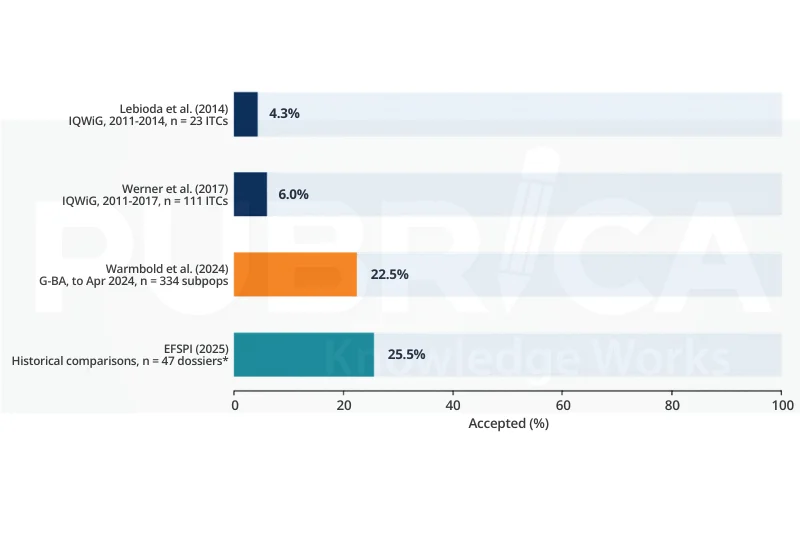
An indirect treatment comparison (ITC) survives German scrutiny only when the evidence network answers the German PICO first and the statistics second. Published analyses of German HTA assessments show that acceptance of indirect comparisons has historically been limited. In a 2024 analysis covering 334 assessed subpopulations, 22.5% of indirect comparisons were accepted by the G-BA, and the leading reasons are a comparator that differs from the G-BA’s appropriate comparator therapy (ACT), dissimilar study populations and unsuitable methods [10][11][12]. This guide is a decision tool, not an explainer: it shows when indirect evidence for Germany is defensible, when it is weak, and how to diagnose feasibility before any model is fitted.

Key takeaways for HEOR, market-access and biostatistics teams

Define the German PICO and the G-BA’s ACT before choosing a method; a wrong comparator ends the assessment regardless of model quality [2][10].

  • A connected network is necessary but not sufficient; it must also be clinically credible for the German subpopulations.
  • Bucher’s anchored comparison remains the German reference point; NMA is acceptable when transitivity and consistency are demonstrated [1][4].
  • Unanchored MAIC, STC and external controls behave like non-randomised comparisons and usually need very large effects to support added benefit [7][13].
  • Since January 2025, EU JCA runs alongside AMNOG for oncology and ATMPs; German-specific analyses can still be needed [3][15].

Scope: methods and requirements as published up to September 2026, including IQWiG General Methods Version 8.0 (December 2025) [1].

1. Start With the German Decision Question, Not the Statistical Model

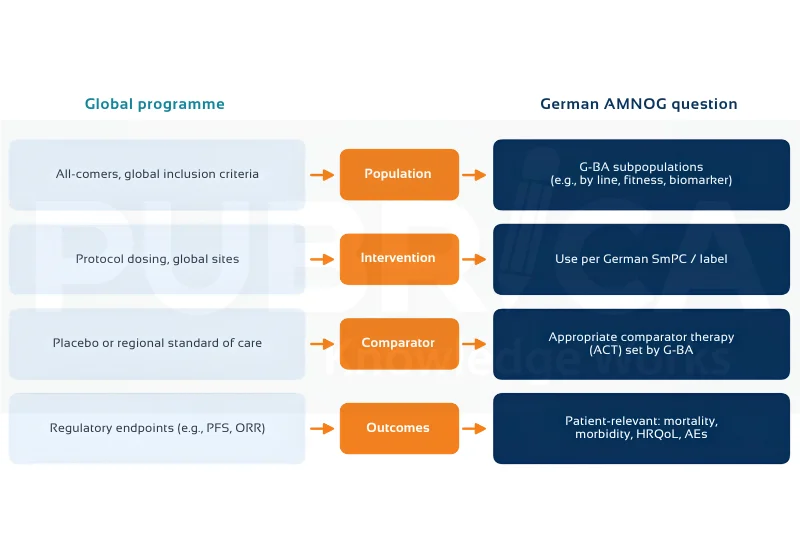
The first question in a German submission is not “which model?” but “added benefit over what, for whom, on which outcomes?”. Under §35a SGB V, the dossier must show added benefit against the appropriate comparator therapy (ACT) that the G-BA defines for each subpopulation . IQWiG then assesses patient-relevant outcomes: mortality, morbidity, health-related quality of life (HRQoL) and adverse events [1].

Every indirect comparison therefore inherits the German PICO. If the ACT, the subpopulation split or the outcome definition is wrong, the comparison is not assessed on its statistical merits at all. Lebioda et al. found that in 10 of 23 early ITCs, the manufacturer’s comparator differed from the G-BA’s ACT, and each of those comparisons was rejected [10].
treatment effect modifiers

2. Why a Strong Global Clinical Programme Can Still Produce a German Evidence Gap

A programme can satisfy EMA and FDA and still leave Germany without usable comparative data. Pivotal trials are designed for regulatory approval, usually against placebo or a multinational standard of care. The G-BA’s ACT reflects German practice and can differ from that trial comparator [2][15].

Four gaps recur in German dossiers:

  • Comparator gap: the trial control arm is not the ACT, or the ACT is used outside its German label.
  • Subpopulation gap: the G-BA splits the label population (for example, by prior therapy or fitness), and the trial is not powered or stratified for those splits.
  • Outcome gap: surrogate or regulatory endpoints are not accepted as patient-relevant without validation [1].
  • Timing gap: the most mature data cut used for Germany differs from the one used in publications or other markets [13].

An indirect comparison is usually the attempt to close the comparator gap. It cannot close the other three, which is why feasibility work must diagnose all four together.

3. First Decision: Is There a Connected and Clinically Credible Evidence Network?

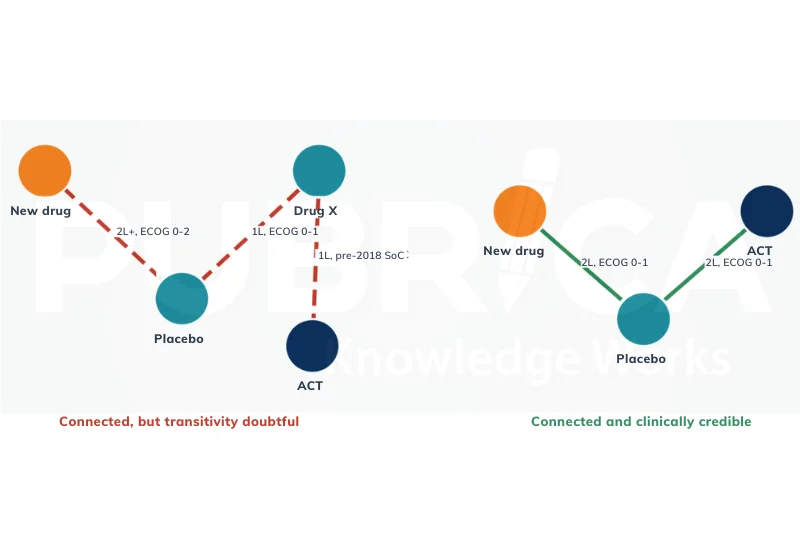
A network is connected when a chain of randomised comparisons links the new drug to the ACT. It is clinically credible only when the trials on each link enrol comparable patients, use comparable common comparators and measure comparable outcomes [5][14].

Connection is a graph property; credibility is a clinical judgement. A chain such as new drug → placebo → drug X → ACT can be fully connected yet join a second-line trial to first-line trials from an older standard-of-care era. Every added link multiplies the chance that an effect modifier differs across the chain.
IQWiG indirect treatment comparison

In analyses of German indirect comparisons, inadequate study similarity and other study-level methodological issues were among the most frequently reported reasons for rejection. In the Werner analysis, study similarity accounted for approximately 39.6% of reported rejection reasons, while statistical procedures accounted for approximately 25.2%  [12]. The practical rule: map the network from a systematic literature review, then prune links that are connected but not credible before any analysis.

4. Bucher Adjusted Indirect Comparison: When a Simple Anchored Network May Be Enough

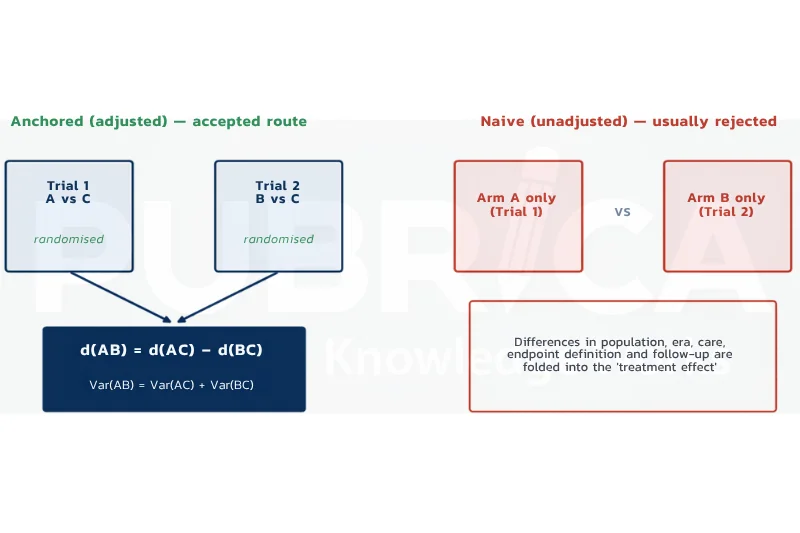
When one common comparator links the new drug (A) and the ACT (B), Bucher’s adjusted indirect comparison is the German reference method [4][10]. It subtracts the two relative effects against the shared comparator C, so each trial’s randomisation is preserved:

d_{AB} = d_{AC} – d_{BC}, \qquad \mathrm{Var}(d_{AB}) = \mathrm{Var}(d_{AC}) + \mathrm{Var}(d_{BC})
AMNOG indirect treatment comparison

The effect is estimated on a scale where effects are additive, such as the log hazard ratio or log odds ratio.

Bucher is often enough when three conditions are held: a single, identically administered common comparator; trials comparable on effect modifiers; and outcomes defined and measured the same way. Its main cost is precision. Because variances add, the indirect estimate is wider than either trial, and IQWiG’s certainty of results is typically downgraded for indirect evidence [1]. A small but real advantage can therefore translate into “added benefit not proven” simply because the confidence interval is too wide.

5. When Network Meta-Analysis Becomes Relevant

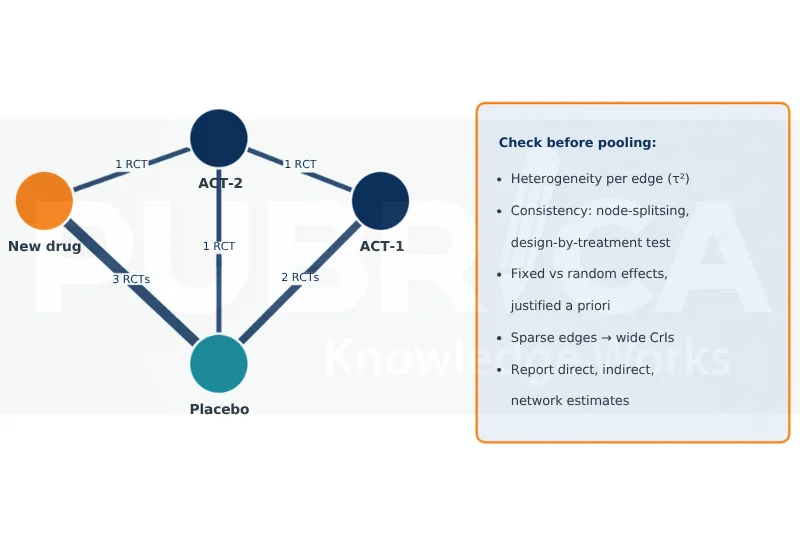
Network meta-analysis (NMA) becomes relevant when Bucher’s single chain is too narrow: several trials per comparison, more than one ACT option, or closed loops where direct and indirect evidence both exist [5][6]. NMA pools all of them in one model and lets direct and indirect estimates be compared.

Three checks decide whether an NMA is defensible for Germany:

  1. Heterogeneity within each comparison, reported and explained, with the fixed- or random-effects choice justified in advance. With few studies, between-study variance is poorly estimated; IQWiG Methods 8.0 adds a dedicated approach for meta-analyses with very few studies [1].
  2. Consistency between direct and indirect evidence where loops exist, tested with node-splitting or a design-by-treatment interaction model [6][9].
  3. Transitivity across all links, argued clinically rather than inferred from a non-significant test (Section 6).

The EU methodological guideline for JCA describes both frequentist and Bayesian approaches to network meta-analysis and emphasises that the underlying assumptions, suitability and consistency of the evidence network should be assessed[9].
G-BA appropriate comparator therapy

6. Transitivity: The Assumption That Can Break the Entire Analysis

Transitivity means that, had the trials on different links been run in the same population, their relative effects would still apply. In practice, it requires that effect modifiers are similarly distributed across the comparisons [5][14]. An effect modifier changes the size of the relative treatment effect; a prognostic factor only changes baseline risk.

The distinction matters. Anchored methods absorb differences in prognostic factors, because the common comparator arm experiences them too. They do not absorb differences in effect modifiers [7].

Transitivity cannot be proved statistically. A non-significant inconsistency test in a sparse network mostly reflects low power. IQWiG therefore expects a documented similarity assessment of study design, populations, interventions and outcomes, not just a test result [1][10].

7. Build an Effect-Modifier Matrix Before Fitting the Model

The effect-modifier matrix turns the transitivity argument into an auditable exhibit. Modifiers are pre-specified from clinical experts, published subgroup interactions and disease guidelines, then rated trial by trial before any outcome data are pooled.

The completed example below shows how the matrix works for one German subpopulation. It is illustrative, based on a hypothetical second-line oncology network: T1 compares the new drug with placebo, and T2 and T3 compare the ACT with placebo. Build one matrix per G-BA subpopulation.

Candidate modifier

Evidence it modifies effect

T1 (new drug vs placebo)

T2 (ACT vs placebo)

T3 (ACT vs placebo)

German target

Rating

Planned handling

Line of therapy

Subgroup interaction in T1; clinical input

100% 2L

100% 2L

62% 2L, 38% 3L+

2L after platinum

T3: Mismatch

Use T3 2L subgroup only, or exclude T3

ECOG / fitness

Published interaction; expert opinion

ECOG 0–1

ECOG 0–1

ECOG 0–2 (14% ECOG 2)

ECOG 0–1

T3: Uncertain

Sensitivity analysis excluding ECOG 2

Biomarker status

Mechanism-based; pre-specified subgroup

48% positive

51% positive

Not reported

All-comers

T3: Uncertain

Request data or run scenario analysis

Prior exposure to ACT class

Plausible cross-resistance

0%

0%

11%

Naïve to ACT class

T3: Uncertain

Sensitivity analysis

Comparator dose and schedule

Label-defined

Placebo

Label dose, q3w

Label dose, q3w

Per German SmPC

Comparable

None needed

Endpoint definition and assessment

OS objective; PFS by BICR vs investigator

OS; PFS by BICR

OS; PFS by BICR

OS; PFS by investigator

OS primary for added benefit

Comparable for OS; PFS Uncertain

Anchor on OS; PFS as supportive only

Follow-up and data-cut era

Changes in post-progression care

Median 24 months, 2023 cut

Median 22 months, 2021 cut

Median 30 months, 2016 cut

Current German care

T3: Mismatch

Exclude T3, or restrict to the post-2018 analysis

Reading this example: T1 and T2 are comparable on every strong modifier, so a Bucher comparison on OS through placebo is defensible. T3 fails on line of therapy and data-cut era. Pooling it would widen the network but weaken transitivity, so it moves to sensitivity analysis only.

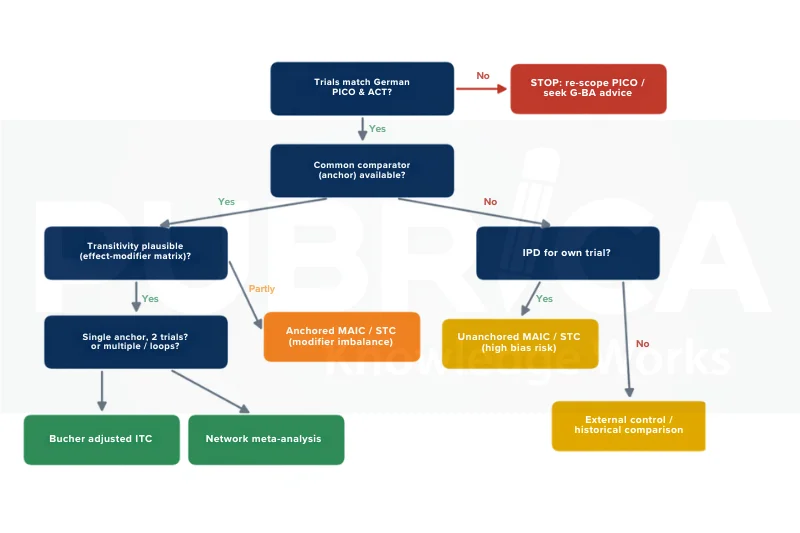
Ratings: Comparable (proceed), Uncertain (sensitivity analysis or meta-regression), Mismatch (exclude the trial, restrict the population or move to population adjustment). A matrix with a mismatch on a strong modifier is a signal to redesign the network, not to add covariates to the model.

8. Why Naive Cross-Trial Comparisons Are Methodologically Fragile

A naive comparison sets the new drug’s arm from one trial against the ACT arm from another, as if both came from one study. It discards randomisation. Any difference in population, era, supportive care, endpoint assessment or follow-up is then counted as treatment effect [10][14].

IQWiG generally rejects unadjusted comparisons as a basis for added benefit [1][10]. In the early AMNOG years, all five unadjusted ITCs reviewed by Lebioda et al. were rejected on that ground [10]. The narrow exception is a dramatic effect in a setting where randomised evidence is not feasible. Warmbold et al. describe two: interferon-free hepatitis C regimens against historical interferon controls, and sebelipase alfa in a rare, rapidly fatal infant disease, where the G-BA granted a hint of non-quantifiable added benefit [11].

9. No Adequate Common Comparator: MAIC, STC and External-Comparator Options

When the network fails, population-adjusted methods use individual patient data (IPD) from the sponsor’s trial and published aggregate data from the comparator trial [7].

  • Matching-adjusted indirect comparison (MAIC) reweighs IPD so that the means of selected covariates match the comparator trial, using propensity-score-type weights [8]. Weighting shrinks the effective sample size, often sharply.
  • Simulated treatment comparison (STC) fits an outcome regression on the IPD and predicts outcomes in the comparator population [7].
  • External or historical controls use registry, real-world or earlier trial data as the comparator arm, adjusted for confounders [13].

The key distinction is anchored versus unanchored [7]. An anchored MAIC or STC keeps a common comparator and adjusts only for effect modifiers. An unanchored analysis, typical for single-arm trials, must adjust for every prognostic factor and effect modifier, which is rarely achievable. IQWiG treats unanchored comparisons like non-randomised evidence: they can support added benefit only when effects are so large that bias cannot plausibly explain them [1][13]. Among 47 AMNOG submissions using historical comparisons assessed up to April 2024, 12 (25.5%) resulted in an added-benefit finding; most of these findings were non-quantifiable [13].

10. Bucher vs NMA vs MAIC vs STC: Match the Method to the Evidence Problem

Choose the method that fits the evidence problem, not the most sophisticated one available. The table sets out what each method needs and where it is exposed in a German assessment.

Criterion

Bucher ITC

Network meta-analysis

MAIC

STC

Evidence problem solved

One anchor links drug and ACT

Many trials, comparators or loops

Effect-modifier imbalance across trials

Effect-modifier imbalance across trials

Data needed

Aggregate data, both trials

Aggregate data, all trials

IPD (own trial) + aggregate (comparator)

IPD (own trial) + aggregate (comparator)

Common comparator

Required

Required (connected network)

Anchored: yes; unanchored: no

Anchored: yes; unanchored: no

Key assumption

Similarity on effect modifiers

Transitivity + consistency

All relevant modifiers (anchored) or all confounders (unanchored) measured and reported

Outcome model correctly specified

Main weakness

Wide intervals

Hidden inconsistency in sparse networks

Loss of effective sample size; target population only

Model dependence; scale choice

German acceptance

Reference method when similarity is shown [1][10]

Accepted if assumptions are shown [1][9]

Anchored: case by case; unanchored: dramatic effects only [11][13]

As MAIC; program code required [10]

Reporting essentials

Similarity table, both estimates

Network plot, node-split, heterogeneity

Weights, ESS, balance before/after

Model, covariates, code

, IQWiG General Methods Version 8.0

11. Why Sophisticated Statistics Cannot Repair an Incompatible PICO

Population adjustment corrects imbalance in measured covariates. It cannot change the question the evidence answers. Three problems sit outside any model:

  • Wrong comparator. If no trial in the network contains the ACT as used in Germany, no method produces an estimate against it. Early AMNOG ITCs were rejected outright on this ground, even when IQWiG considered the method sound [10].
  • Incompatible outcomes. Differing definitions, assessment schedules or HRQoL instruments cannot be reconciled by weighting. A responder analysis with a non-validated threshold stays non-validated after an NMA [1].
  • Severe population mismatch. MAIC only reweights patients inside the IPD trial’s range. If the comparator population lies outside it, effective sample size collapses, and the estimate applies to a population no one enrolled [7].


Pubrica practice point: When the matrix shows a PICO-level mismatch, the right deliverable is a gap memo and an evidence-generation plan (G-BA advice, a targeted trial or a registry), not a more complex model.

12. What German Assessment Experience Reveals About Rejection Risk

Across 15 years of published reviews, most indirect comparisons in German assessments have not been accepted. The most recent and largest review found acceptance in 22.5% of 334 subpopulations up to April 2024 [11].
Bucher indirect comparison

Combining the reported reasons gives a working rejection taxonomy. Categories are drawn from published reviews [10][12][13]; the right-hand column is how each is prevented.

Rejection category

Typical IQWiG / G-BA finding

Prevention at feasibility stage

R1 Comparator mismatch

Comparator is not the ACT, or not used per German label

German PICO table; G-BA advice before dossier

R2 Population mismatch

Trial population differs from the approved or G-BA subpopulation

Subpopulation-level network; restrict or re-analyse IPD

R3 Insufficient similarity

Trials differ on design, duration, era or effect modifiers

Effect-modifier matrix; pruning of non-credible links

R4 Unsuitable method

Unadjusted comparison; unanchored adjustment without dramatic effect

Decision tree; method justified against the evidence problem

R5 Incomplete study pool

Systematic search incomplete or not reproducible

Protocol-driven SLR with registry searches

R6 Heterogeneity or inconsistency not handled

Pooled despite heterogeneity; no consistency check

Pre-specified heterogeneity and node-split plan

R7 Outcome not patient-relevant or not comparable

Surrogates, differing definitions, missing HRQoL

Outcome harmonisation check per endpoint

R8 Documentation gaps

Missing program code, sensitivity analyses or data traceability

Module 4/5-ready code and audit trail

13. EU JCA + AMNOG in 2026: Where Additional German Evidence Work Can Arise

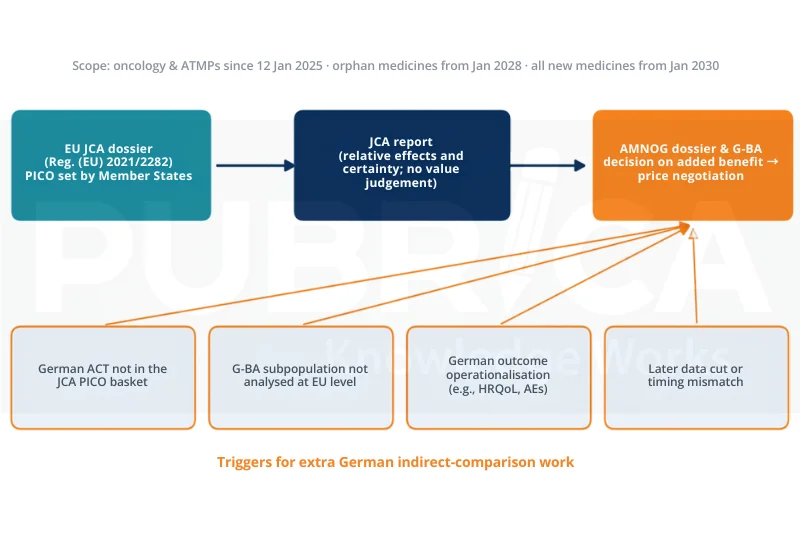
The EU Joint Clinical Assessment (JCA) supplements AMNOG; it does not replace it. Under Regulation (EU) 2021/2282, JCA has applied to new oncology medicines and ATMPs since 12 January 2025, extends to orphan medicines in January 2028 and to all new medicines in January 2030 [3]. The G-BA expects manufacturers to refer to the EU dossier where possible, while national add-ons remain [2][15].
network meta-analysis Germany

The JCA scoping process consolidates PICOs from all Member States, which often yields several comparators. The G-BA may then focus on the single therapy that is standard in Germany [15]. Extra German indirect comparison work typically arises when:

  • the German ACT is absent from, or only indirectly covered by, the JCA analyses;
  • the G-BA subpopulation was not analysed separately at EU level;
  • German outcome operationalisation (for example, HRQoL instruments or adverse-event categories) differs from the JCA presentation;
  • the JCA report is finalised too late for the AMNOG timeline or uses an earlier data cut [13][15].

Because the JCA guideline and IQWiG methods share the same logic on indirect evidence [1][9], one well-built network can serve both, provided the German subpopulation analyses are planned from the start.

14. Pubrica German Indirect Evidence Feasibility Framework

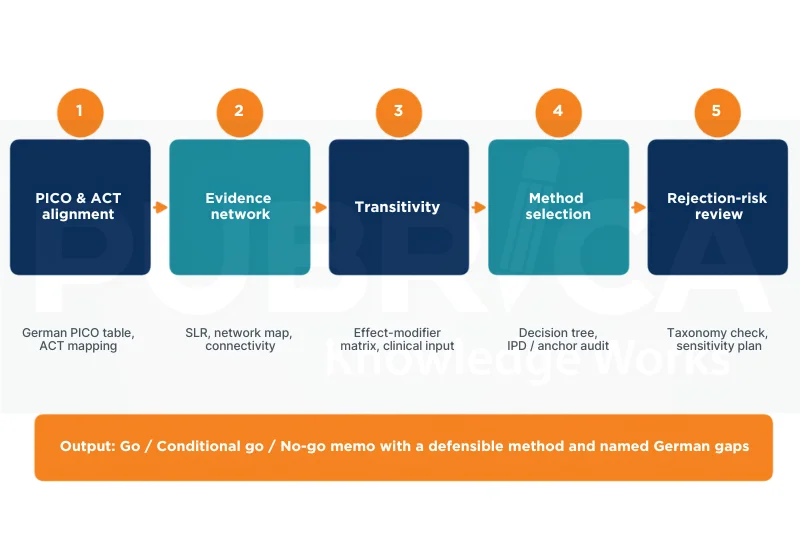
The framework runs five sequential gates, and a red result at any gate is resolved before statistical analysis begins. It converts the sections above into a reproducible diagnostic.

Gate

Question answered

Output

Red flag

1. PICO and ACT alignment

Does any trial answer the German question?

German PICO table per subpopulation

Comparator or outcome not in any trial

2. Evidence network

Is the drug connected to the ACT by randomised evidence?

Protocol-driven SLR, network map

No anchor and no IPD

3. Transitivity

Are the links clinically credible?

Effect-modifier matrix with clinical sign-off

Mismatch on a strong modifier

4. Method selection

Which method fits the evidence problem?

Decision-tree record, IPD and anchor audit

Only unanchored or naive routes remain

5. Rejection-risk review

Which taxonomy risks (R1–R8) remain?

Risk register, sensitivity-analysis plan

Unmitigated R1 or R2 risk

The result is a Go, Conditional go or No-go memo for each German subpopulation, with the defensible method, its expected certainty of results and the German-specific gaps that need G-BA advice or new evidence.

Request a German Indirect Evidence Feasibility Review. Pubrica’s systematic-review and biostatistics team delivers the German PICO table, the network map, a completed effect-modifier matrix, a method recommendation and a rejection-risk register, before you commit to analysis. Contact Pubrica to scope your review.
transitivity network meta-analysis

Get expert support from Pubrica for addressing reviewer comments, preparing point-by-point rebuttals, and strengthening manuscripts for journal resubmission. Prepare your revised manuscript with confidence.

References

  1. Institut für Qualität und Wirtschaftlichkeit im Gesundheitswesen. (2025). Allgemeine Methoden: Version 8.0 [General methods: Version 8.0]. IQWiG. https://doi.org/10.60584/Allgemeine-Methoden_V8.0
  2. Gemeinsamer Bundesausschuss. (n.d.). The benefit assessment of medicinal products in accordance with the German Social Code, Book Five (SGB V), section 35a. G-BA. https://www.g-ba.de/english/benefitassessment/
  3. Regulation (EU) 2021/2282 of the European Parliament and of the Council of 15 December 2021 on health technology assessment and amending Directive 2011/24/EU. (2021). Official Journal of the European Union, L 458, 1–32. https://eur-lex.europa.eu/eli/reg/2021/2282/oj
  4. Bucher, H. C., Guyatt, G. H., Griffith, L. E., & Walter, S. D. (1997). The results of direct and indirect treatment comparisons in meta-analysis of randomized controlled trials. Journal of Clinical Epidemiology, 50(6), 683–691. https://doi.org/10.1016/S0895-4356(97)00049-8
  5. Salanti, G. (2012). Indirect and mixed-treatment comparison, network, or multiple-treatments meta-analysis: Many names, many benefits, many concerns for the next generation evidence synthesis tool. Research Synthesis Methods, 3(2), 80–97. https://doi.org/10.1002/jrsm.1037
  6. Dias, S., Welton, N. J., Sutton, A. J., & Ades, A. E. (2016). NICE DSU technical support document 2: A generalised linear modelling framework for pairwise and network meta-analysis of randomised controlled trials (Rev. ed.). NICE Decision Support Unit. https://www.sheffield.ac.uk/nice-dsu/tsds
  7. Phillippo, D. M., Ades, A. E., Dias, S., Palmer, S., Abrams, K. R., & Welton, N. J. (2016). NICE DSU technical support document 18: Methods for population-adjusted indirect comparisons in submissions to NICE. NICE Decision Support Unit. https://www.sheffield.ac.uk/nice-dsu/tsds
  8. Signorovitch, J. E., Wu, E. Q., Yu, A. P., Gerrits, C. M., Kantor, E., Bao, Y., Gupta, S. R., & Mulani, P. M. (2010). Comparative effectiveness without head-to-head trials: A method for matching-adjusted indirect comparisons applied to psoriasis treatment with adalimumab or etanercept. PharmacoEconomics, 28(10), 935–945. https://doi.org/10.2165/11538370-000000000-00000
  9. Member State Coordination Group on Health Technology Assessment. (2024). Methodological guideline for quantitative evidence synthesis: Direct and indirect comparisons. European Commission. https://health.ec.europa.eu/health-technology-assessment/implementation-regulation-health-technology-assessment/guidance-documents_en
  10. Lebioda, A., Gasche, D., Dippel, F.-W., Theobald, K., & Plantör, S. (2014). Relevance of indirect comparisons in the German early benefit assessment and in comparison to HTA processes in England, France and Scotland. Health Economics Review, 4, Article 31. https://doi.org/10.1186/s13561-014-0031-5
  11. Warmbold, B., Scharrenbroich, J., Teich, K., Ingendoh-Tsakmakidis, A., Löpmeier-Röh, J.-F., Reinartz, M., & Kulp, W. (2024). Navigating indirect comparisons in health technology assessments: Insights from German AMNOG evaluations. Cencora HTA Quarterly. https://www.cencora.com/resources/pharma/htaq-winter-2024-summary/navigating-indirect-comparisons
  12. Böhme, S. (n.d.). Indirect comparisons with and without adjustment for patient characteristics [Conference presentation, citing Werner et al., 2017]. https://www.psiweb.org/docs/default-source/default-document-library/sarah-bohme.pdf
  13. European Federation of Statisticians in the Pharmaceutical Industry. (2025). German benefit assessment: White paper. EFSPI. https://www.efspi.org/wp-content/uploads/2025/05/GermanHTA_WhitePaper_2025.pdf
  14. Jansen, J. P., Fleurence, R., Devine, B., Itzler, R., Barrett, A., Hawkins, N., Lee, K., Boersma, C., Annemans, L., & Cappelleri, J. C. (2011). Interpreting indirect treatment comparisons and network meta-analysis for health-care decision making: Report of the ISPOR Task Force on Indirect Treatment Comparisons Good Research Practices: Part 1. Value in Health, 14(4), 417–428. https://doi.org/10.1016/j.jval.2011.04.002
  15. (2025). JCA and AMNOG integration: Strategic insights from the G-BA info session. https://partners4access.com/jca-and-amnog-integration-strategic-insights-from-the-g-ba-info-session/