
- Services
- Discovery & Intelligence Services
- Publication Support Services
- Sample Work
Publication Support Service
- Editing & Translation
-
Editing and Translation Services
- Sample Work
Editing and Translation Service
-
- Research Services
- Sample Work
Research Services
- Physician Writing
- Sample Work
Physician Writing Service
- Statistical Analyses
- Sample Work
Statistical Analyses
- Data Collection
- AI and ML Services
- Sample Work
AI and ML Services
- Medical Writing
- Sample Work
Medical Writing
- Research Impact
- Sample Work
Research Impact
- Medical & Scientific Communication
- Sample Work
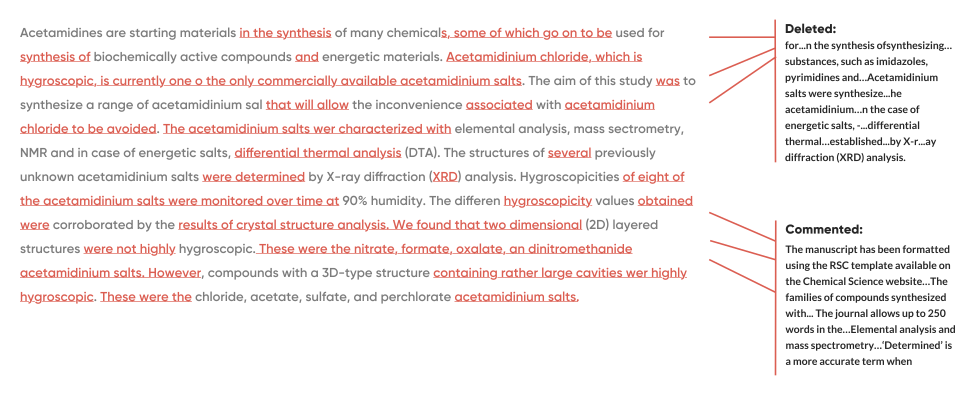
Medical & Scientific Communication
- Medico Legal Services
- Educational Content
- Academic Editorial Services
- Sample Work
Academic Editorial Services
- Educational Editorial Service
-
Education Editorial Services
- Sample Work
Education Editorial Services
-
- Industries
- Subjects
- About Us
- Academy
- Insights
- Contact Us
Writing a scientific research article that meets the standards of a journal, requires more than simply presenting data – it requires clarity, structure, accuracy, and ethical integrity. For first-time authors and researchers alike, understanding how to write, structure and submit a manuscript is vital for having your work published in peer-reviewed journals
How to Structure and Submit a Journal-Ready Scientific Research Paper
- Home
- academy
- Medical Writing
- How to Structure and Submit a Journal-Ready Scientific Research Paper
Manuscript Formatting
Interesting topics
How to Structure and Submit a Journal-Ready Scientific Research Paper
Writing a scientific research article that meets the standards of a journal, requires more than simply presenting data – it requires clarity, structure, accuracy, and ethical integrity. For first-time authors and researchers alike, understanding how to write, structure and submit a manuscript is vital for having your work published in peer-reviewed journals
This article will guide you through the process of structuring and submitting a scientific research paper so that it is ready for journal submissions.
Step 1: Structure Your Manuscript Using the IMRaD Format
Most journals utilize the IMRaD format. IMRaD stands for the Introduction, Methods, Results, and Discussion. Each of these sections has a distinct and defined purpose, and each section has a specific format:
| Section | What to Include |
|---|---|
| Title and Abstract | Provide a concise and informative title and an abstract (250 words maximum) which describes the research you conducted. |
| Introduction | Define the research problem, background, and objectives. What was your hypothesis |
| Methods | scribe the study design, participants, procedures, instruments, and reporting of statistical analysis [1]. |
| Results | Present main findings clearly using tables/figures, but do not interpret. |
| Discussion | Interpret the results, compare with other literature (where necessary), limitations, and future research. |
| Conclusion | Summarize the significance and importance of your research. |
| References | Reference all publications using the prescribed format for the journal (APA, AMA, Vancouver, etc.). |
Step 2: Follow Journal Guidelines Precisely
Select your target journal before you start writing and review its “Guidelines for Authors.” You’ll want to focus on the following:
- Any word count limits for full articles and abstracts
- Formatting requirements include font, headings, spacing, etc.
- Figure and table requirements
- Citation style [2]
- Any ethical requirements (ICMJE, CONSORT, GPP, etc).
- Submission portals and file types accepted.
Step 3: Focus on Clarity, Accuracy, and Ethical Reporting
To ensure your research paper is credible and fit for journal publication.
- Avoid jargon and write clearly for a multidisciplinary audience.
- Be honest with your data which includes negative or inconclusive data.
- Declare funding sources, affiliations, and conflicts of interest.
- Confirm all the authors listed meet authorship criteria.
Seek ethical approval as appropriate and register clinical trials where relevant [3].
Step 4: Edit, Proofread, and Peer Review Internally
Prior to submission:
- Carefully proofread for grammatical issues, clarity, and organization
- Use a professional editing service or medical writing service for technical correctness
- Run a plagiarism check to make sure that your work is original[4]
- Share your draft with co-authors, and possibly internal reviewers, to get their feedback
Step 5: Submit the Paper and Track Progress
When your paper is ready:
- Log in to the journal’s submission system
- Upload the manuscript and any needed supporting files (e.g., ethics approval, cover letter, graphical abstract)
- Write a short, compelling cover letter summarizing your article and why it is a good fit for the journal [5]
- Confirm that you have submitted your manuscript, and check the journal page regularly for the review status
- If revisions are requested, be thoughtful in responding to reviewer comments.
Ethics in Scientific Publishing
Ensuring ethical considerations remain high in priority is important for anyone involved with scientific publishing by:
- Getting informed consent and ethical board approvals where animal or human subjects are used or involved.
- Avoiding plagiarism, data fabrication, and redundant publications.
- Knowing, and being open to disclosing, the source of funding and any conflicts of interest [6].
- Following ICMJE and CONSORT guidelines to follow implementing ethics.
Bonus Tips for Higher Acceptance Rates
| Tip | Description |
|---|---|
| Choose the Right Journal | Streams of Discipline or Research should match your study to ensure the best fit and acceptance rate |
| Check the Abstract & Title | The title and abstract form the first impressions and should clearly outline your study to encourage more interest from editors and reviewers. |
| Consider Visual Enhancements | I’d suggest thinking about graphical abstracts, figures, or visual based decisions of your study (if allowed) to make your research more visually engaging and accessible. |
| Seek Professional Support | Leverage expert help from Pubrica’s medical writers to ensure your manuscript is polished, compliant, and publication ready. |
Connect with us to explore how we can support you in maintaining academic integrity and enhancing the visibility of your research across the world!
Final Thoughts
Writing and submitting a journal-ready research article demands scientific rigor along with purposeful presentation. If you’re able to structure your content in the right way and adhere to journal policies, and ultimately present your study ethically and clearly, you will maximize your chances of acceptance.
Need help writing an error-free manuscript? Pubrica’s skilled professional team of medical writers, editors, and journal services experts will help you with writing, formatting, submission, and revisions.
References
- Root indexing, J-Gate, Scientific Indexing Services, Scilit, WorldCat, DRJI, GENAMICS, INTERNATIONAL Scientific Indexing, ICMJE, Cite Factor https://www.jclinical.org/information/author-guidelines
- Christiansen, S.; Iverson, C.; Flanagin, A.; et al. (2020). AMA Manual of Style: A Guide for Authors and Editors (11th ed.). Oxford University Press.
- Iverson, C.; Christiansen, S.; Flanagin, A.; et al. (2007). AMA Manual of Style (10th ed.). Oxford University Press. ISBN 978-0-19-517633-9.
- “Announcing the 11th Edition”. AMA Manual of Style. Retrieved February 24, 2022
- https://academic.oup.com/pages/publishing-advice-and-guidance
- Stern, Victoria (2017-08-15). “What should journals do when peer reviewers do not disclose potential conflicts?”. Retraction Watch. Retrieved 2018-03-28.