
- Services
- Discovery & Intelligence Services
- Publication Support Services
- Sample Work
Publication Support Service
- Editing & Translation
-
Editing and Translation Services
- Sample Work
Editing and Translation Service
-
- Research Services
- Sample Work
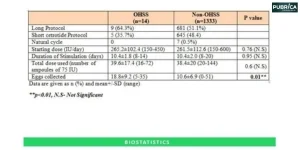
Research Services
- Physician Writing
- Sample Work
Physician Writing Service
- Statistical Analyses
- Sample Work
Statistical Analyses
- Data Collection
- AI and ML Services
- Sample Work
AI and ML Services
- Medical Writing
- Sample Work
Medical Writing
- Research Impact
- Sample Work
Research Impact
- Medical & Scientific Communication
- Sample Work
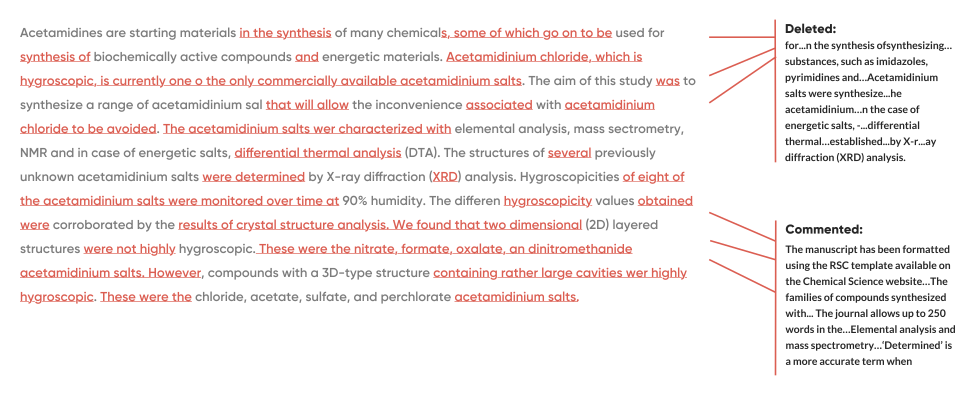
Medical & Scientific Communication
- Medico Legal Services
- Educational Content
- Academic Editorial Services
- Sample Work
Academic Editorial Services
- Educational Editorial Service
-
Education Editorial Services
- Sample Work
Education Editorial Services
-
- Industries
- Subjects
- About Us
- Academy
- Insights
- Contact Us
Cover Letter for Article Submission: Emerging Trends and Future Perspectives in Healthcare and Patient Safety
High-Impact Journals
Interesting topics
Cover Letter for Article Submission: Emerging Trends and Future Perspectives in Healthcare and Patient Safety
One of the most important pieces of paper that comes along with the manuscript when submitting it to the scientific journal is the cover letter for article submission. While it does not include any research results per se, it gives editors an insight into the originality and scientific importance of the work and its relation to the aims of the specific journal. As many studies in the field of healthcare and patient safety affect clinical practice, health policy, and patients’ welfare directly, a well-prepared healthcare article submission cover letter helps to make a better first impression of the submission. [1]
With the ongoing development of scholarly publications with the help of digital technology, artificial intelligence, and open science practices, the requirements for the cover letter for research article submission keep evolving. Understanding updated cover letter guidelines for journals allows researchers to submit more compelling manuscripts and improve their chances of successful publication.
1. Purpose of a Cover Letter in Healthcare Journal Submission
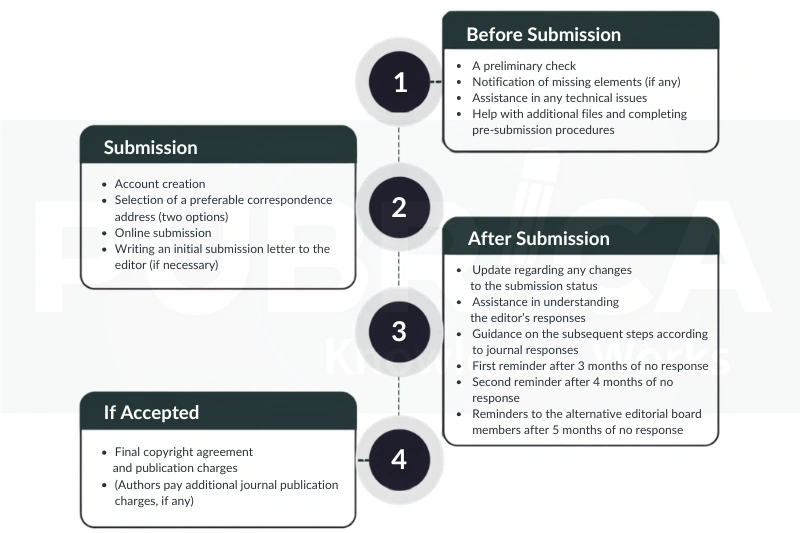
A cover letter acts as the official form of correspondence between authors and journal editors during submission of a manuscript. The main function of a cover letter is to provide an introduction of the manuscript, the scientific contribution of the study and reasons why the manuscript is suitable for that journal. [2]
In the case of healthcare studies or patient safety research, it is important to provide information about how the study results will be useful in improving healthcare delivery, supporting clinical decision-making, or enhancing healthcare systems. This information is considered by the editor to evaluate the suitability of the manuscript for the journal and is an important part of effective healthcare article submission cover letter preparation.
2. Essential Elements of an Effective Cover Letter
Although journals may have different submission requirements, most healthcare publishers expect similar information within a cover letter for research article submission.
Cover Letter Component | Purpose |
Manuscript Title | Identifies the submitted research |
Research Significance | Explains novelty and scientific contribution |
Journal Relevance | Demonstrates alignment with journal scope |
Ethical Statement | Confirms originality and ethical compliance |
Conflict of Interest | Declares potential competing interests |
Corresponding Author Details | Provides communication information |
A concise, professional, and journal-specific cover letter demonstrates preparation and professionalism throughout the submission process.
3. Emerging Trends in Healthcare Manuscript Submission
The field of healthcare publishing has undergone numerous changes in recent years. It is important for editors to encourage transparency, reproducibility, and responsible science communication. Thus, nowadays, cover letters pay attention to both the novelty of research and research integrity. [3]
Scientists are required to provide information about the responsible use of artificial intelligence while writing papers, data availability, sources of funding, and international ethics compliance. These trends reflect the increasing importance of transparency and trust in scientific publishing. The development of cover letter for article submission emerging healthcare trends highlights the need for researchers to adapt to modern publication requirements.
4. Future Perspectives in Patient Safety Publishing
Patient Safety research is becoming increasingly interdisciplinary, data-focused and technologically driven. The use of artificial intelligence, electronic health records, prediction models and digital healthcare systems is creating exciting opportunities for quality improvements within healthcare. [4]
As submission requirements keep developing, it will become necessary to include additional information about the societal implications of the research, patient-centeredness, data sharing approaches and compliance with international reporting requirements in the cover letters. Open science statements might be included in future submissions as well.
5. Common Challenges During Manuscript Submission
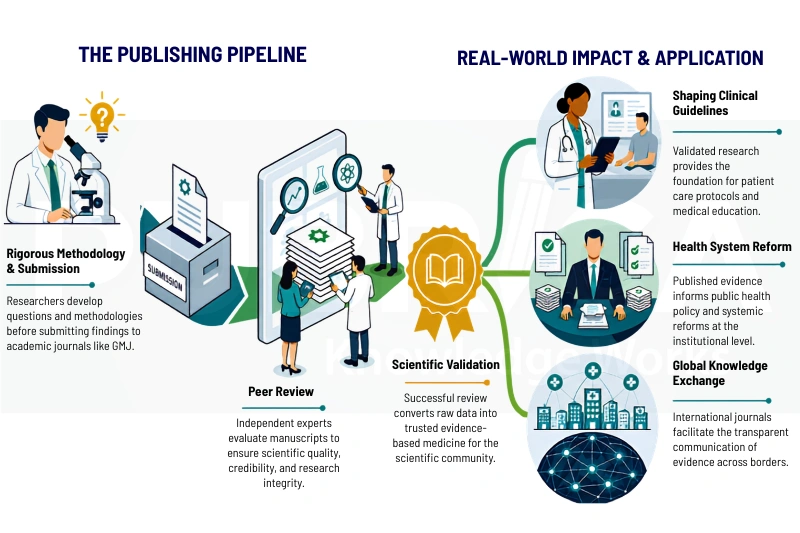
However, many of these papers face delay during editorial review due to poor articulation of the importance of the research paper in the cover letter. Poor use of language, lack of clear articulation of the importance and novelty of the research can lead to poor interest from the editorial board.
Healthcare researchers must ensure that the cover letter for article submission is specifically tailored to the target journal and clearly explains the clinical importance, scientific contribution, and impact of the research work. Applying effective best practices for cover letter article submission can improve communication with editors and support successful publication.
Connect with us to explore how we can support you in maintaining academic integrity and enhancing the visibility of your research across the world!
Conclusion
An effectively written cover letter for research article submission is a key element for successful manuscript submission in the field of healthcare and patient safety research. Besides introducing the manuscript itself, the cover letter represents the author’s professionalism, scientific ethics, and understanding of journal publication policies. In the era of continuous development in scientific publishing through artificial intelligence, digital technology, and open science, researchers must ensure that their cover letters meet current healthcare article submission cover letter requirements and emerging publication standards.
Cover Letter for Article Submission: Emerging Trends and Future Perspectives in Healthcare and Patient Safety. OurPubrica consultants are here to guide you. [Get Expert Publishing Support] or [Schedule a Free Consultation]
Frequently Asked Questions (FAQs)
A cover letter introduces the manuscript to the journal editor and highlights the research significance, originality, relevance to the journal scope, and ethical compliance. It helps editors understand the importance and suitability of the submitted work.
A healthcare journal cover letter should include the manuscript title, research significance, relevance to the journal, originality statement, ethical approval or compliance details, conflict of interest declaration, and corresponding author information.
A well-written cover letter can create a positive first impression by clearly explaining the novelty, clinical importance, and contribution of the research. It helps editors quickly identify the value and relevance of the manuscript.
Current trends include responsible use of artificial intelligence, open science practices, data sharing, transparency, reproducibility, digital health innovations, and increased focus on research integrity and ethical compliance.
Common mistakes include using a generic cover letter, failing to explain the research significance, poor alignment with the journal scope, unclear language, missing ethical statements, and not highlighting the clinical or scientific impact of the study.
References
- Nicholas D. (2019). How to choose a journal and write a cover letter. Saudi journal of anaesthesia, 13(Suppl 1), S35–S41. https://doi.org/10.4103/sja.SJA_691_18
- Bahadoran, Z., Mirmiran, P., Kashfi, K., & Ghasemi, A. (2021). Scientific Publishing in Biomedicine: How to Write a Cover Letter?. International journal of endocrinology and metabolism, 19(3), e115242. https://doi.org/10.5812/ijem.115242
- Li, L., Fu, L., Li, H., Liu, T., & Sun, J. (2024). Emerging trends and patterns in healthcare-seeking behavior: A systematic review. Medicine, 103(8), e37272. https://doi.org/10.1097/MD.0000000000037272
- Emanuel L, Berwick D, Conway J, et al. What Exactly Is Patient Safety? In: Henriksen K, Battles JB, Keyes MA, et al., editors. Advances in Patient Safety: New Directions and Alternative Approaches (Vol. 1: Assessment). Rockville (MD): Agency for Healthcare Research and Quality; 2008 Aug. Available from: https://www.ncbi.nlm.nih.gov/books/NBK43629/