
- Services
- Discovery & Intelligence Services
- Publication Support Services
- Sample Work
Publication Support Service
- Editing & Translation
-
Editing and Translation Services
- Sample Work
Editing and Translation Service
-
- Research Services
- Sample Work
Research Services
- Physician Writing
- Sample Work
Physician Writing Service
- Statistical Analyses
- Sample Work
Statistical Analyses
- Data Collection
- AI and ML Services
- Sample Work
AI and ML Services
- Medical Writing
- Sample Work
Medical Writing
- Research Impact
- Sample Work
Research Impact
- Medical & Scientific Communication
- Sample Work
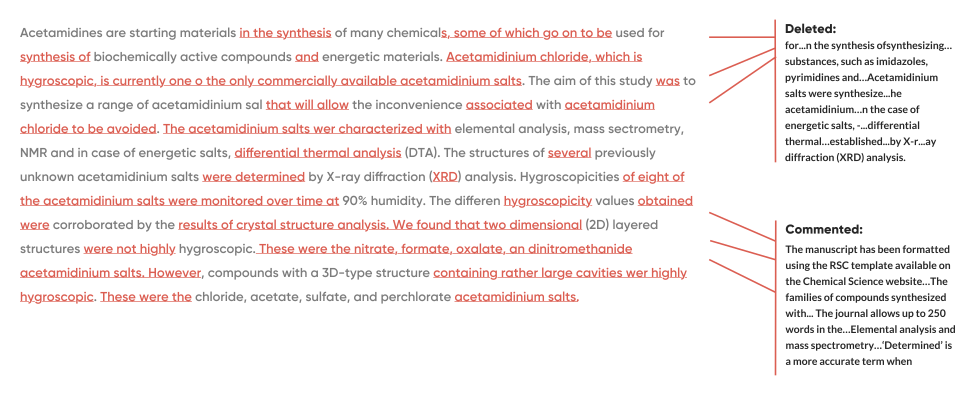
Medical & Scientific Communication
- Medico Legal Services
- Educational Content
- Academic Editorial Services
- Sample Work
Academic Editorial Services
- Educational Editorial Service
-
Education Editorial Services
- Sample Work
Education Editorial Services
-
- Industries
- Subjects
- About Us
- Academy
- Insights
- Contact Us
Translating Industry Challenges into Evidence-Based Manuscripts: A Publishing Guide for Pharma & Biotech Professionals
- Home
- Academy
- Statistical analysis
- Translating Industry Challenges into Evidence-Based Manuscripts: A Publishing Guide for Pharma & Biotech Professionals
High-Impact Journals
- Why Industry Challenges Make Powerful Scientific Manuscripts
- Understanding the Publication Pathway for Pharma & Biotech Teams
- What Real-World Challenges Can Become Publishable Manuscripts?
- Preparing a High-Quality Manuscript Based on Real Industry Experience
- Choosing the Right Journal for Pharma & Biotech Professionals
- Follow Ethical & Formatting Requirements (Critical in Regulated Industries)
- Managing Peer Review Effectively
- Converting Real Industry Challenges into Valuable Lessons for the Entire Sector
- Conclusion
Interesting topics
Translating Industry Challenges into Evidence-Based Manuscripts: A Publishing Guide for Pharma & Biotech Professionals
1. Why Industry Challenges Make Powerful Scientific Manuscripts
2. Understanding the Publication Pathway for Pharma & Biotech Teams
3. What Real-World Challenges Can Become Publishable Manuscripts?
4. Preparing a High-Quality Manuscript Based on Real Industry Experience
5. Choosing the Right Journal for Pharma & Biotech Professionals
6. Follow Ethical & Formatting Requirements (Critical in Regulated Industries)
7. Managing Peer Review Effectively
8. Converting Real Industry Challenges into Valuable Lessons for the Entire Sector
In the pharmaceutical and biotechnology industries, any scientific problem, R&D, Clinical Research, formulation, bioprocessing, regulatory affairs, and quality systems represent the potential to develop a new degree of knowledge. Real-life challenges such as instability of formulations, deviations from a clinical protocol, interferences with assays, toxicology fluctuations, and or scale-up to commercial production are often riddled with scientific knowledge.[1]
When documented in writing, these experiences transform into impactful pharma research papers or biotech research papers that advance the field. The process of publishing your real-life experiences is scientifically beneficial and strategically offers an opportunity to build thoughtful leadership within the organization. This document outlines an easy methodology for professionals to change an industry challenge into a powerful manuscript and confidently publish a pharma research paper or publish a biotech research paper in reputable journals. [2]
1. Why Industry Challenges Make Powerful Scientific Manuscripts
Business and industry education is practical, evidence-based, and problem-based, which lends it much more relevance to everyday pharmaceutical business.[3]
Real-world pharma and biotech issues are excellent for publication since:
- They provide real and actionable solutions based on real experience.
- They reduce risk and prevent repeating mistakes in the industry.
- They improve regulatory readiness.
- They drive continuous improvement in R&D and manufacturing.
- They add credibility to the professionals who publish them.
- They will serve a market with comparable issues.
Real-world pharmaceuticals and biotech issues are excellent topics for manuscript editing for non-academics.
2. Understanding the Publication Pathway for Pharma & Biotech Teams
To successfully publish an industry manuscript, it is important to understand the publication lifecycle. [4]
Stages of the Publication Process
Stage | Description | Industry Examples |
Topic Identification | Select a meaningful challenge | OOS investigations, impurity profiles, assay challenges |
Gather supporting evidence | Lab data, validation trends, clinical observations | |
Manuscript Writing | Convert insights into a scientific structure | Process optimization → technical manuscript |
Choose a journal aligned with the domain | Biotech, clinical, and pharmaceutical sciences | |
Submission & Peer Review | Respond to expert comments | Provide clarifications, add data, and refine results |
This pathway ensures your pharma research publication or biotech research publication meets global scientific standards.
3. What Real-World Challenges Can Become Publishable Manuscripts?
Almost every part of the pharma and biotech lifecycle generates publishable insights:
R&D & Formulation Research
- Solubility challenges in preformulation
- Untoward degradation pathways
- Excipient compatibility insights
Failures and solutions to scale-up
Analytical & QC
- Resolving difficulties in HPLC/GC
- Robustness or precision issues with the method
Stability-indicating methods development
Manufacturing & Process Development
- Granulation variability
- Blend consistency issues
- Biotechnology fermentation optimization
Lyophilization cycle modifications
Clinical Research
- Challenges in recruitment
- Patient adherence behavioural patterns
- Marker variability
Regulatory & Compliance
- Effective answers to regulatory queries
- Response to technical inquiries
- Post-approval change management lessons
Pharmacovigilance
- Rare adverse events
Signal detection patterns
All these topics can be converted into strong manuscripts through scientific publishing support and Pubrica scientific writing services.
4. Preparing a High-Quality Manuscript Based on Real Industry Experience
Strong pharma manuscript writing or biotech manuscript writing requires accuracy, clarity, and adherence to scientific norms. [6]
Manuscript Components
- Title Page: Complete author and affiliation information
- Abstract: Brief overview of the problem, approach, and results
- Introduction: Describe the scientific or operational problem
- Methods: Describe the analytic, clinical, or operational steps in detail
- Results: Present quantitative, qualitative, or trend data
- Discussion: Compare findings with past studies and highlight meaningful conclusions
- Conclusions: Application of the findings to practice in the field
- References: References to scientific and regulatory references
This format is generally accepted by journals covering pharmaceutical and biotechnology areas.
5. Choosing the Right Journal for Pharma & Biotech Professionals
Choosing the right journal influences the visibility, acceptance, and credibility of your work.
Factors to consider in journal selection
- Scientific scope: pharma, biotech, clinical, regulatory
- Indexing: Scopus, Web of Science, PubMed, EMBASE
- Impact factor and reputation
- Open access vs traditional subscription model visibility
- Article processing charges (APCs)
Journal Type Comparison
Type | Pros | Cons |
High visibility and global reach | May require APCs | |
Subscription-Based | High credibility | Limited readership |
Conference Proceedings | Faster publication | Lower prestige |
Selecting correctly improves your chances to publish pharma research papers or publish biotech research papers successfully.
6. Follow Ethical & Formatting Requirements (Critical in Regulated Industries)
Compliance with ethical standards is important in all scientific fields, but is vital in GxP-regulated areas. [7]
| Ethical Guidelines | Formatting Guidelines |
|---|---|
| Follow the journal’s template correctly
|
These help the manuscript fit global publication standards
7. Managing Peer Review Effectively
Peer review serves as the quality gate for scientific publishing. [8]
Peer Review Process
- Editor screening
- Reviewer assignment
- Feedback targeted at technical improvements
- Revised submission
- Decision to accept
Well-structured responses raise the probability of acceptance for pharma research publications or biotech research publications.
8. Converting Real Industry Challenges into Valuable Lessons for the Entire Sector
All issues within pharma and biotech, everything from process variation to clinical trial challenges, can be communicated in a manuscript that serves to: [9]
- Inform the global scientific community
- Positively impact company reputation
- Increase regulatory confidence
- Provide useful information to peer companies that might encounter the same failure
- Provide a record of innovation and continuous improvement
- Exemplify scientific rigor and industry leadership
The act of publishing your experience allows the transformation of internal learning into best practices that benefit our entire industry of practice.
Connect with us to explore how we can support you in maintaining academic integrity and enhancing the visibility of your research across the world!
Conclusion
Those who work in pharma and biotech have massive tacit knowledge developed through everyday R&D, manufacturing, quality, regulatory, and clinical processes. With documentation that follows a systematic review, they will have manuscripts that can be disseminated for the advancement of science worldwide.
As soon as you develop a systematic approach to publishing, choosing a topic, doing the secondary data analysis, writing, selecting a journal, ethical considerations, and peer review, then converting your industry challenges into an authoritative scientific publication will be straightforward and straightforward. Whether you are raising an industry report or adding to the life sciences realm of innovations, your expertise and tacit knowledge in the real world have intrinsic value.
Transform your pharma or biotech experience into high-impact scientific publications.
Pubrica’s scientific writing services provide expert support for manuscript writing, data analysis, journal selection, and end-to-end publishing. [Get Expert Publishing Support] or [Schedule a Free Consultation]
References
- Scheuer J. D. (2023). Translating evidence-based knowledge objects into practice. Frontiers in health services, 3, 1107096. https://doi.org/10.3389/frhs.2023.1107096
- Huston, P., & Choi, B. (2017). A guide to publishing scientific research in the health sciences. Canada communicable disease report = Releve des maladies transmissibles au Canada, 43(9), 169–175. https://doi.org/10.14745/ccdr.v43i09a01
- Vineis P. (2024). Scientific publishing: crisis, challenges, and new opportunities. Frontiers in public health, 12, 1417019. https://doi.org/10.3389/fpubh.2024.1417019
- Institute of Medicine (US) Committee on Conflict of Interest in Medical Research, Education, and Practice; Lo B, Field MJ, editors. Conflict of Interest in Medical Research, Education, and Practice. Washington (DC): National Academies Press (US); 2009. E The Pathway from Idea to Regulatory Approval: Examples for Drug Development. Available from: https://www.ncbi.nlm.nih.gov/books/NBK22930/
- Ruiz M. A. (2012). Challenges of emerging countries: barriers to getting published. 34(2), 71–72. https://doi.org/10.5581/1516-8484.20120021
- Macdonald, N. E., Ford-Jones, L., Friedman, J. N., & Hall, J. (2006). Preparing a manuscript for publication: A user-friendly guide. Paediatrics & child health, 11(6), 339–342. https://doi.org/10.1093/pch/11.6.339
- Hunt, D. F., Dunn, M., Harrison, G., & Bailey, J. (2021). Ethical considerations in quality improvement: key questions and a practical guide. BMJ Open Quality, 10(3), e001497. https://doi.org/10.1136/bmjoq-2021-001497
- Tumin, D., & Tobias, J. D. (2019). The peer review process. Saudi journal of anaesthesia, 13(Suppl 1), S52–S58. https://doi.org/10.4103/sja.SJA_544_18
- Duffy, A., Christie, G. J., & Moreno, S. (2022). The Challenges Toward Real-world Implementation of Digital Health Design Approaches: Narrative Review. JMIR human factors, 9(3), e35693. https://doi.org/10.2196/35693