savings for a limited time.

- Services
- Discovery & Intelligence Services
- Publication Support Services
- Sample Work
Publication Support Service
- Editing & Translation
-
Editing and Translation Services
- Sample Work
Editing and Translation Service
-
- Research Services
- Sample Work
Research Services
- Physician Writing
- Sample Work
Physician Writing Service
- Statistical Analyses
- Sample Work
Statistical Analyses
- Data Collection
- AI and ML Services
- Sample Work
AI and ML Services
- Medical Writing
- Sample Work
Medical Writing
- Research Impact
- Sample Work
Research Impact
- Medical & Scientific Communication
- Sample Work
Medical & Scientific Communication
- Medico Legal Services
- Educational Content
- Academic Editorial Services
- Sample Work
Academic Editorial Services
- Educational Editorial Service
-
Education Editorial Services
- Sample Work
Education Editorial Services
-
- Industries
- Subjects
- About Us
- Academy
- Insights
- Contact Us
Beyond Journal Guidelines: The Role of Academic Editing in Manuscript Readiness
- Home
- Academy
- Poster Presentation
- Beyond Journal Guidelines: The Role of Academic Editing in Manuscript Readiness
Research Impact
- Understanding Manuscript Readiness in Academic Publishing
- The Limitations of Journal Guidelines
- Academic Editing as a Bridge Between Compliance and Evaluation
- Structural Coherence and Logical Flow
- Clarity and Precision in Scholarly Language
- Consistency as a Marker of Rigor
- Discipline- and Journal-Specific Expectations
- Preparing Manuscripts for Peer Review
- Revision as Intellectual Refinement
- Ethical and Reporting Considerations Beyond Checklists
- From Guidelines to Readiness – How Academic Editing Enhances Manuscripts
Interesting topics
Beyond Journal Guidelines: The Role of Academic Editing in Manuscript Readiness
1. Understanding Manuscript Readiness in Academic Publishing
2. The Limitations of Journal Guidelines
3. Academic Editing as a Bridge Between Compliance and Evaluation
4. Structural Coherence and Logical Flow
5. Clarity and Precision in Scholarly Language
6. Consistency as a Marker of Rigor
7. Discipline- and Journal-Specific Expectations
8. Preparing Manuscripts for Peer Review
9. Revision as Intellectual Refinement
10. Ethical and Reporting Considerations Beyond Checklists
11. From Guidelines to Readiness – How Academic Editing Enhances Manuscripts
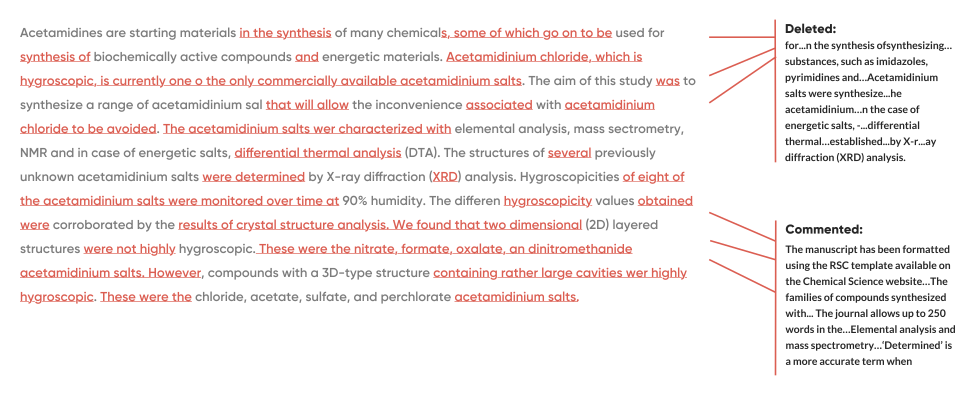
Academic editing is a specialized service that refines scholarly writing beyond basic proofreading, focusing on enhancing clarity, coherence, structure, and adherence to academic standards for documents like journal articles, theses, and grant proposals, often by subject-matter experts to improve language quality, flow, and publication readiness. It involves checking grammar, spelling, and style, but also strengthening arguments, organizing ideas logically, ensuring correct terminology, and formatting citations to help authors achieve publication and career goals. Academic editing plays a central role in manuscript quality improvement by ensuring clarity and coherence in writing while aligning the document with established scholarly publishing standards.
The majority of professional journals offer comprehensive author guidelines to submit an article. Simply meeting these criteria does not ensure that a paper is acceptable for peer review. Studies show that a significant number of papers pass through editorial review only to be turned down due to clarity, organization and presentation, rather than lack of scientific value [1,2]. This illustrates the need for academic editing before submitting scientifically based manuscripts to academic journals.
1. Understanding Manuscript Readiness in Academic Publishing
Manuscripts will be considered ‘ready for submission’ only if they contain all the required information and meet all the criteria listed on the editorial checklist. From an editorial perspective, a ready manuscript demonstrates:
- Research question is clearly articulated
- Arguments are laid out in a logical manner
- Terminology is applied consistently and accurately
- The manuscript is in alignment with the Journal’s scopes and purposes
The above criteria are typically reviewed by Editors at a very fast pace during the first pass screening process, which makes ‘ready manuscripts’, the defining factor for whether the manuscript moves on to peer review or not.[3,4]
Research manuscript clarity and coherence in writing are therefore essential components of a submission-ready manuscript.
2. The Limitations of Journal Guidelines
Journal instructions are usually generic in nature and do not comprehensively include the different nuances of each Discipline and the evolving editorial expectations. They typically emphasize
- Structure of research articles including IMRaD Format
- The maximum allowable number of words per article and the appropriate reference format
- Ethical Statement (Declaration) and Reporting Checklist
However, Journal Instructions do not typically include guidance on whether manuscripts appropriately articulate their contribution to the field, establish themselves within the existing literature, or remain coherent throughout their sections. While journal guidelines emphasize technical and procedural requirements, many critical aspects influencing editorial and peer-review decisions are not formally articulated
| Covered in Guidelines | Rarely Addressed |
| Formatting and layout | Argument clarity |
| Reference style | Narrative flow |
| Ethical statements | Reader engagement |
| Reporting checklists | Discipline-specific tone |
This gap underscores the importance of professional academic editing services in addressing elements that fall outside formal guidelines.
3. Academic Editing as a Bridge Between Compliance and Evaluation
Academic editing provides an important means of bridging between implicit expectations outlined within journal guidelines and the evaluation process used during peer review. Academic editing is much more than making basic edits, it also includes evaluating manuscripts from an editorial perspective (i.e., looking at the overall structure, level of coherence, etc.) and determining the overall level of “scholarly” positioning[5].
This interpretive function helps to align manuscripts with how editors and reviewers read and assess submissions. Structural editing is a core component of academic editing, ensuring that manuscripts meet both technical requirements and editorial expectations.
4. Structural Coherence and Logical Flow
Poor structural coherence is often a reason for early rejection, when the objectives, methods, results, and conclusions do not logically flow from one another. Academic editing will identify and address issues such as unclear research objectives; repeating, irrelevant, and misplaced information; and abrupt transitions between sections. Through targeted structural editing, manuscripts are reshaped to improve logical progression and overall readability. Studies on peer review emphasize that well-structured manuscripts are perceived as more rigorous and credible, independent of study design quality [4].
5. Clarity and Precision in Scholarly Language
Clarity is a cornerstone of effective scientific communication. Overly complex sentences, ambiguous terminology, and inconsistent phrasing can obscure meaning and frustrate reviewers. Academic editing improves:
- Sentence-level clarity
- Precision of technical terms
- Readability without oversimplification
Readability enhancement achieved through academic editing allows reviewers to focus on scientific merit rather than linguistic interpretation.[1].
6. Consistency as a Marker of Rigor
Academic Editing enhances the consistency of research papers through consistency in the use of terminology, verb tense, and data presentation. Any discrepancies in any of these areas could indicate problems with data processing or analytical ability, regardless of the intention[3], resulting in diminished credibility for the research. Academic editing seeks to bring harmony to all the components of a manuscript to provide a greater degree of credibility. Editing for journal acceptance often depends on maintaining consistency as a signal of scholarly rigor and reliability.
7. Discipline- and Journal-Specific Expectations
Fields of science or medicine utilize different conventions when it comes to how to write research papers, and therefore, how to structure a manuscript. For example, journals related to clinical medicine typically consider transparency of methods and the presentation of ethical challenges as primary elements of a research manuscript. In contrast, theoretical disciplines typically focus on argumentative depth and conceptual clarity. Because of these differences between disciplines, generic publishing guidelines, are not adequate to capture the nuances between disciplines [7]. A manuscript editing company with disciplinary expertise can adapt writing to meet journal- and field-specific expectations. Academic Editing is also cognizant of these differences between disciplines and will structure a manuscript, accordingly, thereby presenting the research in a manner that is accepted within the target academic community.
8. Preparing Manuscripts for Peer Review
Peer reviewers are responsible for providing a holistic assessment of the manuscript and will typically make up their minds about the contents of a manuscript after reading the title, abstract, and early portion of the introduction [8]. By enhancing the early parts of the manuscript through improved focus, coherence and alignment with the goals of the journal, Academic Editor will allow for an ideal scenario for a positive review outcome by the peer reviewer. Editing service for researchers plays a crucial role at this stage by strengthening early sections to improve reviewer engagement and interpretation.
Stage | Primary Focus |
Editorial screening | Scope fit, clarity, structure |
Peer review | Methodology, interpretation, contribution |
Revision | Responsiveness, coherence, transparency |
9. Revision as Intellectual Refinement
Revision is often viewed as a method of making sure that mistakes have been corrected; however, effective revisions involve refining an author’s argument, improving the author’s presentation of their argument, and increasing the clarity of the interpretation. Academic editing facilitates this iterative evolving process of revision by allowing authors to respond to comments from editors/reviewers in terms of both expressed and implied feedback.
10. Ethical and Reporting Considerations Beyond Checklists
Internationally recognized reporting standards/conventions such as the CONSORT and the PRISMA improve transparency, but only if the information presented is clearly articulated. In an effort to enhance ethical communication about research, academic editing promotes the logical flow, completeness, and interpretability of research results, supporting responsible research communication. Adherence to scholarly publishing standards is reinforced when ethical reporting is supported by clear and consistent academic writing.
11. From Guidelines to Readiness – How Academic Editing Enhances Manuscripts

Together, these stages demonstrate the role of academic editing in closing gaps between technical compliance and scholarly clarity.
Connect with us to explore how we can support you in maintaining academic integrity and enhancing the visibility of your research across the world!
Conclusion
Journal guidelines are a necessary foundation for manuscript preparation, but they are not sufficient indicators of readiness. Academic editing addresses the qualitative dimensions of scholarly communication that influence editorial and peer-review outcomes. By bridging the gap between formal requirements and evaluative expectations, academic editing contributes meaningfully to the clarity, rigor, and credibility of academic manuscripts.
Strengthen your manuscript beyond compliance. Pubrica’s academic editing services help transform guideline-ready drafts into peer-review-ready publications. [ Get Expert Publishing Support] or [Schedule a free Consultation].
References
- Day, R. A., & Gastel, B. (n.d.). How to write and publish a scientific paper in the seventh edition. Cambridge.org. Retrieved January 12, 2026, from https://assets.cambridge.org
- Byrne, D. W. (2000). Publishing your medical research paper. Lippincott Williams & Wilkins https://idiscover.lib.cam.ac.uk
- Bavdekar S. B. (2015). Writing Introduction: Laying the Foundations of a Research Paper. The Journal of the Association of Physicians of India, 63(7), 44–46. https://pubmed.ncbi.nlm.nih.gov
- Bordage G. (2001). Reasons reviewers reject and accept manuscripts: the strengths and weaknesses in medical education reports. Academic medicine: journal of the Association of American Medical Colleges, 76(9), 889–896. https://doi.org/10.1097/00001888
- Wager, E., & Kleinert, S. (2014). Responsible research publication: international standards for authors. Prilozi (Makedonska akademija na naukite i umetnostite. Oddelenie za medicinski nauki), 35(3), 29–33. https://pubmed.ncbi.nlm.nih.gov
- Gopen, G. D., & Swan, J. A. (n.d.). The science of scientific writing. Usenix.org. Retrieved January 12, 2026, from https://www.usenix.org/sites/default/files/
- Sun, J., & Hyland, K. (2001). Disciplinary discourses: Social interactions in academic writing. TESOL Quarterly, 35(2), 344. https://doi.org/10.2307/3587657
- Hartley J. (2004). Current findings from research on structured abstracts. Journal of the Medical Library Association: JMLA, 92(3), 368–371. https://pmc.ncbi.nlm.nih.gov/articles