
How to Implement a Flawless Editorial Quality Assurance Checklist for your Publication
- Home
- Publication Support
- Journal Selection
- How to Implement a Flawless Editorial Quality Assurance Checklist for your Publication
An Academy Guide
Interesting topics

How to Implement a Flawless Editorial Quality Assurance Checklist for your Publication
Implementing a flawless editorial quality assurance (QA) checklist for a publication requires a structured, multi-stage process that covers everything from initial content creation to final publication. A comprehensive checklist should focus on consistency, accuracy, clarity, and adherence to style guides [1]. This article provides you with guidance on how to successfully implement an editorial QA checklist for your publication’s content.
1. Identify Your Editorial Standards and Guidelines
The first step to developing an editorial quality assurance checklist is to clearly identify your publication’s editorial standards for scientific editing. Your editorial guidelines will serve as the foundation for maintaining consistency and quality in all published material.[2]
- Tone and Voice: The tone of your publication should be clearly defined (e.g., professional, conversational, formal, etc.). Consistent use of tone will create a cohesive reading experience for the audience.
- Style Guide: A comprehensive editorial style guide should include your publication’s grammar rules, spelling conventions (how to spell/abbreviate key terms), punctuation, formatting (headings, bullet points, etc.) and style guidelines for your publication’s voice.
- Accuracy and Sourcing Guidelines: Editorial guidelines should provide editors with the proper tools to research and reference information accurately as well as to ensure that all information is backed up by credible sources.
2. Create the Editorial QA Checklist
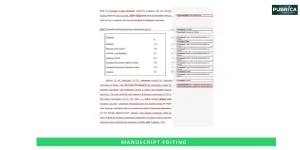
Once editorial guidelines are established, the next step is to set up an Editorial QA checklist. The editorial checklist should contain checkpoints in multiple ways to ensure the content is error-free and meets those published editorial standards. Here’s an example of an editorial QA checklist: [3]
3. The Role of Formatting in the Review Process
While most researchers focus on writing quality content, several factors besides content matter in the review process. First, peer review journals receive large volumes of content; therefore, any submitted manuscripts not following journal submission requirements are often missed or delayed due to high volumes of submissions. The submission process involves more than just submitting a document. Properly formatted manuscripts reduce the chance of rejection and streamline the process, enabling quicker review and acceptance.[5] Adhering to the correct manuscript formatting guidelines, including the Standard IMRaD format (Introduction, Methods, Results, and Discussion) will reduce the chances of delays and ensure smoother processing.
| Checklist Category | Key Actions |
|---|---|
| Content Accuracy |
|
| Grammar and Style |
|
| SEO Optimization |
|
| Visuals and Formatting |
|
| Legal and Ethical |
|
A thorough editorial QA checklist ensures every content piece meets the required quality standards and fits the publication’s brand identity. Incorporating an editorial checklist for content review is crucial of manuscript editing in delivering publication-ready manuscripts that meet editorial guidelines and publication standards.
3. Establish the QA Workflow
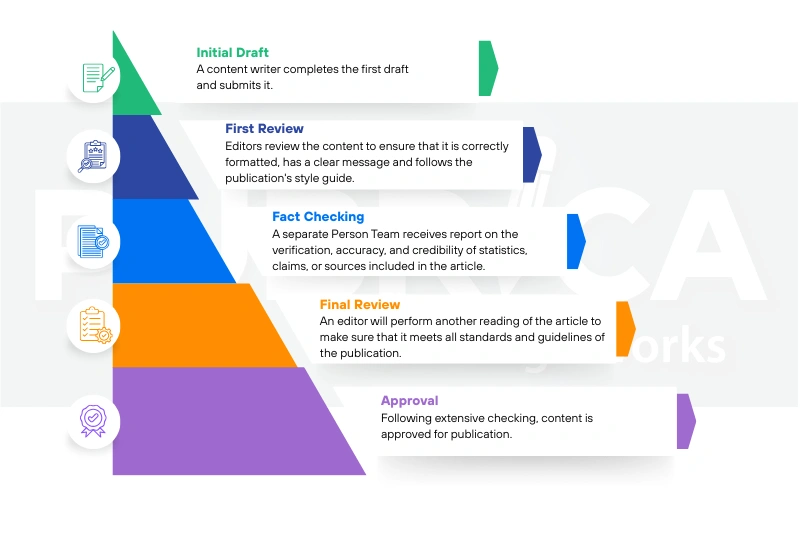
This workflow aligns with the comprehensive Content Review Process that ensures consistent and high-quality scholarly manuscripts. Once content has passed through the thorough Content Review Process, journal submission support comes into play. Editors help refine the manuscript to ensure it meets the specific requirements of academic journals, from formatting to addressing the journal’s submission guidelines
4. Assign Editorial Roles and Responsibilities
To improve efficiency in the QA process, assign specific roles to each member of your editorial team. Each member of your editorial staff should have clearly defined responsibilities, so that items in the review process are not overlooked.
| Role | Responsibility |
|---|---|
| Content Writers |
|
| Copy Editors |
|
| Fact-Checkers |
|
| SEO Specialist |
|
| Design / Visual Team |
|
By assigning individual roles to different team members, every content quality area will receive attention. For instance, fact checkers focus solely on verifying fact and copy editors focus on accuracy and clarity when correcting grammatical errors.[5] This ensures that each aspect of the content adheres to the Editorial Quality Guidelines and Metadata Optimization Checklist.
When working on larger academic projects such as thesis editing, it’s critical that each chapter follows the established Editorial Quality Guidelines. A comprehensive Content Accuracy Checklist can ensure that every section, from the introduction to the conclusion, maintains accuracy, clarity, and consistency throughout the manuscript.
5. Leverage Editorial Tools and Software
The use of Editorial tools greatly reduces the time required for a QA review, resulting in quicker review times and improved accuracy for the requestor.
The following are recommended key editorial tools: Grammarly, an AI-based tool for grammar and style checking; Hemingway Editor, which identifies complex sentences and improves readability; Copy scape, a plagiarism detection tool to ensure content originality; and Yoast SEO, a WordPress plugin that helps optimize content for search engines by offering suggestions on keyword usage and readability.
- Utilizing these tools allows for the production of high-quality and SEO friendly content while reducing the amount of manual labour involved in producing the content.[6]
- Effective research paper editing involves not only the correction of grammar and style but also ensuring that the research methodology, references, and data analysis are presented clearly.
- In the final stages of the editorial process, academic proofreading ensures that no errors whether grammatical, typographical, or syntactical are left in the manuscript before it is submitted for publication
6. Regularly Review and Update the QA Checklist
As Editorial Standards Change, Challenge Yourself to Update the Quality Assurance Checklist. The more frequently you update the Quality Assurance Checklist, the easier it is to keep the most current content available per our industry’s best practices and ever-changing trends in SEO, Writing Style, Technology, etc.[7]. Here are some
Tips for Maintaining Your Checklist:
- Review the Quality Assurance Checklist on a quarterly basis to ensure it reflects the Most Recent Best Practices
- Incorporate suggestions for how this checklist can be improved via feedback received from everyone-Authors, Editors, Readers, etc.
- Make updates to the Quality Assurance Checklist when SEO algorithms change and any new Grammar Trends arise and as Editorial Standards evolve
Keeping your checklist updated is a key part of the Editorial QA Checklist and ensures adherence to industry standards and evolving content accuracy checklist.
Many academic professionals and researchers rely on Pubrica editorial services to enhance their manuscripts. Their specialized support includes everything from scholarly manuscript editing to final journal submission support, ensuring that each piece is publication-ready.
Conclusion
Establishing an excellent, error-free Editorial Q&A Checklist is key to delivering a consistent level of quality to your audience and meeting the standards of your Publisher. By defining editorial requirements, developing a comprehensive Editorial Quality Assessment Checklist (EQA), creating a streamlined Editorial Evaluation Process, and using appropriate editorial tools, you will create a platform that provides accurate, consistent and error-free publications. Periodically reviewing and updating your checklist on a regular basis will allow you to keep your editorial process in alignment with developing trends/best practices so that your publications remain at the highest level of excellence.
Contact Pubrica Editorial Services for academic editing, scholarly manuscript editing, and journal submission support. Let us help you create publication-ready manuscripts! [Get Expert Publishing Support] or [Schedule Free Consultation].
References
- Quality Control in Scientific Publishing: what is it actually like to review papers?(2020, October 30). Girlymicro. https://girlymicrobiologist.com/2020/10/30/quality-control-in-scientific-publishing-what-is-it-actually-like-to-review-papers/
- Sudhakar, N. (2025, January 7). How to create editorial standards for quality and integrity in publishing? https://blog.quintype.com/industry/how-to-create-editorial-standards-for-quality-and-integrity-in-publishing
- Rastogi, A. (2024, December 4). How to create an editorial checklist for advanced content teams. Multicollab. https://www.multicollab.com/blog/create-an-editorial-checklist/
- Lakic, N. (2025, October 16). How to implement an editorial QA checklist. EasyContent.Io. https://easycontent.io/resources/how-to-implement-an-editorial-qa-checklist/
- Rushby, N. J., & Institute of Psychology and Education at Kazan (Volga Region) Federal University. (2018). Quality Assurance in journal editorial processes. World-Class Scientific Publication – 2018: Editorial Policy, Open Access, Scientific Communications. https://doi.org/10.24069/2542-0267-2018-1-2-6-12
- : what is it actually like to review papers?(2020, October 30). Girlymicro. https://girlymicrobiologist.com/2020/10/30/quality-control-in-scientific-publishing-what-is-it-actually-like-to-review-papers/
- Bataineh, A. Q., Qasim, D., Idris, M., & A. Abu-AlSondos, I. (2025). The evolution of SEO strategies: from keywords to user experience in private universities of Jordan. Cogent Business & Management, 12(1). https://doi.org/10.1080/23311975.2025.2491678