
- Services
- Discovery & Intelligence Services
- Publication Support Services
- Sample Work
Publication Support Service
- Editing & Translation
-
Editing and Translation Services
- Sample Work
Editing and Translation Service
-
- Research Services
- Sample Work
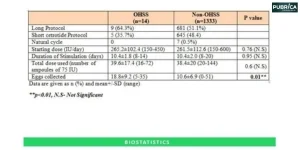
Research Services
- Physician Writing
- Sample Work
Physician Writing Service
- Statistical Analyses
- Sample Work
Statistical Analyses
- Data Collection
- AI and ML Services
- Sample Work
AI and ML Services
- Medical Writing
- Sample Work
Medical Writing
- Research Impact
- Sample Work
Research Impact
- Medical & Scientific Communication
- Sample Work
Medical & Scientific Communication
- Medico Legal Services
- Educational Content
- Academic Editorial Services
- Sample Work
Academic Editorial Services
- Educational Editorial Service
-
Education Editorial Services
- Sample Work
Education Editorial Services
-
- Industries
- Subjects
- About Us
- Academy
- Insights
- Contact Us
Scoping Reviews in Research: Methods, Standards, and Challenges
- Home
- Academy
- Publication support
- Scoping Reviews in Research: Methods, Standards, and Challenges
Research Impact
- What Is a Scoping Review? Definition and Purpose
- When to Choose a Scoping Review Over a Systematic Review
- Methodological Frameworks for Conducting Scoping Reviews
- Search Strategy and Study Selection in Scoping Reviews
- Data Charting and Evidence Mapping Techniques
- Reporting Standards for Scoping Reviews; PRISMA ScR
- Key Challenges in Conducting Scoping Reviews
Interesting topics
Scoping Reviews in Research: Methods, Standards, and Challenges
1. What Is a Scoping Review? Definition and Purpose
2. When to Choose a Scoping Review Over a Systematic Review
3. Methodological Frameworks for Conducting Scoping Reviews
4. Search Strategy and Study Selection in Scoping Reviews
5. Data Charting and Evidence Mapping Techniques
6. Reporting Standards for Scoping Reviews; PRISMA ScR
7. Key Challenges in Conducting Scoping Reviews
Scoping reviews are a form of knowledge synthesis used to systematically map the volume, nature, and characteristics of evidence on a topic, often to identify research gaps. Adhering to iterative methods (usually Arksey & O’Malley) and PRISMA-ScR standards, they are flexible, exploratory, and typically skip quality assessment. Within evidence synthesis methods, scoping reviews play a central role in mapping existing literature and supporting research gap identification.
Scoping reviews have gained popularity in recent years as an effective means of synthesising knowledge to gain both a complete and in-depth view of the existing evidence on a particular topic. In contrast to systematic reviews, which attempt to answer very narrowly defined questions, scoping reviews investigate research areas that are more complex, varied and evolving due to ongoing development of both conceptual and methodological aspects and evidence source types. Across various fields (including but not limited to health sciences, social sciences, education, and policy research), scoping reviews are frequently used to identify areas where further research is needed, to clarify key concepts and/or to provide direction for future research.[1]
1. What Is a Scoping Review? Definition and Purpose
A scoping review is a type of literature that includes research done on a specific topic, regardless of the type of study design or the quality of each study’s methodology, and has four main purposes:
- To examine the extent, range, and nature of research activity.
- To clarify key concepts, definitions, and terminology
- To identify gaps in knowledge and future directions for research; and
- To provide information regarding whether a full systematic review may be appropriate or necessary.
Scoping reviews usually serve as an effective method to address very broad geographic or subject area research questions, as exploratory hypotheses, or for understanding how research has been conducted, rather than estimating the effects of an intervention.[2] From a scoping review methodology perspective, this approach emphasizes conceptual framework in scoping review design rather than outcome synthesis.
Scoping Review: Maps the breadth, concepts, and types of evidence on a broad or emerging topic without assessing effect sizes.
Systematic Review: Synthesizes evidence from predefined studies to answer a focused research question, often including critical appraisal and meta-analysis.
Narrative Review: Provides a descriptive, expert-driven summary of literature without a structured search or formal synthesis methods.
If your objective is to map evidence rather than judge effectiveness, a scoping review is often the most appropriate design.
2. When to Choose a Scoping Review Over a Systematic Review
Selecting the right type of review for methodological strength will be enhanced through using a Scoping Review when:
- The topic of the review is emerging or poorly defined.
- There is an expectation of various forms of study design, including many different types of sources of evidence.
- The outcome and intervention categories will vary significantly.
- The purpose of the review is for conceptual clarification and not for combining effect sizes.
A scoping review is particularly well-suited when the intent is to explore, map, or clarify evidence rather than to synthesise effect sizes or assess intervention effectiveness.[3]
Aspect | Scoping Review | Systematic Review |
Research question | Broad, exploratory | Narrow, focused |
Study designs included | All relevant designs | Predefined designs |
Critical appraisal | Usually not mandatory | Essential |
Quantitative synthesis | Rare | Common (meta-analysis) |
Primary outcome | Evidence mapping | Effect estimation |
This distinction is central to understanding systematic review vs scoping review approaches in academic research.
3. Methodological Frameworks for Conducting Scoping Reviews
Arksey and O’Malley created the basic framework for a scoping review while Levac et al later improved this method. JBI Methodology Guidance shows what we should now consider to be best practice.[4] These foundations underpin how to conduct a scoping review in a methodologically rigorous and transparent manner. Scoping Review Protocol development is increasingly recommended to enhance transparency and reproducibility before study initiation.
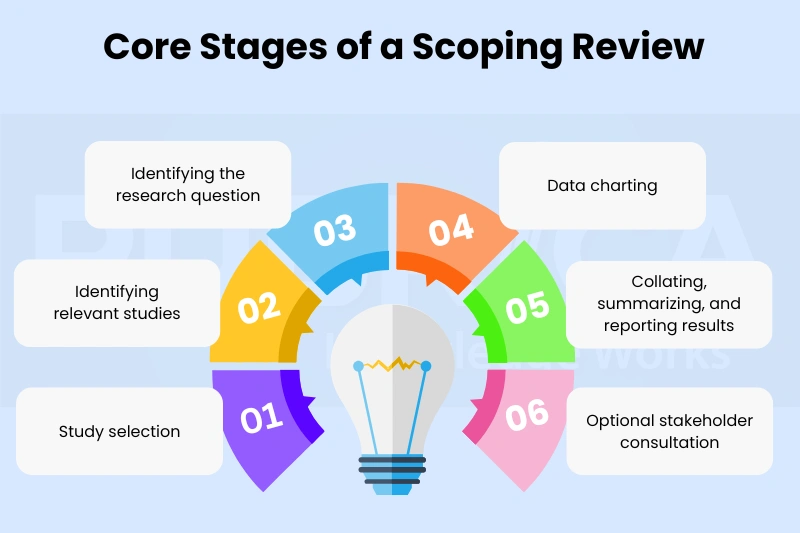
The research question will typically use the PCC (Population, Concept and Context) approach rather than PICO framework, which is the framework for conducting a systematic review.
Example for Using the PCC Framework in a Scoping Review
Population: Healthcare workers (e.g., physicians, nurses, allied health professionals)
Concept: Burnout measurement tools and assessment instruments
Context: Low- and middle-income countries across healthcare settings
This PCC formulation helps define the scope of the review by specifying who is being studied, what is being examined, and in which setting, thereby guiding the search strategy and study selection process.
4. Search Strategy and Study Selection in Scoping Reviews
High-quality scoping review requires comprehensive, transparent search strategies, and typically these include:
- Multiple bibliographic databases (e.g., MEDLINE, Scopus, Web of Science)
- Grey literature sources (e.g., reports, theses, policy documents)
- Manual reference list screening
While systematic reviews will usually use a fixed search strategy, scoping reviews may allow an iterative search strategy, adapted over time as the reviewers become familiar with the literature. Selection of my studies is generally done by at least two independent reviewers to minimise the chance of bias in the selection process.[5] Such practices are frequently supported through scoping review consulting and academic literature review services.
5. Data Charting and Evidence Mapping Techniques
Scoping reviews involve the use of data charts to record essential elements about each study, rather than recording full detailed outcome data. Commonly charted elements include:
Data Domain | Examples |
Bibliographic details | Author, year, journal |
Study context | Setting, population |
Conceptual focus | Definitions, frameworks |
Evidence type | Quantitative, qualitative, mixed methods |
Key findings | Themes, trends, gaps |
Charted data is typically displayed using a range of visualisation techniques including descriptive numerical summaries, thematic groupings, tables and visual maps. These techniques are fundamental to mapping existing literature in a transparent and reproducible manner.
6. Reporting Standards for Scoping Reviews; PRISMA ScR
The PRISMA extension for Scoping Reviews (PRISMA-ScR) has been created to help with transparency and reproducibility of scoping reviews. This includes a 22-item checklist which lists the minimum requirements for reporting on a Scoping Review including the rationale for the review, the eligibility criteria, the search strategy, and the synthesis methodology. Following the PRISMA-ScR guidelines will improve the credibility of the Scoping Review’s methods and thus increase its chances of being published in high-quality journals. Increasingly, journals and publishers emphasize PRISMA-ScR Guidelines to ensure reporting quality. PRISMA-ScR Compliance Services support authors in ensuring that scoping reviews fully adhere to PRISMA-ScR reporting requirements, improving transparency, methodological rigour, and publication readiness.
Research Tip: Include a PRISMA flow diagram even when exclusions are iterative or exploratory.
7. Key Challenges in Conducting Scoping Reviews
Scoping reviews are flexible in nature; however, they do present various methodological challenges:
- The conceptual ambiguity of poorly defined concepts can lead to reviews that are either extremely broad or too unfocused
- The sheer volume of records may overburden available resources
- The absence of critical appraisal limits the interpretability of findings for potential decision-making
- Inconsistent reporting of results limits the degree to which reviews can be compared
The balance between comprehensiveness and feasibility has been one of the most persistent methodological tensions.[6,7]
Connect with us to explore how we can support you in maintaining academic integrity and enhancing the visibility of your research across the world!
Conclusion
Scoping reviews are now a mainstream research tool, particularly suited to interdisciplinary and rapidly evolving fields. Ongoing methodological refinements, greater standardisation, and improved reporting practices will further strengthen their contribution to evidence-based research. When conducted rigorously and reported transparently, scoping reviews provide invaluable insight into what is known, what is uncertain, and where future research should focus. As a result, scoping review services and scoping review consulting have become integral components of modern academic literature review services. As the demand for rigorously conducted and transparently reported scoping reviews grows, publication support plays a critical role in ensuring methodological quality, reporting compliance, and successful dissemination in high-quality journals.
Need expert support with scoping review methodology or PRISMA-ScR compliance? Pubrica provides end-to-end scoping review services, protocol development, and publication support to enhance methodological rigor and publication success. [Get Expert Publishing Support] or [Schedule a Free Consultation].
References
- Peters, M. D., Godfrey, C. M., Khalil, H., McInerney, P., Parker, D., & Soares, C. B. (2015). Guidance for conducting systematic scoping reviews. International journal of evidence-based healthcare, 13(3), 141–146. https://doi.org/10.1097/XEB.0000
- Munn, Z., Peters, M. D. J., Stern, C., Tufanaru, C., McArthur, A., & Aromataris, E. (2018). Systematic review or scoping review? Guidance for authors when choosing between a systematic or scoping review approach. BMC medical research methodology, 18(1), 143. https://doi.org/10.1186/s12874-018-0611-x
- Tricco, A. C., Lillie, E., Zarin, W., O’Brien, K. K., Colquhoun, H., Levac, D., Moher, D., Peters, M. D. J., Horsley, T., Weeks, L., Hempel, S., Akl, E. A., Chang, C., McGowan, J., Stewart, L., Hartling, L., Aldcroft, A., Wilson, M. G., Garritty, C., Lewin, S., … Straus, S. E. (2018). PRISMA Extension for Scoping Reviews (PRISMA-ScR): Checklist and Explanation. Annals of internal medicine, 169(7), 467–473. https://doi.org/10.7326/M18-0850
- Peters, M. D. J., Marnie, C., Tricco, A. C., Pollock, D., Munn, Z., Alexander, L., McInerney, P., Godfrey, C. M., & Khalil, H. (2020). Updated methodological guidance for the conduct of scoping reviews. JBI evidence synthesis, 18(10), 2119–2126. https://doi.org/10.11124/JBIES-20-00167
- Pham, M. T., Rajić, A., Greig, J. D., Sargeant, J. M., Papadopoulos, A., & McEwen, S. A. (2014). A scoping review of scoping reviews: advancing the approach and enhancing the consistency. Research synthesis methods, 5(4), 371–385. https://doi.org/10.1002/jrsm.1123
- Colquhoun, H. L., Levac, D., O’Brien, K. K., Straus, S., Tricco, A. C., Perrier, L., Kastner, M., & Moher, D. (2014). Scoping reviews: time for clarity in definition, methods, and reporting. Journal of clinical epidemiology, 67(12), 1291–1294. https://doi.org/10.1016/j.jclinepi
- Daudt, H. M., van Mossel, C., & Scott, S. J. (2013). Enhancing the scoping study methodology: a large, inter-professional team’s experience with Arksey and O’Malley’s framework. BMC medical research methodology, 13, 48. https://doi.org/10.1186/1471-2288-13-48