
- Services
- Discovery & Intelligence Services
- Publication Support Services
- Sample Work

Publication Support Service
- Editing & Translation
-
Editing and Translation Services
- Sample Work

Editing and Translation Service
-
- Research Services
- Sample Work

Research Services
- Physician Writing
- Sample Work
Physician Writing Service
- Statistical Analyses
- Sample Work

Statistical Analyses
- Data Collection
- AI and ML Services
- Sample Work
AI and ML Services
- Medical Writing
- Sample Work
Medical Writing
- Research Impact
- Sample Work
Research Impact
- Medical & Scientific Communication
- Sample Work
Medical & Scientific Communication
- Medico Legal Services
- Educational Content
- Academic Editorial Services
- Sample Work
Academic Editorial Services
- Educational Editorial Service
-
Education Editorial Services
- Sample Work
Education Editorial Services
-
- Industries
- Subjects
- About Us
- Academy
- Insights
- Contact Us
Why Use the PICO Framework in Research?
- Home
- Academy
- Poster Presentation
- Why Use the PICO Framework in Research?
Research Impact
Interesting topics
Why Use the PICO Framework in Research?
1. Definition of the PICO Framework
2. Key Characteristics of the PICO Framework
3. Components of the PICO Framework
4. Types of Research Questions Addressed by PICO
5. Steps in Using the PICO Framework
6. Role of PICO in Literature Searching
7. Applications of the PICO Framework
8. Example of a PICO Research Question
In research, the PICO framework in research allows researchers to create clear, focused, and answerable PICO research questions. A poorly defined, non-structured research question often leads to ambiguous or vague research objectives, which may cause inefficient literature searches and weak evidence-based research methodology. Utilising the PICO systematic approach for defining the basic research components allows for a better understanding of what you will research and supports formulating focused research questions. The clarity and precision of the population intervention comparison outcome structure are particularly valuable when conducting evidence-based research, as these qualities allow for the drawing of valid and reliable conclusions from the data collected. [1]
The PICO framework in evidence-based practice is widely used within Health, Nursing, and Public Health, as well as Clinical Research, as a clinical research question framework to ethically and practically assess the intervention, comparison, and outcome components of the research.[2]
1. Definition of the PICO Framework
The PICO framework provides a structure for creating clearly defined research questions, based on four components:
- population (P)
- intervention (I)
- comparison (C)
- Outcome (O)
The PICO framework supports evidence-based research support by helping researchers design and conduct studies and develop an effective PICO search strategy to search for relevant literature and support clinical and research decision-making.[3]
2. Key Characteristics of the PICO Framework
The PICO framework is a structured tool used in evidence-based healthcare to develop clear and focused clinical research questions. By defining the Population, Intervention, Comparison, and Outcome, it strengthens evidence-based research methodology, guides effective literature searching, and improves clinical decision-making.[3]
Feature | Description | Example |
Structured Design | Breaks research questions into clear components | Clinical intervention study |
Research Focus | Prevents broad or unclear research questions | Specific patient outcome |
Evidence-Based Orientation | Supports systematic reviews and trials | Healthcare guidelines |
Non-Experimental & Experimental Use | Applicable across study designs | RCTs and observational studies |
Efficiency | Improves database search accuracy | PubMed keyword strategy |
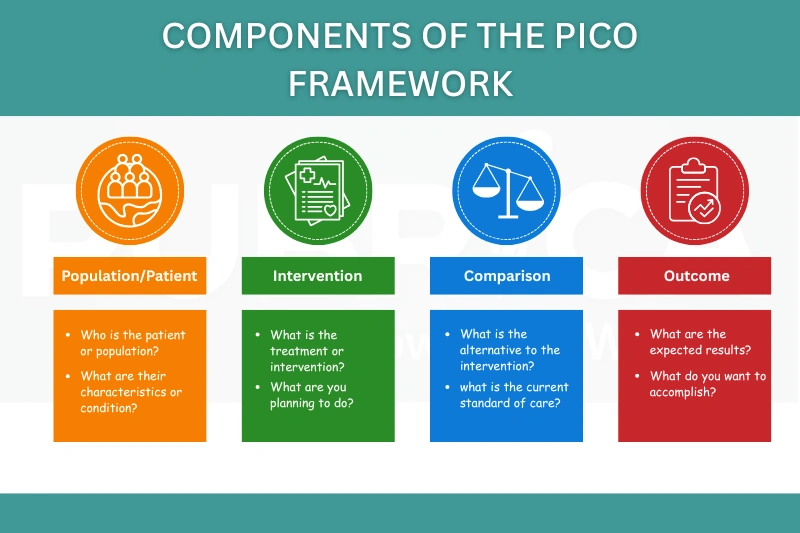
3. Components of the PICO Framework
The PICO framework consists of four interrelated components that define the scope of a research question and support systematic review question development. [4]
4. Types of Research Questions Addressed by PICO
The PICO framework can be adapted to different types of research questions depending on the study objective and is widely used in systematic review writing support. [5]
Type | Description | Example |
Therapy | Evaluates treatment effectiveness | Drug A vs. Drug B |
Diagnosis | Assesses diagnostic accuracy | MRI vs. CT scan |
Prognosis | Predicts disease outcomes | Survival rate analysis |
Etiology | Identifies risk factors | Smoking and lung disease |
Prevention | Examines preventive measures | Vaccination effectiveness |
5. Steps in Using the PICO Framework
The PICO framework is used to structure a patient’s clinical, therapeutic, or preventative issue using a systematic and ethical research process. These steps enhance evidence-based research support and ensure methodological rigour. [3]
- Identify the Population of Interest
- Define the Intervention Exposure
- Determine an Appropriate Comparison
- Define Measurable Outcomes
- Integrate these into a Single Research Question.
6. Role of PICO in Literature Searching
With the aid of a structured PICO search strategy, users of major databases such as PubMed, Scopus, and the Cochrane Library can enhance the process of obtaining high-quality evidence. The PICO framework improves the accuracy of searches, reduces irrelevant results, and supports systematic review question development and synthesis. [6]
7. Applications of the PICO Framework
The PICO framework is widely used across multiple research disciplines:
- Healthcare: Evidence-based clinical decision-making
- Nursing: Practice-based research questions
- Public Health: Intervention and prevention studies
- Education: Structured research planning
- Systematic Reviews: Study identification and synthesis. [7]
Example of a PICO Research Question
In elderly patients with hypertension (P), does regular aerobic exercise (I) compared to no structured physical activity (C) reduce systolic blood pressure (O)?
Among elderly patients diagnosed with hypertension, does participation in regular aerobic exercise compared with no structured physical activity lead to a reduction in systolic blood pressure?
Connect with us to explore how we can support you in maintaining academic integrity and enhancing the visibility of your research across the world!
Conclusion
The PICO framework will continue to be one of the most important tools in evidence-based research methodology, supporting research question development and improving research quality. Defining the population, intervention, comparison, and outcomes using the PICO framework for systematic review allows for improved research design, literature searching, and data analysis. While the PICO framework has been instrumental in healthcare research, it can be applied across multiple research disciplines. Ultimately, effective use of the PICO framework enhances the quality, transparency, and impact of research outcomes.
Why Use the PICO Framework in Research? Our Pubrica consultants are here to guide you. [Get Expert Publishing Support] or [Schedule a Free Consultation]
Frequently asked questions
1. What is the PICO framework in research?
The PICO framework is a widely used mnemonic tool in evidence-based practice and research to formulate precise, structured, and answerable clinical questions. It is primarily used to break down complex research problems into four key components to facilitate efficient literature searches and, ultimately, to improve the quality of Evidence-Based Medicine (EBM).
2. Why is the PICO framework important in evidence-based research?
it provides a structured, focused way to formulate clear clinical questions, guiding efficient literature searches, improving study design, reducing bias, and ensuring relevance for better clinical decision-making in healthcare. It transforms vague information needs into answerable, searchable queries, making the process of finding and applying the best evidence systematic and reproducible.
3. How does the PICO framework help in formulating a research question?
The PICO framework (Population, Intervention, Comparison, Outcome) helps formulate focused research questions by breaking them into key components, making them clear, specific, and searchable, which guides literature searches, study design, and evidence appraisal by defining the target group, action, alternative, and desired result, ensuring all aspects of the clinical problem are addressed systematically.
4. How is the PICO framework used for systematic reviews and literature searches?
The PICO (Population, Intervention, Comparison, Outcome) framework structures research questions for systematic reviews by breaking them into four key components, making literature searches more focused, efficient, and transparent, helping identify relevant studies, defining clear search terms (synonyms, keywords) for databases, and ensuring a systematic, reproducible process for evidence-based practice
5. What is the difference between the PICO and PEO frameworks in research?
The PICO and PEO frameworks are both structured, evidence-based tools used to formulate research questions, but they differ primarily in their methodology: PICO is generally used for quantitative (interventional) research, while PEO is best suited for qualitative or observational studies.
References
- Eldawlatly, A., Alshehri, H., Alqahtani, A., Ahmad, A., Al-Dammas, F., & Marzouk, A. (2018). Appearance of Population, Intervention, Comparison, and Outcome as research question in the title of articles of three different anesthesia journals: A pilot study. Saudi journal of anaesthesia, 12(2), 283–286. https://doi.org/10.4103/sja.SJA_767
- Tucker, S., Edmonds, S. W., Cullen, L., Hanrahan, K., & Laures, E. (2023). The problem with PICO for finding the best evidence: Fishing with the wrong bait and the SEARCH solution. Journal of Perianesthesia Nursing, 38(5), 809–812. https://doi.org/10.1016/j.jopan.2023
- Cumpston, M. S., McKenzie, J. E., Thomas, J., & Brennan, S. E. (2020). The use of ‘PICO for synthesis’ and methods for synthesis without meta-analysis: protocol for a survey of current practice in systematic reviews of health interventions. F1000Research, 9, 678. https://doi.org/10.12688/f1000
- Schardt, C., Adams, M.B., Owens, T. et al.Utilization of the PICO framework to improve searching PubMed for clinical questions. BMC Med Inform Decis Mak 7, 16 (2007). https://doi.org/10.1186/1472-6947-7-16
- Covvey, J. R., McClendon, C., & Gionfriddo, M. R. (2024). Back to the basics: Guidance for formulating good research questions. Research in social & administrative pharmacy : RSAP, 20(1), 66–69. https://doi.org/10.1016/j.sapharm
- Eriksen, M. B., & Frandsen, T. F. (2018). The impact of patient, intervention, comparison, outcome (PICO) as a search strategy tool on literature search quality: a systematic review. Journal of the Medical Library Association : JMLA, 106(4), 420–431. https://doi.org/10.5195/jmla.2018
- Al-Khabori, M., & Rasool, W. (2022). Introduction to Systematic Reviews and Meta-analyses of Therapeutic Studies. Oman medical journal, 37(5), e428. https://doi.org/10.5001/omj.2022