
What Are the Tools and Standards That Define High-Quality Academic Editing?
- Home
- Publication Support
- Journal Selection
- What Are the Tools and Standards That Define High-Quality Academic Editing?
An Academy Guide
Interesting topics

What Are the Tools and Standards That Define High-Quality Academic Editing?
High-quality academic editing goes beyond correcting grammatical errors; it is about the use of an organised and systematic approach to applying International Standards, using discipline-specific reporting guidelines, and utilising specialised editorial tools to produce clear, transparent, ethically compliant, and journal-ready content. As manuscripts undergo peer review to become even more difficult to read and comprehend, they need to conform to both the linguistic and structural requirements set forth by the International Standards, and to align with the global publishing norms.[1,2]
Academic editing is an essential process for transforming research paper editing outputs into publication-ready manuscripts that meet international journal expectations.
1. The Role of Editorial Standards in Academic Editing
Scholarly Communication is now underpinned by Editorial Standards, which govern ethical and structural aspects. By setting the editorial and authorial expectations for transparency, accountability, and reproducibility for all types of research output, Editorial Standards provide the framework upon which editors and authors rely to achieve their goals.[3]. Scholarly manuscript editing relies on internationally recognised editorial standards to ensure ethical compliance and reporting integrity in academic publishing.
The editorial standards listed below are recognized internationally.
- ICMJE Recommendations for Authorship, Conflicts of Interest and Structure of the Manuscript.
- COPE Guidelines for Publication Ethics and Publication Misconduct
- EQUATOR Network Reporting Guidelines (e.g., CONSORT, PRISMA, STROBE) improve research transparency.
- Style Manuals such as AMA, APA and Vancouver – ensure consistency with regard to citations and presentation.
Editorial Standard | Primary Focus | Manuscript Impact |
ICMJE | Authorship, disclosure, structure | Ethical transparency |
COPE | Publication ethics | Misconduct prevention |
Randomized trials | Reporting completeness | |
Reproducibility | ||
Observational studies | Methodological clarity |
Adhering to Editorial Standards improves the quality of reporting and decreases the likelihood of being rejected. [4]. Professional academic editing services apply these standards to support high-quality academic paper editing for journals.
2. Core Tools Used in High-Quality Academic Editing
The function of editorial tools is to be used in conjunction with the expert judgment of an editor. By incorporating these editorial tools into a structured editorial workflow, they enable greater accuracy, efficiency, and compliance. The common types of tools used to edit academic content include:
- Language and style analysis tools– that help with the grammar/syntax and academic tone of a document. Language editing for academic manuscripts supports clarity, consistency, and accuracy during academic manuscript editing
- Reference management systems– to ensure accuracy and consistency in citing sources/references.
- Plagiarism detection tools-to identify overlap with previously published material and/or issues with ethical behaviour.
- Reporting guideline checklists– to identify compliance with guidelines for working with specific types of studies:
- Terminology consistency tools-for multi-author, inter-discipline studies/ manuscripts.
Journal submission support like journal formatting services for submission aid in preparing manuscripts for peer review using these core tools.
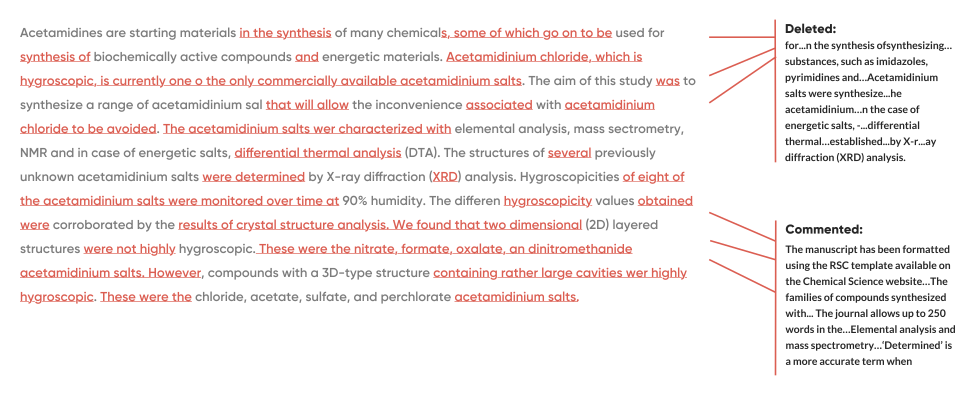
Beyond language correction, academic editing frequently involves improving manuscript organization, coherence, and adherence to journal expectations, as outlined in applied academic editing resources[5]
3. Integrating Tools and Standards in Editorial Workflows
A streamlined editorial workflow that incorporates professional editing tools that comply with established scholarly standards is likely to produce edited manuscripts that have both the proper linguistic style and are suitable for publication in any journal.
Typical editorial workflows that follow established standards include:
- Assessing scholarly journal and scope.
- Assessing compliance with reporting guidelines.
- Implementing tool-based screening assessments of manuscripts.
- Providing editorial service that is performed by experts in the field (i.e., academic editing)
- Conducting ethical compliance checks; and
- Conducting final quality assurance checks.
Structured editorial workflows have demonstrated statistically substantiated improvements in all aspects of the peer-review process and contribute to a more clearly articulated manuscript.[6,7]
4. Layered Framework for High-Quality Academic Editing
This framework illustrates how high-quality academic editing is achieved through the integration of internationally accepted editorial standards, specialised editing tools, and structured workflows that result in publication-ready manuscripts.

5. Ensuring Quality Across Disciplines
Different fields utilize the same tools and standards in different ways. Clinical Research places great emphasis on standardising the way things are reported and making ethical disclosures, however; the Social Sciences tend to place greater emphasis on methodological transparency and ensuring there is consistency in how citations are presented. Therefore, it is important to adapt how Editorial Tools can be used by each specific discipline to meet Reviewer and Editor expectations. Substantive editing for research papers helps address discipline-specific expectations across diverse academic fields.
Conclusion
The combination of high-quality academic editing using editorial tools combined with internationally accepted standards creates an edited manuscript that meets all the ethical, structural, and linguistic criteria required of today’s academic publishers. With publishers placing increased focus on transparency and rigour in their review processes, standards-based, tool-supported editing has become essential for publication success. Academic editorial services remain central to delivering publication-ready manuscripts through rigorous research paper editing and academic proofreading services.
Transform your manuscript into a publication-ready masterpiece. Contact Pubrica today for expert academic editing, journal submission support, and language editing services. [Gt Expert Publishing Support] or [ Schedule Free Consultation].
References
- Icmje.org. Retrieved January 2, 2026, from https://www.icmje.org/recommendations/
- COPE core practices. Publication-ethics.org. Retrieved January 2, 2026, from https://publication-ethics.org/resources/cope-core-practices/
- Understanding editorial standards: A guide for editors. LIS (Library & Information Science) Academy. https://lis.academy/technical-writing/understanding-editorial-standards-guide/
- Altman, D. G., & Simera, I. (2010). Responsible reporting of health research studies: transparent, complete, accurate and timely. The Journal of antimicrobial chemotherapy, 65(1), 1–3. https://doi.org/10.1093/jac/dkp410
- Desai, P. (2024, April 13). Beyond proofreading: Academic editing strategies for success. Mind the Graph Blog. https://mindthegraph.com/blog/academic-editing/
- Galipeau, J., Barbour, V., Baskin, P., Bell-Syer, S., Cobey, K., Cumpston, M., Deeks, J., Garner, P., MacLehose, H., Shamseer, L., Straus, S., Tugwell, P., Wager, E., Winker, M., & Moher, D. (2016). A scoping review of competencies for scientific editors of biomedical journals. BMC medicine, 14, 16. https://doi.org/10.1186/s12916-016-0561-2
- Gasparyan, A. Y., Yessirkepov, M., Voronov, A. A., Koroleva, A. M., & Kitas, G. D. (2018). Updated Editorial Guidance for Quality and Reliability of Research Output. Journal of Korean medical science, 33(35), e247. https://doi.org/10.3346/jkms.2018.33.e247