
- Services
- Discovery & Intelligence Services
- Publication Support Services
- Sample Work
Publication Support Service
- Editing & Translation
-
Editing and Translation Services
- Sample Work
Editing and Translation Service
-
- Research Services
- Sample Work
Research Services
- Physician Writing
- Sample Work
Physician Writing Service
- Statistical Analyses
- Sample Work
Statistical Analyses
- Data Collection
- AI and ML Services
- Sample Work
AI and ML Services
- Medical Writing
- Sample Work
Medical Writing
- Research Impact
- Sample Work
Research Impact
- Medical & Scientific Communication
- Sample Work
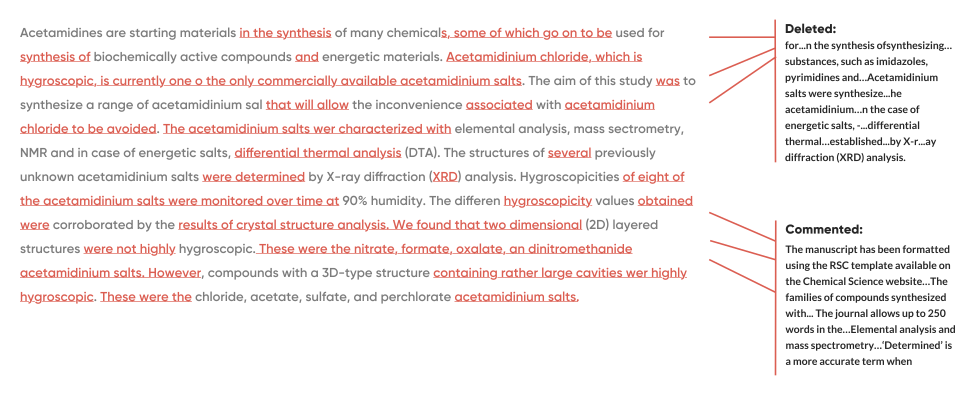
Medical & Scientific Communication
- Medico Legal Services
- Educational Content
- Academic Editorial Services
- Sample Work
Academic Editorial Services
- Educational Editorial Service
-
Education Editorial Services
- Sample Work
Education Editorial Services
-
- Industries
- Subjects
- About Us
- Academy
- Insights
- Contact Us
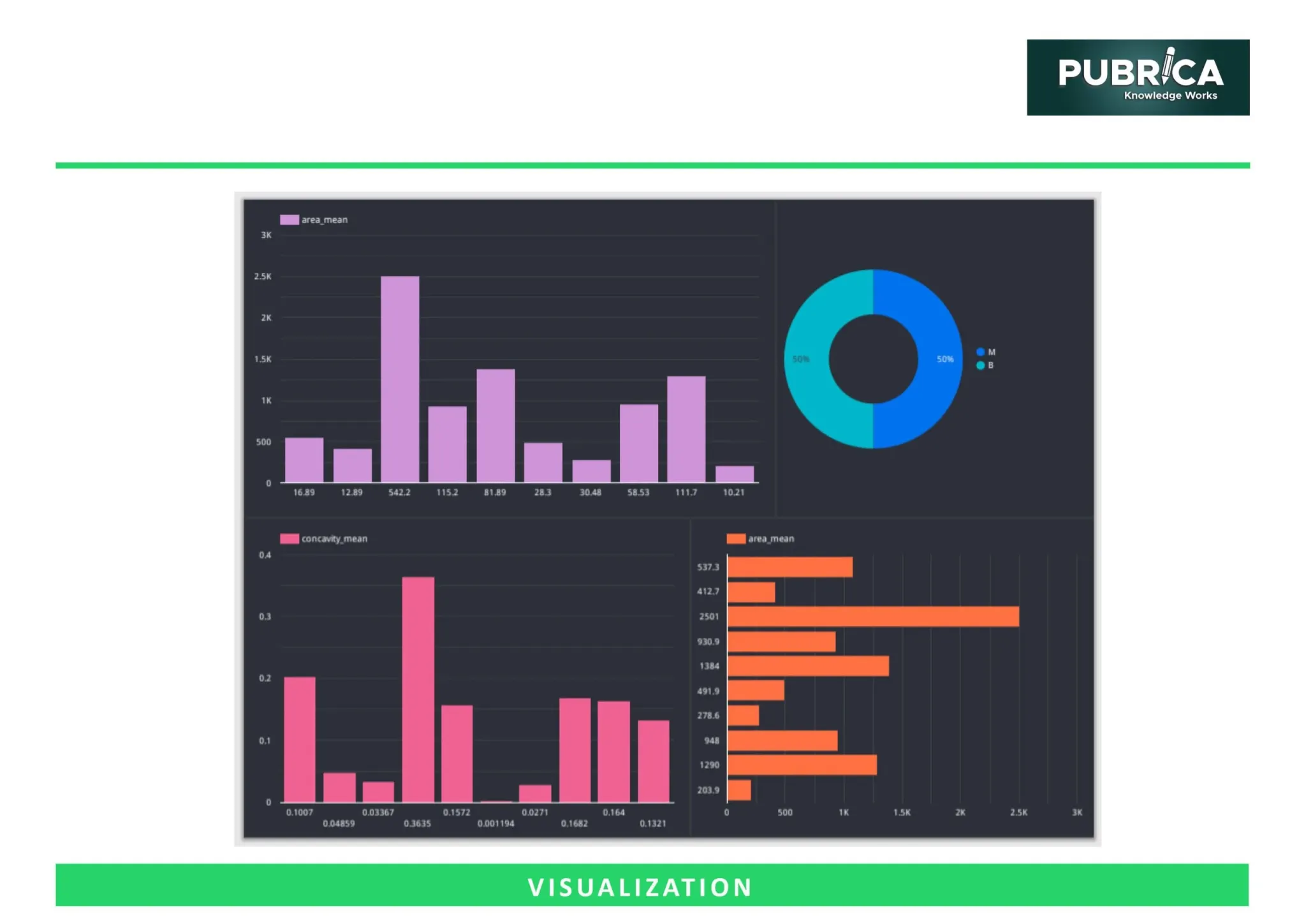
Predictive Analysis in Research: When to Use It and Why
- Home
- Academy
- Poster Presentation
- Predictive Analysis in Research: When to Use It and Why
Research Impact
- What Is Predictive Analysis?
- Why Is Predictive Analysis Useful in Research?
- Common Predictive Modelling Techniques
- When Should Predictive Analysis Be Used in Research?
- Benefits and Limitations of Predictive Analysis
- Research Applications of Predictive Analytics
- Evaluating Model Performance
- Ethical and Practical Considerations
Interesting topics
Predictive Analysis in Research: When to Use It and Why
1. What Is Predictive Analysis?
2. Why Is Predictive Analysis Useful in Research?
3. Common Predictive Modelling Techniques
4. When Should Predictive Analysis Be Used in Research?
5. Benefits and Limitations of Predictive Analysis
6. Research Applications of Predictive Analytics
7. Evaluating Model Performance
8. Ethical and Practical Considerations
Predictive analysis is used in research to forecast future outcomes by analysing historical and current data, crucial for risk mitigation, optimizing operations, personalizing experiences, and enhancing decision-making across industries like finance, healthcare, retail, and marketing. You use it when you need to anticipate trends, predict behaviour, or understand potential future scenarios to guide strategy, improve efficiency, reduce costs, or identify opportunities before they happen, leveraging machine learning and statistical models. Machine learning in predictive analysis and statistical modelling for prediction together form the core of modern future outcome prediction in research-driven environments.
The use of predictive analytics in research is growing rapidly. Predictive analytics will not replace traditional statistical analyses in research; however, it will expand beyond traditional statistical analyses by providing a source of statistical information from a series of previously collected datasets that can be used to predict the likely future outcome based on those datasets.[1,2]
1. What Is Predictive Analysis?
Predictive analytics uses statistical algorithms, machine learning, and data mining, along with old data, to forecast future occurrences. In practice, forecasting with predictive analytics relies on predictive models for research that transform historical patterns into actionable predictions.
Key features include
- Use of historical data to forecast outcomes
- Incorporation of statistical models and machine learning
- Iterative model refinement based on performance tests
This evolution reflects the increasing role of data mining for predictive insights and data science forecasting techniques in contemporary research analytics services.
2. Why Is Predictive Analysis Useful in Research?
Predictive analysis provides several distinct advantages in research:
- Improved Forecast Accuracy: A predictive model uses data patterns to predict future conditions and by doing so, it increases the precision of your projections.[5]
- Informed Decisions: When researchers know the probability of different outcomes occurring, they can make better decisions regarding the design of their study, the number of subjects needed for the study and strategies to reduce their risk.
- Optimized Resource Use: In fields like clinical research, predictive analysis can be used to predict difficulties in recruiting participants and also to pre-determine potential patient drop-out percentages.
3. Common Predictive Modelling Techniques
Different predictive models are suited for different types of research questions. Below is a summary of key model categories:
Model Type | Description | Typical Research Use |
Regression (e.g., linear, logistic) | Describes relationships between inputs and outputs | Predicting the outcome of a particular health condition based on multiple risk factors |
Time-Series Models | Use sequential data collected over a period to predict future events | Forecasting trends in longitudinal studies. |
Decision Trees & Random Forests | Non-linear, classification prediction | Establishing categories of risk for patients |
Neural Networks | Complex pattern recognition | High-dimensional biomedical data |
These statistical modelling for prediction approaches are widely implemented using predictive analytics tools and predictive analytics software in research environments.
4. When Should Predictive Analysis Be Used in Research?
Predictive analysis is not appropriate for every research design. It is most valuable in specific scenarios:
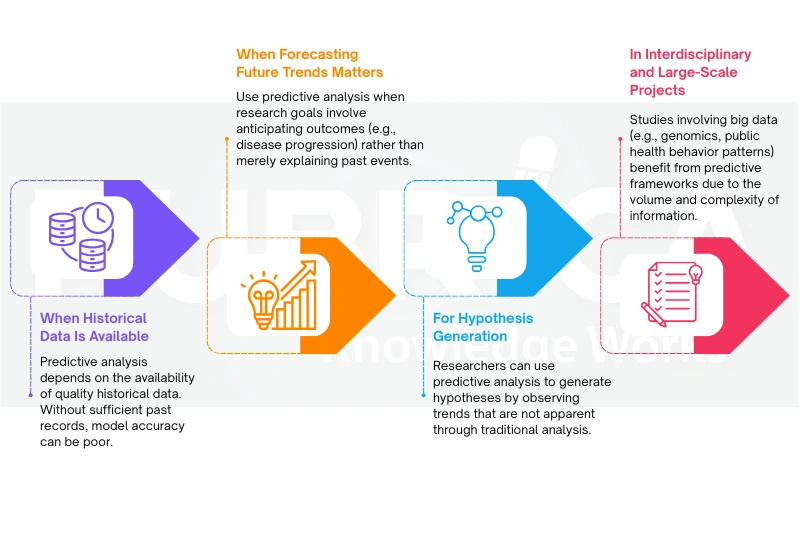
5. Benefits and Limitations of predictive analysis
Understanding both advantages and constraints is key to effective use.
Benefits | Limitations |
Proactive insights: Predictive analytics allow researchers to be proactive in their approach to data analysis. | Data dependency: Predictive analytics depend on high-quality, complete data for accurate predictions. |
Risk identification: Using predictive models, researchers can identify high-risk situations before they develop. | Assumption of pattern continuity: Most predictive models rely on the assumption that the future will follow the same patterns as the past; this is not always the case in times of rapid change or disruption.[6] |
Enhanced planning: With predictive analytics, researchers can design follow-up studies or interventions more effectively. | Complexity: Because of their complexity, some predictive analytic methods (such as neural networks) can be difficult to interpret and understand unless you have a high level of expertise in data science.[7] |
Balancing these predictive analytics benefits with methodological limitations is essential when selecting predictive analytics tools for research.
6. Research Applications of Predictive Analytics
Predictive analysis has been applied across multiple scientific domains:
- Healthcare: Predictive models allow the estimation of which patients are at risk for developing a disease, or being readmitted to the hospital based on prior hospitalizations, thereby aiding in both clinical decision making and preventative care strategies.[8]
- Public Health: Patterns of disease spread are projected based on information collected regarding previous outbreak activity. This information is provided to policymakers for proactive action.
- Social Sciences: Researchers utilize predictive methodologies to analyse past trends, and to understand the historical evolution of specific types of behaviour or social outcomes.
- Economics and Policy: Predictive models can estimate certain economic indicators (unemployment rates, inflation levels, etc.) and will therefore guide the policymaking process.
7. Evaluating Model Performance
Before a predictive model can be used in research, it is important to assess the model’s strength or reliability through performance metrics. Common performance metrics are:
- Accuracy Error Rates
- ROC-AUC for classification models
- Mean Squared Error (MSE) for continuous outcomes
Validation methods including cross-validation provide an assessment of how well the model will perform outside its training dataset.
8. Ethical and Practical Considerations
Predictive analytics can be highly effective, but when conducting research, it is important to keep some things in mind:
- Bias and Fairness of your Data – Creating Predictions using a Biased Dataset will Reinforce Inequities.
- Transparency of Results – Complex Model Creation Must Be Demonstrated and Made Understandable to Non-Technical Individuals and Participants.
- Privacy and Consent – Ethical Conduct of Personal Data Is Very Important, Especially in Health Research.
Responsible use of predictive modelling solutions ensures ethical compliance while maintaining analytical reliability.
Connect with us to explore how we can support you in maintaining academic integrity and enhancing the visibility of your research across the world!
Conclusion
In today’s research, predictive analysis is an important component for providing insight into what may happen in the future and preparing for those scenarios using data-driven approaches to decision making. Predictive analysis is especially helpful when researchers work with high-quality historical data, when the outcome being studied is focused on future events, and when researchers employ appropriate procedures to validate their predictive methods. As the volume of available data and analytic methods increases, predictive analytics is expected to continue being a key tool in researchers’ methodological resources.
Need expert support with predictive statistical analysis for your research? Pubrica’s biostatistics and analytics experts help researchers design, validate, and interpret predictive models with scientific rigor and publication-ready accuracy. [ Get Expert Publishing Support] or [Schedule a Free Consultation].
References
- Predictive analysis: Why it matters. (2024, September 27). Coursera. https://www.coursera.org/articles
- What is predictive analytics? (2025, December 23). com. https://www.ibm.com/think/topic
- Predictive modelling: Techniques, uses, and key takeaways. (2016, October 30). Investopedia. https://www.investopedia.com
- What is predictive analytics? (2020, April 22). org. https://www.discoverdatascience
- Walsh, C. G., McKillop, M. M., Lee, P., Harris, J. W., Simpson, C., & Novak, L. L. (2021). Risky business: a scoping review for communicating results of predictive models between providers and patients. JAMIA Open, 4(4), ooab092. https://doi.org/10.1093/jamiaopen
- Wikipedia contributors. (2025, October 4). Predictive power. Wikipedia, The Free Encyclopedia. https://en.wikipedia.org/w/index.php?
- Hassan, M. (2024, March 26). Predictive analytics – techniques, tools and examples. Research Method. https://researchmethod.net/