
- Services
- Discovery & Intelligence Services
- Publication Support Services
- Sample Work
Publication Support Service
- Editing & Translation
-
Editing and Translation Services
- Sample Work
Editing and Translation Service
-
- Research Services
- Sample Work
Research Services
- Physician Writing
- Sample Work
Physician Writing Service
- Statistical Analyses
- Sample Work
Statistical Analyses
- Data Collection
- AI and ML Services
- Sample Work
AI and ML Services
- Medical Writing
- Sample Work
Medical Writing
- Research Impact
- Sample Work
Research Impact
- Medical & Scientific Communication
- Sample Work
Medical & Scientific Communication
- Medico Legal Services
- Educational Content
- Academic Editorial Services
- Sample Work
Academic Editorial Services
- Educational Editorial Service
-
Education Editorial Services
- Sample Work
Education Editorial Services
-
- Industries
- Subjects
- About Us
- Academy
- Insights
- Contact Us
What Are the Common Challenges Researchers Face During the Journal Submission Process?
- Home
- Academy
- Journal Submission
- What Are the Common Challenges Researchers Face During the Journal Submission Process?
High-Impact Journals
- Selecting the Right Journal
- Visual Overview: Journal Submission Workflow
- Manuscript Formatting and Submission Requirements
- Peer Review and Reviewer Criticism
- Ethical and Compliance Issues
- Publication Delays and Administrative Barriers: Financial Issues Related to Publication
- Common Journal Submission Challenges and Solutions
- Strategies for Successful Journal Submission
- Conclusion
Interesting topics
What Are the Common Challenges Researchers Face During the Journal Submission Process?
Table of Contents
1. Selecting the Right Journal
2. Visual Overview: Journal Submission Workflow
3. Manuscript Formatting and Submission Requirements
4. Peer Review and Reviewer Criticism
5. Ethical and Compliance Issues
6. Publication Delays and Administrative Barriers: Financial Issues Related to Publication
7. Common Journal Submission Challenges and Solutions
8. Strategies for Successful Journal Submission
9. Conclusion
Publishing papers in scholarly journals plays a vital role in scholarly communication and the journal submission process. This process enables the researcher to disseminate knowledge, make contributions to the field of science, and enhance their academic reputation. Nevertheless, it should be noted that submitting papers for journal publication may become quite difficult and complicated. Indeed, there exist numerous issues that researchers face when working on the journal submission process, such as problems with choosing the right journal, manuscript preparation, peer reviewing, publication ethics, etc. [1,2]
1. Selecting the Right Journal
The initial hurdle in this process is selecting a journal that would be appropriate for submitting your work. Many researchers find it difficult to select a journal that: [3]
- Matches their area of research
- Fit their target audience
- Suitably matches their methodology
- Have the right level of impact
Some Common Issues When Selecting Journals
- The topic of the manuscript does not match the journal’s focus – Submitting to a journal outside the scope reduces chances of acceptance.
- Poor awareness about indexing platforms and journal submission guidelines – authors may not know which databases (e.g., Scopus, PubMed) index reputable journals.
- Incorrect understanding of impact factors – Misinterpreting or overvaluing impact factors can lead to choosing inappropriate journals.
- Difficulties identifying predatory journals – Lack of knowledge about predatory publishers increases the risk of submitting to low-quality or non-reputable outlets.
2. Visual Overview: Journal Submission Workflow
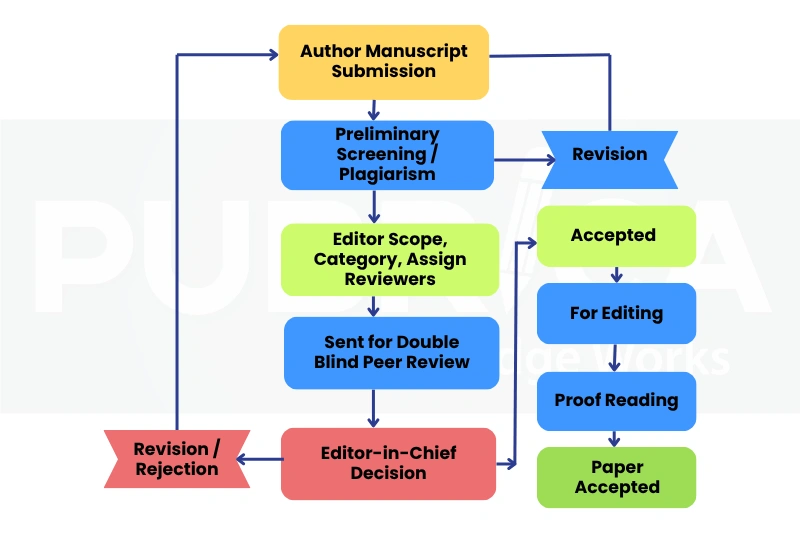
A clear understanding of the journal submission process template can help researchers navigate these steps efficiently.
3. Manuscript Formatting and Submission Requirements
The academic journals have stringent formatting rules that must be adhered to during paper submission for journal. Some of the challenges that researchers encounter include: [4]
- Referencing formats – Journals have specific citation styles (APA, Vancouver, MLA, etc.), and incorrect referencing can lead to desk rejection.
- Word count limitations – Exceeding or underutilising the allowed word count may cause rejection or require major revisions.
- Formatting for figures – Journals require specific resolution, size, and labelling for figures and tables to ensure clarity and publication quality.
- Abstract format – structured (Background, Methods, Results, Conclusion) or unstructured abstracts must comply with journal submission guidelines.
- The cover letter format – A professional cover letter should include the manuscript’s significance, novelty, and fit with the journal’s scope.
4. Peer Review and Reviewer Criticism
Peer review can be the most nerve-racking phase of the academic publishing process. The reviewer’s comments might necessitate changes, further experiments, or an explanation of results. [5]
Problems Encountered in Peer Review
- Contradictory remarks from reviewers
- Need for major changes to manuscript
- Slow response from reviewers
- Script rejection despite major changes
- Objective reaction to criticisms
Researchers must handle the reviews professionally.
5. Ethical and Compliance Issues
There is increasing pressure on journals to adhere to publication ethics standards. A failure to do so may result in outright rejection or retraction of the paper.
Ethical Issues Involve
- Plagiarism – Using others’ work without proper citation or presenting it as original can lead to manuscript rejection and ethical violations.
- Simultaneous submission – Submitting the same manuscript to multiple journals at once is unethical and can result in sanctions.
- Misrepresentation of data – Fabricating, falsifying, or selectively reporting data undermines the integrity of research and can lead to retraction.
- Inappropriate assignment of authorship – Listing individuals who did not contribute or omitting those who did is unethical and violates authorship guidelines.
- Lack of informed consent or ethics committee approval – Conducting research involving humans or animals without proper consent or approval breaches ethical standards and can invalidate the study.
6. Publication Delays and Administrative Barriers: Financial Issues Related to Publication
Even high-quality research can face delays and hurdles when financial constraints and administrative barriers stand between authors and publication. [6]
publication process | Financial Issues |
The publication process may be delayed from several months to years due to:
| Publication requires payment of article processing charges (APCs), open access publishing fees, language editing fees, and fees for preparing figures. Such requirements can be a challenge for researchers who lack institutional funding. |
7. Common Journal Submission Challenges and Solutions
Understanding journal submission challenges and practical solutions can save researchers time, reduce frustration, and increase the chances of acceptance. [2]
| Challenge | Impact on Publication | Possible Solution |
| Wrong journal selection | Immediate rejection | Match scope and audience carefully |
| Formatting errors | Technical rejection | Follow author guidelines strictly |
| Weak academic writing | Negative reviewer feedback | Use editing and proofreading support |
| Ethical non-compliance | Rejection or retraction | Follow research ethics standards |
| Reviewer criticism | Major revisions required | Respond professionally and clearly |
| Publication delays | Academic setbacks | Plan timelines early |
| Publication fees | Financial burden | Seek institutional funding |
8. Strategies for Successful Journal Submission
Publication success in the journal submission process can be greatly enhanced by effective preparation.
Recommendations for Preparation
- Pay close attention to journal submission guidelines
- Checking for plagiarism before submitting
- Maintaining open communication channels with peers/mentors
- Engaging professional editing services
- Developing thorough responses to reviewers’ criticisms
- Targeting journals included in reputable databases
- Good preparation lowers the risk of mistakes.
Connect with us to explore how we can support you in maintaining academic integrity and enhancing the visibility of your research across the world!
Conclusion
Journal submissions have many obstacles that range from journal selection, manuscript preparation, peer review, ethical compliance, to publication delays. Awareness of common journal submission challenges and implementation of structured publication strategies can help researchers immensely in the academic publishing process and improve success in open-access publishing.
What Are the Common Challenges Researchers Face During the Journal Submission Process? Our Pubrica consultants are here to guide you. [Get Expert Publishing Support] or [Schedule a Free Consultation]
References
- Chirukandath, R., Sunil, G., Balakrishnan, V., Menon, R. A., Gayathry P, S., Sulaiman, S. V., George, M., Mohan, K., & Maria Joseph, D. (2024). Difficult Terrains of Research Publications Faced by Researchers: A Cross-Sectional Study. Cureus, 16(7), e64787. https://doi.org/10.7759/cureus.6478
- Remya, U. R., Pai, M. S., Nayak, B. S., & Noronha, J. A. (2024). Selecting the right journal: Navigating challenges and maximizing research impact – a discussion paper. Nordic Journal of Nursing Research, 44. https://doi.org/10.1177/205715852412
- Ramia J. M. (2023). How to select a journal for your research. World journal of gastroenterology, 29(21), 3379–3384. https://doi.org/10.3748/wjg.v29.i21.3
- Karabulut N. (2015). Requirements for manuscript submission: what every author needs to know and comply with to facilitate the review process. Diagnostic and interventional radiology (Ankara, Turkey), 21(2), 93–95. https://doi.org/10.5152/dir.2015.0001
- Peh W. C. (2022). Peer review: concepts, variants and controversies. Singapore medical journal, 63(2), 55–60. https://doi.org/10.11622/smedj.202113
- Alsulami, A. F., Khaimi, Z. O., Hadi, M. A., Aljabri, Y. H., Mayet, T. S., & Althubaiti, A. (2023). “Publish or Perish”: barriers to research publication in an undergraduate medical research program. BMC research notes, 16(1), 269. https://doi.org/10.1186/s13104-023-06542-5