
MARS Guidelines Explained: Improving the Quality of Meta-Analysis Reporting
- Home
- Academy
- Research Impact
- MARS Guidelines Explained: Improving the Quality of Meta-Analysis Reporting
High-Impact Journals
Interesting topics
MARS Guidelines Explained: Improving the Quality of Meta-Analysis Reporting
The Meta-Analysis Reporting Standards (MARS) are a set of 74 specific items developed by the American Psychological Association (APA) to enhance the transparency and replicability of meta-analytic research. Initially introduced in 2008 and updated in 2018 (as part of the JARS-Meta standards), MARS was created to address common deficiencies in how researchers report their methods and results in the social and behavioural sciences.
The evidence synthesis process involves various methods of combining independent studies to assess their reliability. One of the primary methods for doing so is using meta-analysis; this involves the statistical combination of results from independent studies. However, the ability to produce reliable conclusions using meta-analysis relies heavily on the ability of researchers to adhere to guidelines regarding reporting transparency and standardization. An established standard that has been developed specifically for this purpose is the MARS (Meta-analysis Reporting Standards) established by the American Psychological Association.[1] This guide provides details regarding the MARS framework and provide practical guidance to assist researchers in improving their publication readiness through appropriate reporting practices.
1. What Are MARS Guidelines in Meta-Analysis Reporting?
The MARS Guidelines were introduced to standardise the reporting of meta-analyses in behavioural and social sciences. They aim to:
- Enhance transparency in study selection
- Improve methodological reporting
- Standardize effect size presentation
- Promote reproducibility
- Reduce selective reporting bias
MARS was updated in 2020 to align with modern open science practices [2].
The Insight
MARS focuses on reporting transparency, not on prescribing statistical techniques. It ensures readers can critically evaluate how the meta-analysis was conducted.
2. Why MARS Guidelines Matter for Evidence-Based Research
If reporting is incomplete, it can result in incorrect interpretation of bias, heterogeneity, and effect size. Examples of how reporting standards, such as MARS, can benefit the scientific community include:
- Enhancing the credibility of findings
- Encouraging replication
- Supporting systematic peer review
- Increasing the potential for indexing and citations
Many studies have shown that using structured reporting improves the methodological transparency of the research and reduces the chance of risk bias when synthesising evidence.[3] transparent framework also strengthens the Risk of Bias Assessment process by clearly documenting how bias is evaluated and reported.
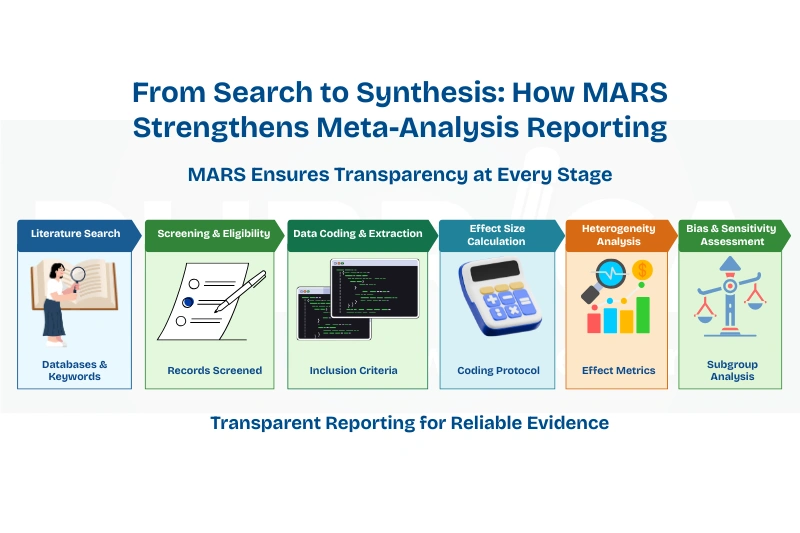
This visual can resemble a methodological pipeline, highlighting where MARS enhances transparency.
3. Core Components of MARS Reporting Standards
MARS provides an organized framework for reporting meta-analytic studies and their resultant data.
- The Title and Abstract of the manuscript should include the identification of the manuscript as a meta-analysis; the databases that were searched; the number of included studies; and the key effect sizes from the included studies.
- In the Introduction, the research questions should be clearly defined; the theoretical framework should be specified; and the justification for using a meta-analytic method should be provided.
- The Method Section should detail the eligibility criteria; the search strategy; the coding procedures, the calculation of effect sizes; and the assessment of bias. Specify the theoretical framework
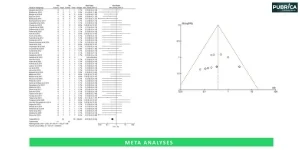
- The Results should include a flowchart of study selection, forest plots, heterogeneity statistics, and moderator analyses.
- Lastly, the Discussion should include an interpretation of the pooled results, limitations, and practical implications of the results.
Section | Required Reporting Elements | Purpose |
Title/Abstract | Identification as a meta-analysis | Clarity & discoverability |
Method | Search strategy, coding protocol | Reproducibility |
Results | Effect sizes, heterogeneity, bias | Transparency |
Discussion | Limitations & implications | Interpretation strength |
In many research contexts, MARS complements broader Systematic Review Reporting Guidelines to ensure comprehensive documentation of evidence synthesis methods.
4. MARS vs. Other Reporting Guidelines
The MARS (Marketing Accountability Standards) framework and the PRISMA (Preferred Reporting Items for Systematic Reviews and Meta-Analyses) framework are often compared with one another, however, they have different areas of focus and thus indicate different types of quality improvement when reporting. PRISMA Guidelines for Systematic Reviews emphasize structured study selection and reporting flow diagrams in clinical and health research.
Feature | MARS | PRISMA |
Primary Domain | Behavioural & social sciences | Health Care & Clinical Research |
Emphasis | Reporting transparency | Study selection & flow |
Bias Reporting | Detailed coding transparency | Risk-of-bias assessment |
These two frameworks are complementary and are often used together when conducting interdisciplinary research.[4] Researchers frequently rely on a structured Systematic Review Checklist to ensure alignment with both frameworks during manuscript preparation.
Practical Example: Applying MARS in Research
A researcher conducting a meta-analysis on cognitive behavioral therapy:
✔ Clearly reports database search strings
✔ Documents coding reliability (e.g., inter-rater agreement)
✔ Provides effect size formulae
✔ Presents heterogeneity (I² statistics)
✔ Conducts publication bias tests
Such reporting aligns with MARS recommendations and strengthens manuscript credibility [5].
5. Common Mistakes in Meta-Analysis Reporting
- No detail on how the search was done
- No information on how the effect size is determined
- Did not do moderator analysis
- Reported outcomes selectively
- Did not disclose reasons for excluding studies
Research shows that incomplete reporting continues to be a concern among many fields [6].
6. How to Ensure Compliance with MARS Guidelines
- Complete a MARS checklist before submitting.
- Keep coding manuals on file.
- Keep records of all data extraction.
- Report confidence intervals and prediction intervals.
- Report the sources and conflicts of funding.
TIP:
Journals increasingly Favor manuscripts that explicitly mention adherence to reporting standards such as MARS or PRISMA.
Connect with us to explore how we can support you in maintaining academic integrity and enhancing the visibility of your research across the world!
Conclusion
For a meta-analysis to be credible, researchers must properly report statistical results as they are administered in accordance with accepted research methodology standards. The MARS guidelines were created to provide a prescriptive framework for reproducibility, interpretation of results, and publication of meta-analysis research. By utilizing the MARS guidelines along with other best practices throughout the entire research process, researchers strengthen their credibility as researchers and provide a foundation of support for evidence-based decision-making.
Strengthen Your Meta-Analysis with Expert Reporting Support! Ensure MARS compliance and journal readiness with Pubrica’s expert meta-analysis review and publication support. [Get Expert Publishing Support] or [Schedule a Free Consultation].
References
- APA Publications and Communications Board Working Group on Journal Article Reporting Standards. (2008). Reporting standards for research in psychology: why do we need them? What might they be? The American Psychologist, 63(9), 839–851. https://doi.org/10.1037/0003-066X.63.9.839
- Schalken, N., & Rietbergen, C. (2017). The Reporting Quality of Systematic Reviews and Meta-Analyses in Industrial and Organizational Psychology: A Systematic Review. Frontiers in psychology, 8, 1395. https://doi.org/10.3389/fpsyg.2017
- Page, M. J., Moher, D., Bossuyt, P. M., Boutron, I., Hoffmann, T. C., Mulrow, C. D., Shamseer, L., Tetzlaff, J. M., Akl, E. A., Brennan, S. E., Chou, R., Glanville, J., Grimshaw, J. M., Hróbjartsson, A., Lalu, M. M., Li, T., Loder, E. W., Mayo-Wilson, E., McDonald, S., … McKenzie, J. E. (2021). PRISMA 2020 explanation and elaboration: updated guidance and exemplars for reporting systematic reviews. BMJ (Clinical Research Ed.), 372, n160. https://doi.org/10.1136/bmj.n160
- Borenstein, M., Hedges, L. V., Higgins, J., & Rothstein, H. (2009). Introduction to meta-analysis. Wiley-Blackwell. https://www.agropustaka.id/wp-content/uploads/2020/04/agro
- Higgins, J. P., & Thompson, S. G. (2002). Quantifying heterogeneity in a meta-analysis. Statistics in medicine, 21(11), 1539–1558. https://doi.org/10.1002/sim.1186
- Johnson, B. T., & Hennessy, E. A. (2019). Systematic reviews and meta-analyses in the health sciences: Best practice methods for research syntheses. Social science & medicine (1982), 233, 237–251. https://doi.org/10.1016/j.socscimed