
What is Patient Segmentation and How to Leverage It for Smarter Healthcare Decisions
- Home
- Academy
- Research Impact
- What is Patient Segmentation and How to Leverage It for Smarter Healthcare Decisions
High-Impact Journals
Interesting topics
What is Patient Segmentation and How to Leverage It for Smarter Healthcare Decisions
Patient segmentation is the strategic process of dividing a patient population into distinct, manageable groups based on shared characteristics like demographics, clinical needs, health behaviours, or risk profiles. It allows healthcare providers to tailor care, optimize resources, and improve patient outcomes by targeting specific interventions.
Patient segmentation in healthcare is widely recognized as a foundational approach for improving care delivery, operational efficiency, and long-term population outcomes. This approach enables providers to tailor care delivery, improve outcomes, and make data‑driven decisions. In a value-based healthcare environment, effective segmentation supports targeted interventions and efficient resource utilization [1,2].
1. Why Patient Segmentation Matters
Healthcare organizations use patient segmentation to better understand the wide range of patient needs and deliver care interventions tailored to those needs. When patients with similar health characteristics are grouped, healthcare organizations can:
- Increase clinical outcomes through treatment and prevention programs tailored to the specific needs of each group.[1]
- Improve resource utilization through the identification and allocation of providers and services where the highest demand is located.[1]
- Providing proactive care to high-risk patients to prevent further complications from developing. [3]
- Facilitate data analytics based decision-making from the identification of trends and clinical data.[1]
Population health patient segmentation supports long-term care planning by addressing disease prevalence, utilization trends, and social determinants of health across communities. Increasingly, healthcare organizations are viewing patient segmentation as a key element in their overall population health management strategy by identifying disease states as well as service utilization patterns, as well as social determinants of public health[2].
2. Types of Patient Segmentation
Understanding the types of patient segmentation in healthcare allows organizations to apply the right model based on clinical, behavioural, or operational objectives. There are many ways to segment patients. Some examples of the different types of segmentation and their uses in healthcare are outlined in the table below:
Segmentation Type | Key Attributes | Healthcare Use |
Demographic | Age, gender, geographical location | Developing age-specific programmes or preventive health strategies |
Clinical | Chronic disease and risk scoring | Targeting patients with the highest level of risk |
Behavioral | Patient adherence to treatment and patient visit frequency | Developing strategies for patient education and patient engagement |
Psychographic | Central patient preference, attitude and motivation | Developing specific communication and support for patients |
Risk-based patient segmentation models are particularly valuable for identifying high-cost and high-need patients requiring intensive care management. Segmentation provides insight into patient interaction with the healthcare system from a clinical risk perspective, as well as through the lens of patient interaction with the healthcare system.[4].
3. How Patient Segmentation Works
The procedure for patient segmentation generally follows the outlined steps:
- Collect Health Data — Assemble information from clinical sources, demographic characteristics, and patient behaviours. [1].
- Analyze and Cluster — Use analytics or machine learning tools to find groups of patients who are similar, based on shared characteristics.[5].
- Define Segments — Create categories of patients that are clinically important to assist in making healthcare decisions. [4].
- Design Interventions — Create care plans that match patients’ needs with each of the segments identified above.[1].
- Monitor & Adjust — Monitor patient outcomes; as necessary, revise patient segmentation based upon trends seen in the collected data.[1].
Healthcare data analytics for patient segmentation enables organizations to process large-scale clinical and operational data efficiently. Data-driven patient segmentation ensures that clinical decisions are based on objective insights rather than assumptions.
AI and advanced analytic techniques are used in these modernised methods to discover new, complex patterns of data that can not be identified through traditional approaches, providing an improved capacity for making accurate predictions and providing more individualised treatment options.[6].
4. Leveraging Segmentation for Smarter Decisions
The effectiveness of strategic healthcare decisions depends on the knowledge of how and when specific patient population segments respond or react to healthcare delivery methods. A well-defined healthcare segmentation strategy enables organizations to align clinical, operational, and economic goals by focusing on distinct patient groups. Strategic Uses of Patient Segmentation include
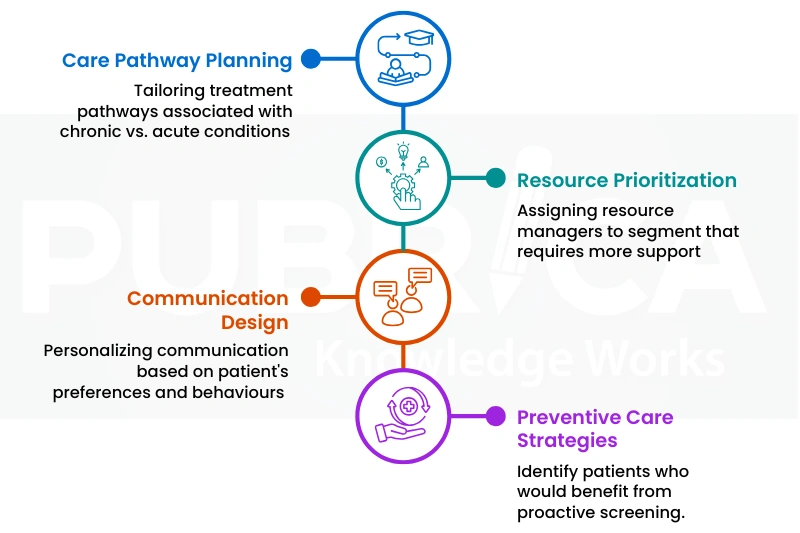
Patient segmentation analytics supports evidence-based planning by linking patient characteristics with care outcomes and utilization patterns. Matching patient profiles with their care approaches creates opportunities for healthcare providers to reduce the need for emergency room visits and prevent unnecessary hospital admissions, which can lead to increased patient satisfaction and improved clinical results.[3][7].
5. Accreditation and Quality Assurance in CME
Despite the many advantages of Segmentation, it can also have challenges:
- Data Collection and Integration: The data obtained from various sources needs to be standardised and cleaned prior to optimising its use in Segmentation [8].
- Complexity of Clinical Profiles: For patients with multiple conditions, there will be a requirement for carefully defined nuanced segments [8].
- Balancing Precision with Practicality: Having many segments may complicate care planning processes, whereas having only a few segments may result in loss of important clinical detail [8].
The ethical and privacy implications associated with the usage of patient data to develop a Segmentation strategy must also always be addressed[9].
Patient segmentation software for healthcare helps address these challenges by integrating data sources and automating segmentation workflows. Patient segmentation tools for hospitals support clinical teams by enabling real-time insights and actionable dashboards.
Connect with us to explore how we can support you in maintaining academic integrity and enhancing the visibility of your research across the world!
Conclusion
Healthcare organizations can use patient segmentation as a powerful source of information to make better decisions about their patients’ care. By grouping people with similar health issues together and creating specific plans for those patients, healthcare organizations can improve results (i.e., patients’ health) and effectiveness of services they provide (i.e., efficiency). As technology continues to improve, the role of segmentation will only increase within the scope of strategic health care service delivery. Healthcare patient segmentation solutions empower organizations to operationalize segmentation at scale across clinical and administrative functions. Healthcare analytics solutions for patient segmentation will continue to play an increasingly critical role as digital health and value-based care models expand.
Unlock smarter, data-driven patient care with Pubrica. Leverage our healthcare analytics and patient segmentation expertise to improve outcomes, optimize resources, and support value-based care. [Get Expert Publishing Support] or [Schedule a Free Consultation].
References
- Patient segmentation in physical therapy: Benefits & how-to. (2024, July 29). Empoweremr.com; Empower EMR. https://www.empoweremr.com/blog/patient-segmentation
- Population segmentation and risk stratification. (n.d.). Cwm Taf Morgannwg University Health Board. Retrieved January 23, 2026, from https://ctmuhb.nhs.wales/services/public-health-team/areas-of-focus/population-health-and-population-health-management/population-segmentation-and-risk-stratification
- Castagna, C., Huff, A., Douglas, A., Garofano, M., Fabi, M., Hass, R., & Maio, V. (2025). Stratifying the population based on health risk: identification of patient key health risk factors through consensus techniques. BMC Primary Care, 26(1), 229. https://doi.org/10.1186/s12875-025-02923-w
- Patient segmentation and patient groups. Is. Retrieved January 23, 2026, from https://thestory.is/en/journal/patient-groups-segmentation
- Aljohani, A. (2024). Optimizing patient stratification in healthcare: A comparative analysis of clustering algorithms for EHR data. International Journal of Computational Intelligence Systems, 17(1). https://doi.org/10.1007/s44196-024-00568-8
- Why use AI for smarter patient segmentation. (n.d.). Healingpixel.com. Retrieved January 23, 2026, from https://healingpixel.com/why-use-ai-for-patient-segmentation
- Vuik, S. I., Mayer, E. K., & Darzi, A. (2016). Patient Segmentation Analysis Offers Significant Benefits For Integrated Care And Support. Health affairs (Project Hope), 35(5), 769–775. https://doi.org/10.1377/hlthaff.2015.1311
- Patient segmentation in pharma: Overcoming key challenges. (2025, January 24). Infiniti Research. https://www.infinitiresearch.com/casestudy/patient-segmentation-research
- What role does data segmentation play in personalized healthcare CRM? (2025, November 28). Doctorna. https://doctorna.com/what-role-does-data-segmentation-play-in-personalized-healthcare-crm