
- Services
- Discovery & Intelligence Services
- Publication Support Services
- Sample Work
Publication Support Service
- Editing & Translation
-
Editing and Translation Services
- Sample Work
Editing and Translation Service
-
- Research Services
- Sample Work
Research Services
- Physician Writing
- Sample Work
Physician Writing Service
- Statistical Analyses
- Sample Work
Statistical Analyses
- Data Collection
- AI and ML Services
- Sample Work
AI and ML Services
- Medical Writing
- Sample Work
Medical Writing
- Research Impact
- Sample Work
Research Impact
- Medical & Scientific Communication
- Sample Work
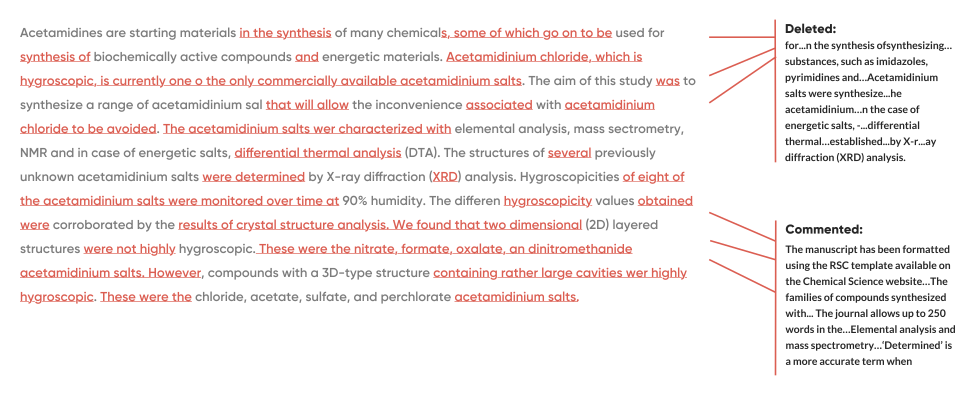
Medical & Scientific Communication
- Medico Legal Services
- Educational Content
- Academic Editorial Services
- Sample Work
Academic Editorial Services
- Educational Editorial Service
-
Education Editorial Services
- Sample Work
Education Editorial Services
-
- Industries
- Subjects
- About Us
- Academy
- Insights
- Contact Us
What Are the Different Challenges Researchers Face During the Journal Selection Process?
High-Impact Journals
- Understanding the Importance of Journal Selection
- Major Challenges in Journal Selection
- Common Journal Selection Challenges
- Evaluating Journal Scope and Audience
- The Challenge of Predatory Journals
- Impact Metrics and Indexing Considerations
- Financial and Open Access Challenges
- Strategies for Effective Journal Selection
- Conclusion
Interesting topics
What Are the Different Challenges Researchers Face During the Journal Selection Process?
The selection of the journal is probably one of the most important steps that authors undertake in the journal publishing process, following the completion of research work. The right choice of the journal will help the author not only publish their research but also make sure that it gains recognition and that the findings reach the target audience. However, choosing a journal is never an easy task since it requires evaluating numerous criteria. [1]
Considering the increasing number of journals on different topics available to researchers, choosing the right journal is never easy. It might be simple since there are many journals into which one can submit their research findings. Nevertheless, it still requires quite some effort and awareness of journal selection challenges.
1. Understanding the Importance of Journal Selection
The selection of a good journal should not only focus on selecting the right place to publish the work but also ensure that the objectives and methods used in the article are aligned with those of the journal itself. Selecting an appropriate journal would help in attracting attention to the research theme and avoiding common journal selection mistakes.[2]
Apart from this, there are other factors that should also be taken into consideration. Some funding agencies may ask for open-access publications of their funded projects.
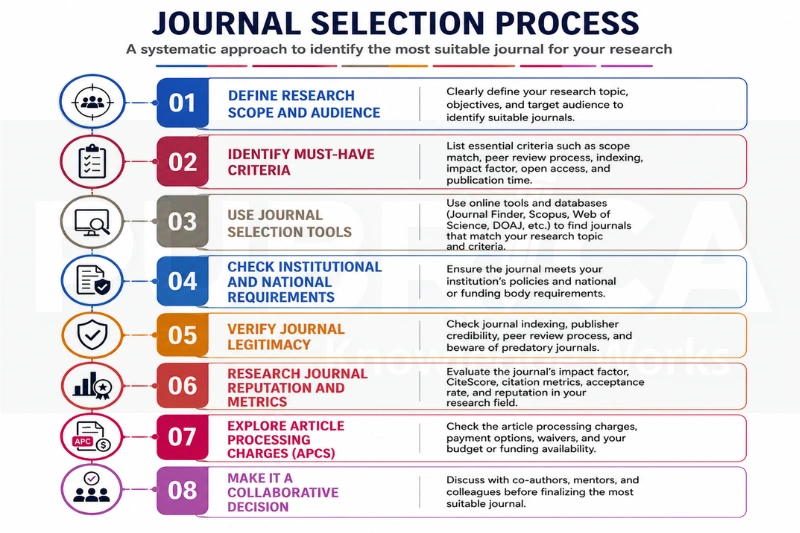
2. Major Challenges in Journal Selection
Researchers often encounter several journal selection challenges during the publication process. [3]
- Journal reputation: Distinguishing between good journals and predatory publications may be a tricky task since the latter rarely apply peer review and are interested primarily in profits.
- Citation statistics: Parameters like Impact Factor, CiteScore, SCImago Journal Rank, and Source Normalised Impact per Paper may be ambiguous.
- Speed of publication: Journals have different policies regarding the speed of peer review and publication.
3. Common Journal Selection Challenges
| Challenge | Description | Potential Impact |
| Scope Mismatch | Research does not align with the journal’s objectives | Immediate rejection |
| Predatory Journals | Lack of legitimate peer review | Loss of credibility |
| Impact Metric Confusion | Difficulty comparing journal rankings | Poor journal choice |
| Publication Delays | Lengthy review processes | Delayed dissemination |
| Open Access Costs | High article processing charges | Financial burden |
| Indexing Uncertainty | Journal not included in major databases | Reduced visibility |
These represent some of the most common problems in selecting research journals faced by authors worldwide.
4. Evaluating Journal Scope and Audience
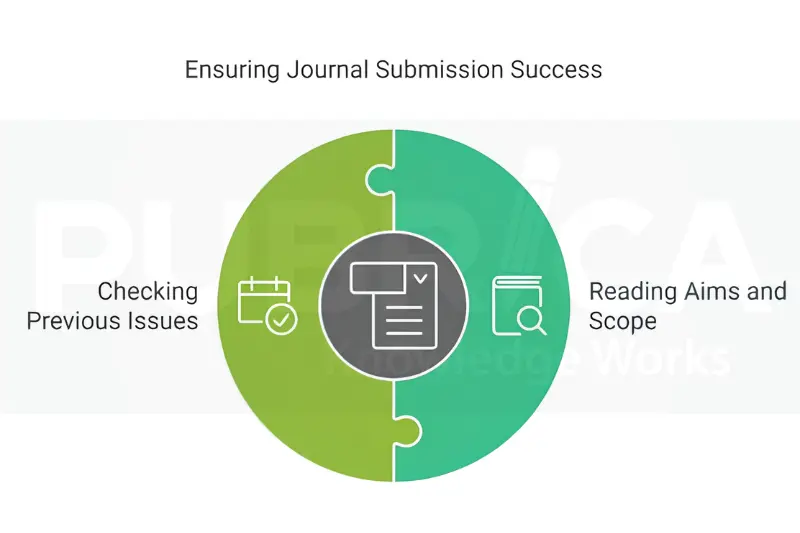
One common cause of rejection in scholarly journals is the lack of fit between the manuscript and the aims and objectives of the journal. Many researchers consider the reputation of the journal more than anything else, yet it is crucial to keep in mind that the publication process will mainly depend on how interesting the content is to the journal’s audience.
Analysing recent publications will provide a researcher with an understanding of the journal’s focus area. Another useful tool in this situation is the analysis of author guidelines, which forms an essential part of effective journal selection strategies for researchers.
5. The Challenge of Predatory Journals
Predatory journals have emerged as a significant threat within the realm of scholarly communication. Predatory journals tend to imitate reputable journals but do not provide any quality editorial or peer review process. [4]
It is hard for a scientist, particularly at an early stage of their career, to recognise some signals of a questionable journal. Some typical signals include promising rapid publication, unsolicited email solicitations, unclear editorial boards, and non-indexation in reputable sources.
Publishing research in such journals may adversely affect the reputation of scientists and is among the most serious common journal selection mistakes.
6. Impact Metrics and Indexing Considerations
Journal impact metrics are commonly utilized to evaluate the quality and impact of publications. Nevertheless, depending only on quantitative measures may be deceiving because each academic field has its specific citation patterns, thus comparison becomes problematic.[5]
In addition, researchers need to check if the journal they are submitting to is included in credible indexing sources, such as the following:
- Scopus
- Web of Science
- PubMed
- MEDLINE
- Directory of Open Access Journals (DOAJ).
7. Financial and Open Access Challenges
The emergence of Open Access publications has brought about increased accessibility, but at the same time raised financial issues. Numerous journals impose article processing charges (APCs), ranging from a couple of hundred to thousands of dollars.
Without proper institutional support, scholars might find themselves unable to bear these costs. This means that cost-effectiveness becomes another factor when choosing a suitable journal. In some cases, a professional Journal Selection Service may help researchers identify cost-effective publication options. [6]
8. Strategies for Effective Journal Selection
The choice of a suitable journal demands an organized method. It would be helpful for researchers to find out which journals frequently publish papers like theirs. Scope, audience, indexing, review duration, and cost of publication are some of the factors that must be considered before shortlisting journals.
Many publishers nowadays provide journal finder services where authors enter the title, abstract, and keywords of their manuscripts, and journals are suggested based on similarity. Such tools support effective journal selection strategies for researchers and simplify the journal publishing process.
Connect with us to explore how we can support you in maintaining academic integrity and enhancing the visibility of your research across the world!
Conclusion
Choosing an appropriate journal is an important component of research publication. Scientists often encounter many problems, such as scope mismatch, journals’ quality analysis, metrics assessment, long publication time, and budget restrictions. These common problems in selecting research journals can be minimised through careful planning and evaluation.
Evaluating these aspects may contribute to the achievement of successful research dissemination among the target community. A proper selection of journals through careful consideration and the use of suitable journal selection strategies for researchers allows researchers to achieve more success in publication.
What Are the Different Challenges Researchers Face During the Journal Selection Process? Our Pubrica consultants are here to guide you. [Get Expert Publishing Support] or [Schedule a Free Consultation]
References
- Shreffler J, Huecker MR. Common Pitfalls In the Research Process. [Updated 2023 Mar 6]. In: StatPearls [Internet]. Treasure Island (FL): StatPearls Publishing; 2026 Jan-. Available from: https://www.ncbi.nlm.nih.gov/books/NBK568780/
- Bhatia S. J. (2017). How to Choose the Right Journal. Reporting and Publishing Research in the Biomedical Sciences, 143–153. https://doi.org/10.1007/978-981-10-7062-4_16
- Warren B. (2003). Current challenges and choices in scientific publication. Proceedings (Baylor University. Medical Center), 16(4), 401–404. https://doi.org/10.1080/08998280.2003.11927937
- Richtig, G., Berger, M., Lange-Asschenfeldt, B., Aberer, W., & Richtig, E. (2018). Problems and challenges of predatory journals. Journal of the European Academy of Dermatology and Venereology : JEADV, 32(9), 1441–1449. https://doi.org/10.1111/jdv.15039
- Iyengar, K. P., & Vaishya, R. (2023). Article-level metrics: A new approach to quantify reach and impact of published research. Journal of orthopaedics, 40, 83–86. https://doi.org/10.1016/j.jor.2023.05.001
- Bosch X. (2008). An open challenge. Open access and the challenges for scientific publishing. EMBO reports, 9(5), 404–408. https://doi.org/10.1038/embor.2008.60