
- Services
- Discovery & Intelligence Services
- Publication Support Services
- Sample Work
Publication Support Service
- Editing & Translation
-
Editing and Translation Services
- Sample Work
Editing and Translation Service
-
- Research Services
- Sample Work
Research Services
- Physician Writing
- Sample Work
Physician Writing Service
- Statistical Analyses
- Sample Work
Statistical Analyses
- Data Collection
- AI and ML Services
- Sample Work
AI and ML Services
- Medical Writing
- Sample Work
Medical Writing
- Research Impact
- Sample Work
Research Impact
- Medical & Scientific Communication
- Sample Work
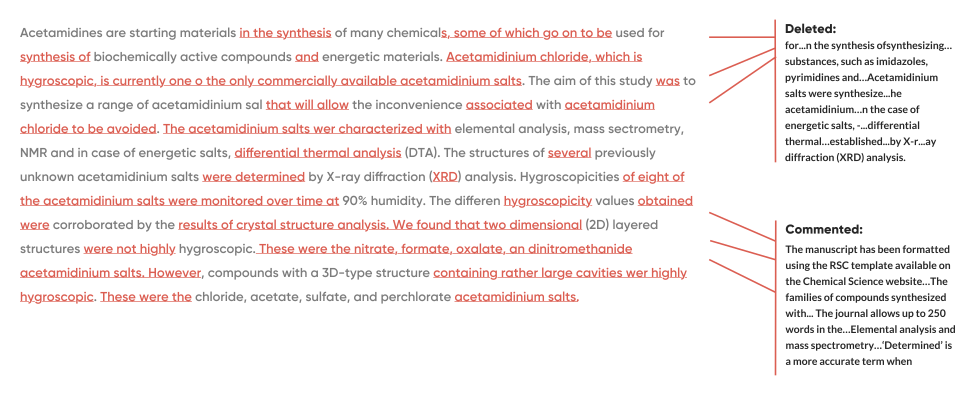
Medical & Scientific Communication
- Medico Legal Services
- Educational Content
- Academic Editorial Services
- Sample Work
Academic Editorial Services
- Educational Editorial Service
-
Education Editorial Services
- Sample Work
Education Editorial Services
-
- Industries
- Subjects
- About Us
- Academy
- Insights
- Contact Us
How to Format Your Life Science Manuscript for Quicker Academic Publication
- Home
- Academy
- Poster Presentation
- How to Format Your Life Science Manuscript for Quicker Academic Publication
Research Impact
- Formatting with Editorial Evaluation in Mind
- Structural Consistency for Scientific Clarity
- Integrating Data Presentation into the Narrative
- Formatting Methods for Clarity and Reproducibility
- Emphasising Key Findings Through Formatting
- Formatting for Efficient Revision Cycles
- Formatting as a Publication Strategy
Interesting topics
How to Format Your Life Science Manuscript for Quicker Academic Publication
1. Formatting with Editorial Evaluation in Mind
2. Structural Consistency for Scientific Clarity
3. Integrating Data Presentation into the Narrative
4. Formatting Methods for Clarity and Reproducibility
5. Emphasising Key Findings Through Formatting
6. Formatting for Efficient Revision Cycles
7. Formatting as a Publication Strategy
When it comes to life science publishing, there are many factors that affect how quickly a manuscript goes through the editorial process, including its scientific content (merit). Formatting plays a significant role in how easily a manuscript will be processed through an editorial system, as well as how quickly and efficiently reviewers perform their jobs.
Formatting is not the last step in preparing a manuscript; rather, it is an integral part of the preparation process that impacts how quickly and efficiently a manuscript will be processed through the editorial system and peer-review process. Manuscript formatting plays a central role in ensuring clarity, consistency, and efficiency throughout the journal manuscript submission process. Effective academic writing practices help authors comply with research paper formatting rules while clearly communicating scientific intent. This article discusses practical approaches to formatting manuscripts that will help expedite the peer-review and editorial processes in life science journals.
1. Formatting with Editorial Evaluation in Mind
Editors typically do not read each word of every manuscript submitted/received for initial screening. Instead, they assess the structure, coherence, and clarity of each submission to determine whether it is ready to undergo the peer review process. A manuscript may allow an editor to make a faster determination regarding the appropriateness and scope of the submission because it displays its information in a visually arranged format and is logically divided into sections.
Having separate sections and consistently displaying pages allows editors to orient themselves quickly and efficiently within a manuscript. Conversely, if the formatting of the manuscript obscures its overall structure or interrupts the visual flow, the editor is more likely to return that manuscript to the author for a technical revision prior to beginning his or her review, thereby increasing the time before it is published.[1,2].
Meeting manuscript title page requirements at this stage allows editors to efficiently assess author information, study scope, and journal fit.
Many peer review publication tips highlight formatting clarity as a key determinant of editorial screening speed.
2. Structural Consistency for scientific Clarity
Scientific writing (e.g. journal articles) involves presenting complicated processes and multiple layers of output in a way that does not confuse the reader. To do this, there should be a common structure throughout different sections to provide reviewers with an easy-to-follow trail of scientific rationality without requiring additional effort on their part. Consistency in the formatting of like-sections (e.g. when using similar types of experiments or methods of reporting data) is essential. Alternatively, having a lot of variation in formatting will detract from continuity of the story, which will impede on understanding. Clear abstract and keywords selection supports logical alignment between manuscript structure and reader expectations.
Formatting Feature | Purpose | Editorial Benefit |
Consistent section layout | Reinforces narrative flow | Faster screening |
Balanced paragraph length | Improves readability | Reduced reviewer fatigue |
Predictable heading patterns | Guides navigation | Efficient evaluation |
Research on peer review behaviour indicates that manuscripts with clear structural organisation are processed more efficiently during review [3].Accurate use of scientific journal indexing terms depends on structural consistency across sections of the manuscript.
3. Integrating Data Presentation into the Narrative
Data Interpretation in Life Science Research is based on a visual relationship to the textual data. Data Formatting should incorporate images, tables and a narrative description within an integrated format rather than a series of isolated data points.
Connecting the interpretive text close to the relevant visual component(s) will decrease the amount of cognitive load necessary for the user to make connections between result(s) and explain(s) them. Using a consistent format and method of referring to the same visual component(s) will also enable the user to navigate through data-heavy documents much more quickly. Existing research has shown that a well-integrated format of visually presenting research findings in an integrated format increases reviewer understanding and reduces requests for further explanations.[4,5].Clear presentation of article highlights and searchability elements allows key findings to be identified quickly by reviewers and readers.
Presentation Approach | Reviewer Experience | |
Text–figure proximity | Easier interpretation | Fewer clarification requests |
Uniform visual style | Visual continuity | Improved focus |
Logical sequencing | Clear result progression | Faster assessment |
4. Formatting Methods for Clarity and Reproducibility
In life science publishing, it is important for authors to be transparent about their methodology. When formatting their methods, they should ensure that their reader can understand and replicate their experiment. There are several methods that facilitate this.
- Visual separation of methodological stages – Clearly define different sections of your methodology (e.g., sample preparation, experiment setup, data analysis, etc.). This will help the reader follow your often very complex workflows without being confused.
- Consistent presentation of experimental parameters – Present all experimental parameters (e.g., reagent concentrations, incubation times, instrument settings, etc.) in a structured format (e.g., tables and bullet points). This allows reviewers to easily evaluate the analytical rigor of your methodology.
- Logical grouping of related procedures- When describing multiple techniques/assays (e.g., RNA isolation vs. qPCR), group all steps for a particular technique together to prevent fragmentation and increase clarity.
- Focus on structure – While a well-formatted methods section does not add additional information to the overall content of your article, it will allow your readers to easily access the procedures you have followed without experiencing unnecessary confusion. This will decrease the number of reviewer-related queries and, ultimately, reduce the time spent revising your methods section before the article is published [6].
By implementing the above strategies, authors will improve the reproducibility of their work, giving readers an opportunity to focus on the scientific continuity and integrity of the research. Clear reporting and structured presentation reinforce publication ethics in manuscripts by supporting transparency and reproducibility. In life science publishing, professional manuscript proofreading contributes to readability and ensure consistency across manuscript sections
5. Emphasising Key Findings Through Formatting
Formatting subtly directs attention. When major findings are visually distinguishable from supporting data, reviewers can quickly identify the study’s primary contributions. Maintaining uniform formatting for statistically comparable results prevents unintended emphasis, while consistent visual cues help reviewers interpret significance accurately. Over-formatting or inconsistent emphasis can mislead readers and generate unnecessary reviewer concerns [7].
Journal impact and manuscript quality are closely associated with how effectively key findings are formatted and communicated.
6. Formatting for Efficient Revision Cycles
Most life science manuscripts will be revised multiple times. The more stable the format is through the revision processes, the less effort the authors and reviewers must put forth to complete all subsequent rounds of revisions. Manuscripts having stable structure and format help reviewers quickly verify any new revisions submitted by the author(s). This is beneficial and can help speed up the review process and the reviewer’s decision to approve or deny the submission. On the contrary, formatting changes that occur as part of the revision Process can often create additional work for reviewers, causing them to take longer to complete their review process.
The following image summarizes key formatting practices that support faster editorial reassessment during revision cycles.
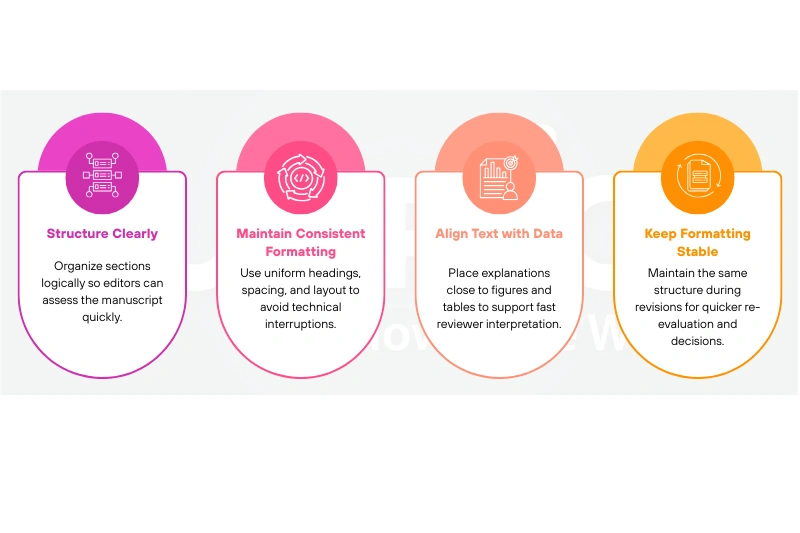
During revision stages, manuscript formatting service and research publication support are often used to maintain consistency and reduce avoidable delays.
7. Formatting as a Publication Strategy
When considering how to format a manuscript for publication, it is critical that you do not view the format as a compliance activity but as an element of your research communication strategy. When it comes to successful publications, it is imperative that the manuscript is easy to navigate, has visual coherence and follows a logical structure; in other words, it is easy to read. In addition, in the highly competitive publication environment of life science journals, where there are limited time periods for peer review and a significant increase in the volume of submissions, publication decisions made based upon format can have a major impact on time to publication.[8].
Life science editing services are commonly integrated to support this strategic approach to publication.
Connect with us to explore how we can support you in maintaining academic integrity and enhancing the visibility of your research across the world!
Conclusion
Faster academic publications within the life sciences field depend heavily upon how well the research has been presented or formatted to support an efficient editorial screening process, reviewer navigation process, and revision process. The correct formatting of research allows editors, reviewers, and researchers to process the manuscript efficiently, which significantly reduces the delay associated with the publication process. In considering the format of a manuscript as a functional aspect of academic communication, a researcher can improve their ability to publish their work in a journal more efficiently and successfully.
Partner with Pubrica to ensure your life science manuscript is professionally formatted, editorially compliant, and publication-ready helping you reduce review delays and publish faster. [Get Expert Publishing Support] or [Schedule a free Consultation].
References
- Day, R. A., & Gastel, B. (n.d.). How to write and publish a scientific paper seventh edition. Cambridge.org. Retrieved January 5, 2026, from https://assets.cambridge.org/97811076/70747/frontmatter/9781107670747_frontmatter.pdf
- Powell, K. (2016). Does it take too long to publish research? Nature, 530(7589), 148–151. https://doi.org/10.1038/530148a
- Hartley, J. (2008). Academic writing and publishing: A practical handbook. Routledge. http://inf.ucv.ro/~mirel/courses/MIAM114/docs/academicwriting.pdf
- Bourne, P. E., & Korngreen, A. (2006). Ten simple rules for reviewers. PLoS computational biology, 2(9), e110. https://doi.org/10.1371/journal.pcbi.0020110
- Tufte, E. R. (n.d.). The visual display of quantitative information. Windows.net. Retrieved January 5, 2026, from https://ptabdata.blob.core.windows.net/files/2016/IPR2016-01237/Exhibit-1018.pdf
- Gasparyan, A. Y., Ayvazyan, L., Blackmore, H., & Kitas, G. D. (2011). Writing a narrative biomedical review: considerations for authors, peer reviewers, and editors. Rheumatology international, 31(11), 1409–1417. https://doi.org/10.1007/s00296-011-1999-3
- Fox, J., & Petchey, O. L. (2010). Pubcreds: Fixing the peer review process by “privatizing” the reviewer commons. Bulletin of the Ecological Society of America, 91(3), 325–333. https://doi.org/10.1890/0012-9623-91.3.325
- HenglA, T., & GouldB, M. (2002). RULES OF THUMB FOR WRITING RESEARCH ARTICLES. https://edgeforscholars.vumc.org/wp-content/uploads/2022/08/Rules-of-Thumb-Hengl.pdf