
- Services
- Discovery & Intelligence Services
- Publication Support Services
- Sample Work

Publication Support Service
- Editing & Translation
-
Editing and Translation Services
- Sample Work

Editing and Translation Service
-
- Research Services
- Sample Work

Research Services
- Physician Writing
- Sample Work

Physician Writing Service
- Statistical Analyses
- Sample Work

Statistical Analyses
- Data Collection
- AI and ML Services
- Sample Work

AI and ML Services
- Medical Writing
- Sample Work
Medical Writing
- Research Impact
- Sample Work

Research Impact
- Medical & Scientific Communication
- Sample Work
Medical & Scientific Communication
- Medico Legal Services
- Educational Content
- Academic Editorial Services
- Sample Work
Academic Editorial Services
- Educational Editorial Service
-
Education Editorial Services
- Sample Work
Education Editorial Services
-
- Industries
- Subjects
- About Us
- Academy
- Insights
- Contact Us

Case-Control Study: Definition, Purpose & Examples
- Home
- Academy
- Case Reports Writing
- Case-Control Study: Definition, Purpose & Examples
High-Impact Journals
Interesting topics
Case-Control Study: Definition, Purpose & Examples
1. Visual Overview of Case-Control Study Design
2. Definition of Case-Control Study
3. Purpose of Case-Control Studies
4. Key Characteristics of Case-Control Studies
5. Process of Conducting a Case-Control Study
6. Advantages and Limitations
7. Applications in Modern Research
8. Conclusion
In epidemiology, it is essential to know why some people can develop a certain disease and others do not when trying to develop a prevention or treatment for the disease. Of all the different types of observational study designs, the case control study is an excellent and highly efficient way to find causes of rare disease, or a long time between the occurrence of the disease and when it is diagnosed. The case control study design has contributed greatly to the identification of risk factors for diseases as varied as cancer or infectious diseases.[1,2]
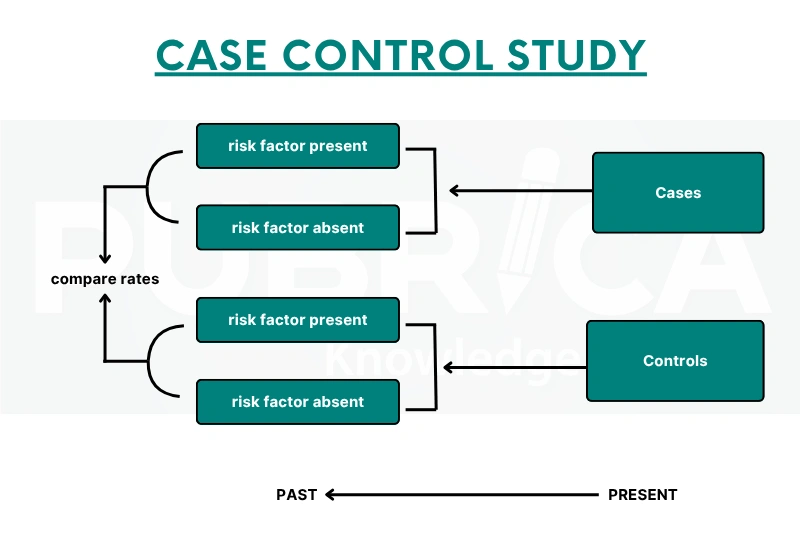
1. Visual Overview of Case-Control Study Design
2. Definition of Case-Control Study
An observational analytical type of research design that compares two or more groups of persons based on their outcome status is a case-control study definition in epidemiology. One group, referred to as the “cases,” is made up of people who have the disease or condition of interest, while the other, referred to as the “controls,” is made up of people who do not have the condition. The main purpose of the case control study method is to determine whether there are any differences in exposure to potential risk factors between the two groups using a retrospective approach.[3]
Unlike experimental studies, case-control studies do not involve any interventions or assignments of exposure by the researchers. Rather, researchers rely on historical data (e.g. interviews, medical records) to recreate the exposures of cases and controls. Because of this retrospective nature of data collection, case-control studies can be low-cost, time-efficient and provide valuable information regarding the potential causes of disease.
3. Purpose of Case-Control Studies
The objectives of a case control study are used primarily to determine whether a relationship exists between a risk factor and outcome of interest (the most common example would be the relation between smoking and lung cancer). This type of study is especially useful when the disease is uncommon or when there is a long latency period between exposure to the risk factor and the development of the disease.[4]
Hypothesis generation is the second main objective of case control studies; such studies are frequently used to identify potential causal relationships that can be confirmed through more definitive studies such as cohort and randomised controlled trials.
4. Key Characteristics of Case-Control Studies
Feature | Description |
Study Type | Observational and analytical |
Direction | Retrospective (looks backwards in time) |
Groups Compared | Cases (with disease) vs Controls (without disease) |
Outcome Measurement | Already occurred at the start of the study |
Exposure Assessment | Based on records or participant recall |
Common Measure of Association | Odds Ratio (OR) |
5. Process of Conducting a Case-Control Study
Identifying cases or individuals with the disease or outcome is how the research cohort is formed. The control group must not have the disease but must be comparable to the case group in every way except for the fact that the control group does not have the disease.[5]
After creating both groups, researchers then collect data about past exposures. Past exposures may include lifestyle characteristics, environmental exposure, genetic susceptibility, or occupational risk. Finally, case control study statistical analysis explained methods are used to investigate whether there is a statistically significant association between exposure and disease/outcome.
5.1. Example of a Case-Control Study
Study Component | Example Scenario |
Cases | Patients diagnosed with lung cancer |
Controls | Individuals without lung cancer |
Exposure Investigated | History of smoking |
Outcome | Presence or absence of lung cancer |
Result Interpretation | Higher odds of smoking among cases suggest a strong association |
This is one of the most common case control study examples. Researchers compared individuals with lung cancer to those without it and found that smoking was significantly more common among the cases. This provided strong evidence linking smoking to lung cancer.
6. Advantages and Limitations
A few of the elements that make a case-control study advantageous are timesaving and cost-saving factors. Case-control studies are especially used for rare medical conditions as following many people over time to notice these events is unreasonable. The case control study method also allows researchers to explore several risk factors at once. [6]
On the other hand, there are some disadvantages to conducting case-control studies. A large concern or issue may be recalling bias, which could result when participants do not recall their prior exposures to an event or a risk factor. There is also the issue of selection bias when a control is not adequate (should be the same as cases). Additionally, case-control studies do not provide direct evidence of causation but only suggest associations.
7. Applications in Modern Research
Nowadays, case control study design is extensively utilised in public health research, medical and clinical studies, as well as in the social sciences. They play an important role in epidemiological outbreak investigations and allow for rapid identification of the source(s) of infection. Additionally, case-control studies are helpful in identifying potential gene-disease associations through genetic research. Furthermore, case-control studies can be utilised in environmental health to evaluate the effects of environmental pollutants or workplace hazards. [7]
Connect with us to explore how we can support you in maintaining academic integrity and enhancing the visibility of your research across the world!
Conclusion
The case control study continues to serve as a key component of the field of epidemiology because it is practical and provides an effective means of exploring the association between exposure (risk factor) and disease (outcome). In addition, it has some drawbacks, but it still offers value in generating early knowledge that can help prevent disease and improve health, especially when case-control studies are carefully done to minimize bias. Thus, careful case control study statistical analysis explained approaches and design can provide valuable evidence for disease prevention and health promotion.
Case-Control Study: Definition, Purpose & Examples. Our Pubrica consultants are here to guide you. [Get Expert Publishing Support] or [Schedule a Free Consultation]
References
- Tenny S, Kerndt CC, Hoffman MR. Case Control Studies. [Updated 2023 Mar 27]. In: StatPearls [Internet]. Treasure Island (FL): StatPearls Publishing; 2026 Jan-. Available from: https://www.ncbi.nlm.nih.gov/books
- Setia M. S. (2016). Methodology Series Module 2: Case-control Studies. Indian journal of dermatology, 61(2), 146–151. https://doi.org/10.4103/0019-5154.177773
- National cancer institute (.Gov). (2011, February 2). Cancer.gov. https://www.cancer.gov/publications/dictionaries/cancer-terms/def/case-control-study
- Andrade C. (2022). Research Design: Case-Control Studies. Indian journal of psychological medicine, 44(3), 307–309. https://doi.org/10.1177/02537176221090104
- Lutsey P. L. (2023). Case-control studies: Increasing scientific rigor in control selection. Research and practice in thrombosis and haemostasis, 7(2), 100090. https://doi.org/10.1016/j.rpth.2023.100