savings for a limited time.

- Services
- Discovery & Intelligence Services
- Publication Support Services
- Sample Work
Publication Support Service
- Editing & Translation
-
Editing and Translation Services
- Sample Work

Editing and Translation Service
-
- Research Services
- Sample Work
Research Services
- Physician Writing
- Sample Work
Physician Writing Service
- Statistical Analyses
- Sample Work
Statistical Analyses
- Data Collection
- AI and ML Services
- Sample Work
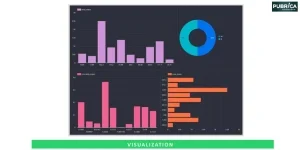
AI and ML Services
- Medical Writing
- Sample Work
Medical Writing
- Research Impact
- Sample Work
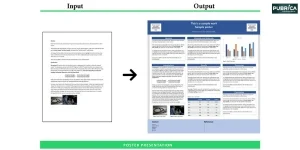
Research Impact
- Medical & Scientific Communication
- Sample Work
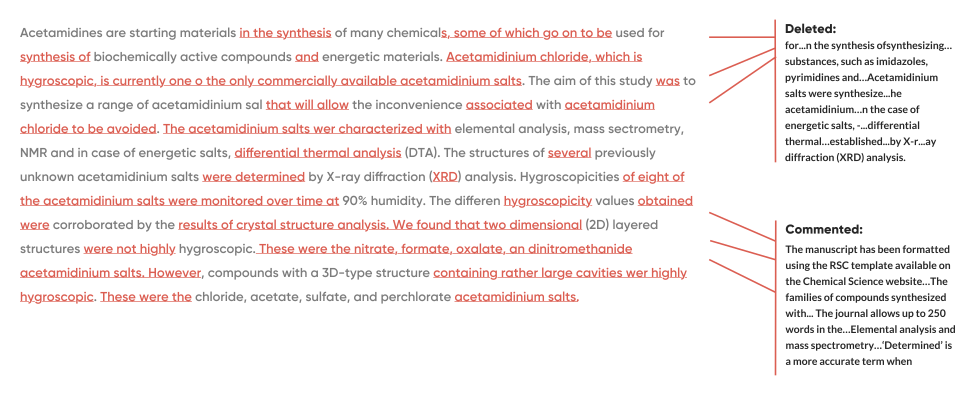
Medical & Scientific Communication
- Medico Legal Services
- Educational Content
- Academic Editorial Services
- Sample Work
Academic Editorial Services
- Educational Editorial Service
-
Education Editorial Services
- Sample Work
Education Editorial Services
-
- Industries
- Subjects
- About Us
- Academy
- Insights
- Contact Us
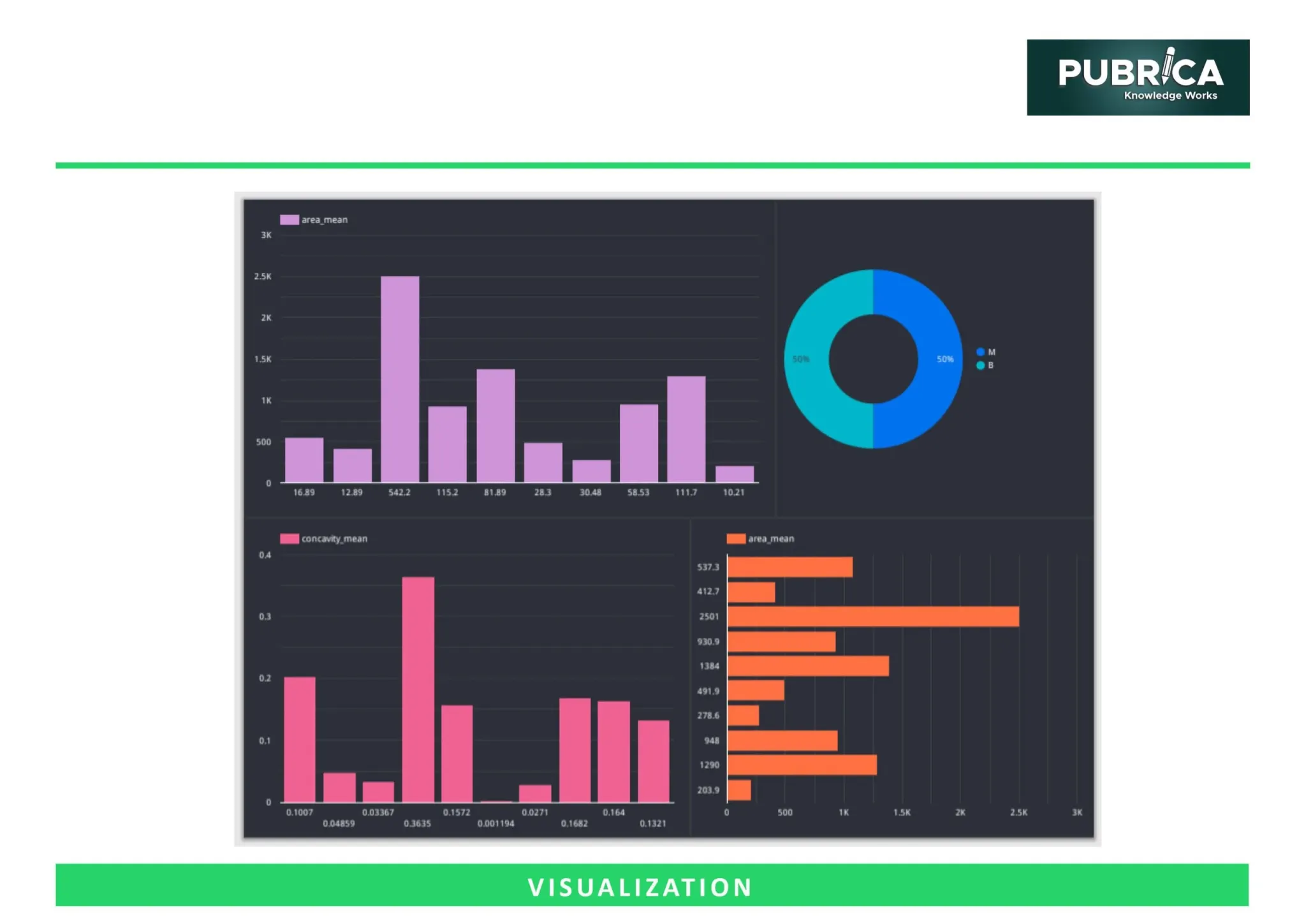
What Is Correlational Research: Definition, Types, and Examples
What Is Correlational Research: Definition, Types, and Examples
Correlation research is used in many fields such as social science research, psychology research, educational research, healthcare, business, and marketing to look at the relationship that exists among two or more variables in research without suggesting that one variable causes the other. For instance, one can undertake a correlational research study or a correlational study to establish the relationship between time spent studying and grade achieved. This type of correlation research design is widely applied in these fields.[1]
1. Definition of Correlational Research
The concept of correlational research involves a type of non-experimental research where there is an examination of statistical relationship among two or more variables. The main objective of this research methodology involves the establishment of an association between one variable in research and another. [1]
According to experts in research methodology, correlational research involves measurements of the magnitude and direction of relationships between variables, which could be positive, negative, or zero.
- Correlation involves a statistical link between variables.
- This is not causation.
- Variables are observed as they are.
2. Characteristics of Correlational Research
The following are some of the key features of correlational studies: [2]
- Non-experimental in nature: In this approach, variables are neither manipulated nor controlled.
- Quantitative: It is an approach that is primarily numeric in nature.
- Measurement of relationships: Relationships are what this study measures, often using statistical tools like Pearson correlation or Spearman rank correlation.
- Practicality: Correlational studies may be carried out in real-life situations.
- Prediction: Correlation results can be used for predicting future occurrences.
3. Types of Correlational Research
There exist three main categories of correlations.
Positive Correlation
This is when the two variables in research change in the same direction. When one variable increases, the other also increases.
Example:
- Study time results in improved performance in studies.
- Exercise results in improved physical fitness.
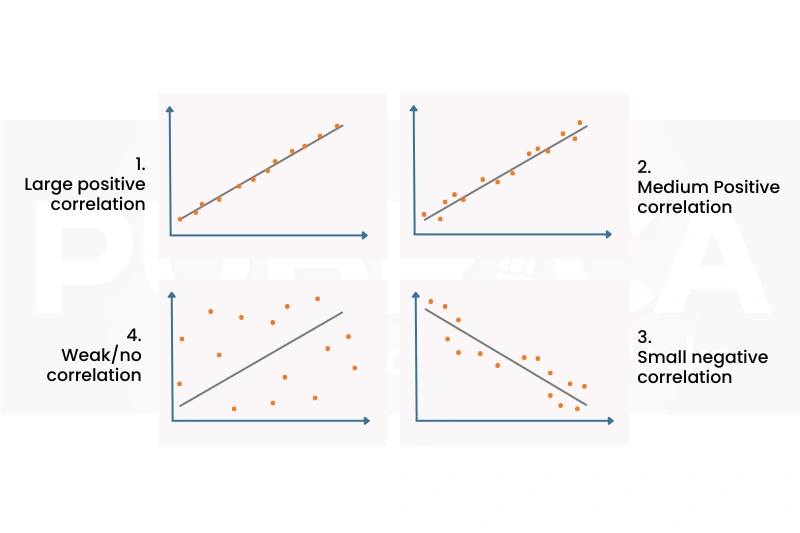
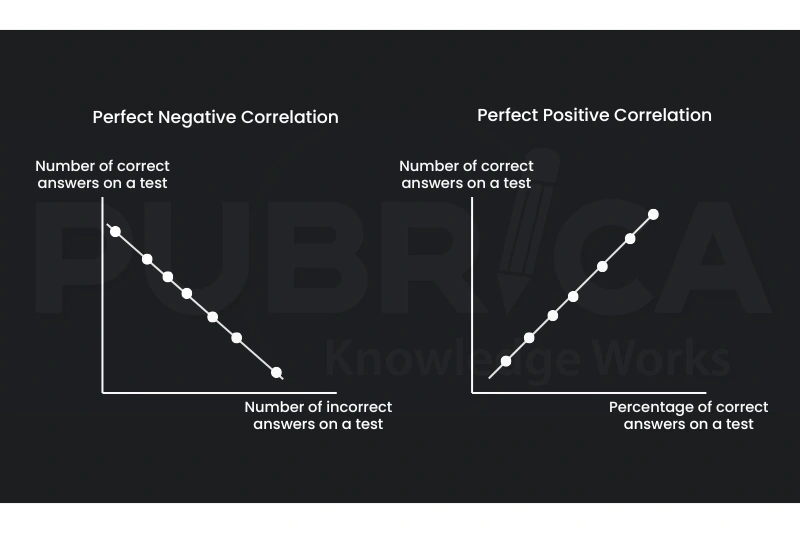
4. Negative Correlation
A negative correlation occurs when one variable increase while the other decreases. [3]
Example:
- Higher stress levels reduce productivity.
- Increased screen time lowers sleep quality.
5. Zero Correlation
Zero correlation means there is no relationship between the variables.
Example:
- Shoe size and intelligence level.
- Hair colour and mathematical ability.
6. Positive and Negative Correlation
Correlation is usually measured using a correlation coefficient, denoted r. [4]

Interpretation of Correlation Coefficient
Correlation Value | Meaning |
+1 | Perfect positive correlation |
0 | No correlation |
-1 | Perfect negative correlation |
Strength of Correlation
- Strong correlation: Variables closely related
- Moderate correlation: Partial relationship
- Weak correlation: Small relationship
7. Methods Used in Correlational Research
Different approaches can be applied to get correlational research data.
- Questionnaire and Surveys: Can be used to collect opinions, behaviours, and attitudes of respondents.
- Observational Study: When researchers observe participants in their natural environment.
- Archive Research: Where data is already available for analysis.
- Statistics Tools: For example, Pearson correlation and Spearman’s rank correlation.
Examples of Correlational Research
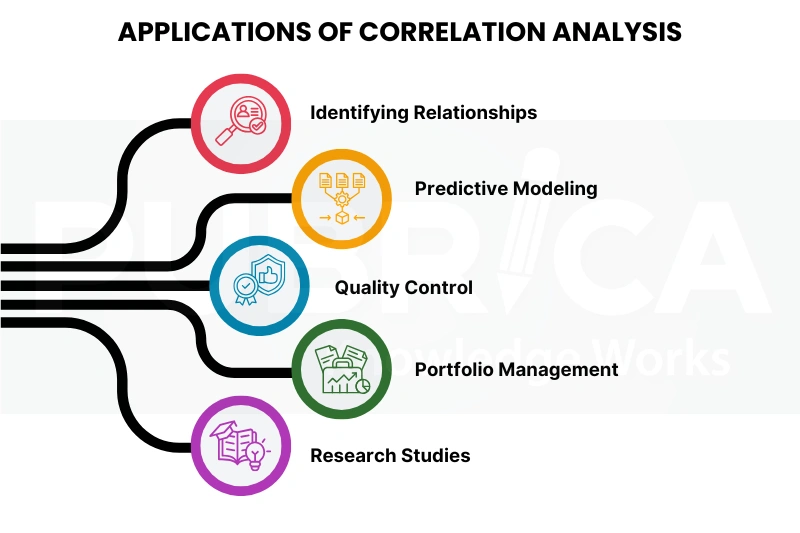
Correlation studies find many practical applications in different industries and disciplines of science.
Education: The link between attendance and performance is being researched by scientists.
Health Care: The correlation between smoking and lung disease is examined.
Psychology: Scientists explore the correlation between anxiety and sleeping patterns.
Marketing and Business Studies: Scientists examine the connection between customer satisfaction and brand loyalty.
Technology: Social networking effects on mental well-being are explored.
8. Advantages of Correlational Research
Some advantages of correlational research include: [5]
- Efficient financially: It is relatively cheap when compared to an experimental research design.
- Effortless Data Collection: Research can be done using questionnaires, interviews, and databases.
- Conforming to Reality: Research is done within real-life situations.
- Able to Predict: Correlation enables predictions on certain tendencies and behaviours.
- Flexible Ethically: Scientists can work on variables that cannot be experimented on.
Example
It is immoral to put people under the influence of something dangerous in an experimental study, but not in a correlational study
9. Limitations of Correlational Research
Nevertheless, there exist certain weaknesses associated with correlation studies. [6]
Cannot Demonstrate Causation: Correlation does not necessarily mean that one variable leads to another.
For example,
Both the sales of ice cream and the occurrence of drownings could be high during the summer months. But ice creams cannot result in drowning.
- Third Variable Issue: An unaccounted factor can act upon both the variables.
- Misinterpretation: Researchers could misinterpret findings and draw wrong conclusions.
- Limited Control: Unrelated factors can influence results.
Conclusion
Correlational research is one of the major types of research design used to analyse the statistical relationship between two variables in research within their real-life contexts. Though correlational research does not determine causality, it gives useful information that can be applied in further investigation and in decision-making. Through analysis of correlations, researchers get a better understanding of human behaviour, social dynamics, and organisational performance.
What Is Correlational Research: Definition, Types, and Examples.Our Pubrica consultants are here to guide you. [Get Expert Publishing Support] or [Schedule a Free Consultation]
References
- Curtis, E. A., Comiskey, C., & Dempsey, O. (2016). Importance and use of correlational research. Nurse researcher, 23(6), 20–25. https://doi.org/10.7748/nr.2016
- Miot H. A. (2018). Correlation analysis in clinical and experimental studies. Jornal vascular brasileiro, 17(4), 275–279. https://doi.org/10.1590/1677-5449.174118
- Zhan, L., Jenkins, L. M., Wolfson, O. E., GadElkarim, J. J., Nocito, K., Thompson, P. M., Ajilore, O. A., Chung, M. K., & Leow, A. D. (2017). The significance of negative correlations in brain connectivity. The Journal of comparative neurology, 525(15), 3251–3265. https://doi.org/10.1002/cne.2427
- Schober, P., Boer, C., & Schwarte, L. A. (2018). Correlation Coefficients: Appropriate Use and Interpretation. Anesthesia and analgesia, 126(5), 1763–1768. https://doi.org/10.1213/ANE.0000
- Lau F. Chapter 12 Methods for Correlational Studies. In: Lau F, Kuziemsky C, editors. Handbook of eHealth Evaluation: An Evidence-based Approach [Internet]. Victoria (BC): University of Victoria; 2017 Feb 27. Available from: https://www.ncbi.nlm.nih.gov/
- Fu, H., Tang, S., & Zhao, X. (2025). Limitations of Correlation Coefficients in Research on Functional Connectomes and Psychological Processes. Human brain mapping, 46(10), e70287. https://doi.org/10.1002/hbm.702

Give yourself the academic edge today
Each order includes
- On-time delivery or your money back
- A fully qualified writer in your subject
- In-depth proofreading by our Quality Control Team
- 100% confidentiality, the work is never re-sold or published
- Standard 7-day amendment period
- A paper written to the standard ordered
- A detailed plagiarism report
- A comprehensive quality report