
- Services
- Discovery & Intelligence Services
- Publication Support Services
- Sample Work
Publication Support Service
- Editing & Translation
-
Editing and Translation Services
- Sample Work
Editing and Translation Service
-
- Research Services
- Sample Work
Research Services
- Physician Writing
- Sample Work
Physician Writing Service
- Statistical Analyses
- Sample Work
Statistical Analyses
- Data Collection
- AI and ML Services
- Sample Work
AI and ML Services
- Medical Writing
- Sample Work
Medical Writing
- Research Impact
- Sample Work
Research Impact
- Medical & Scientific Communication
- Sample Work
Medical & Scientific Communication
- Medico Legal Services
- Educational Content
- Academic Editorial Services
- Sample Work
Academic Editorial Services
- Educational Editorial Service
-
Education Editorial Services
- Sample Work
Education Editorial Services
-
- Industries
- Subjects
- About Us
- Academy
- Insights
- Contact Us
How to Use Peer-Reviewed Journals in Your Literature Review
High-Impact Journals
Interesting topics
How to Use Peer-Reviewed Journals in Your Literature Review
Table of Contents
1. Understanding the Role of Peer-Reviewed Journals
2. Finding Relevant Peer-Reviewed Articles
3. Evaluating Journal Articles Critically
4. Organising Literature Effectively
5. Synthesising Evidence Instead of Summarising
6. Identifying Research Gaps
7. Integrating Sources into Academic Writing
8. Conclusion
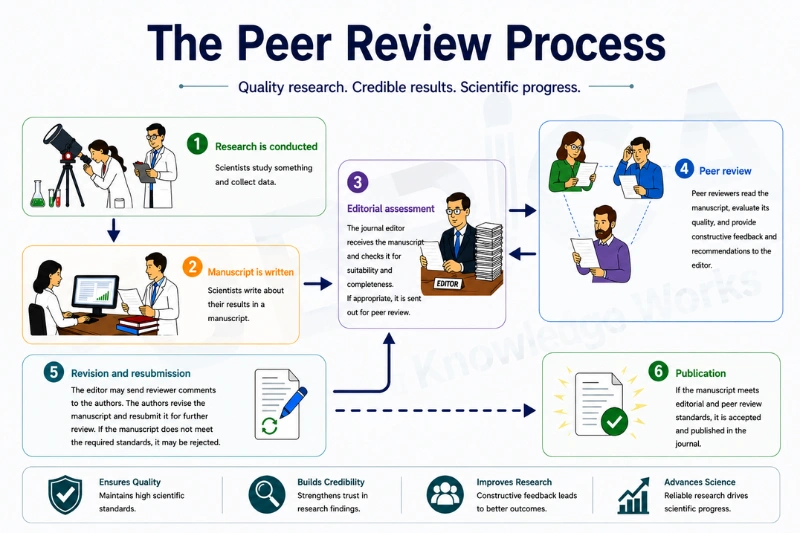
The literature review is not only an analysis of other academic works but also a critical assessment of these academic papers, which serves as a basis for the creation of new research. There are many sources from which one can use information; however, peer-reviewed journals are the most reliable of all. The reason for this is that the journal articles are carefully examined by scholars before their publication. Inclusion of such materials in a literature review adds validity to the study. Understanding what is peer review and why is it important can help researchers appreciate the value of credible academic sources.[1]
1. Understanding the Role of Peer-Reviewed Journals
Academic journals become the source of trustworthy information due to being peer-reviewed. As the quality of content in terms of its accuracy and validity is ensured by subject matter experts before publication, the articles found in such academic journals tend to meet certain criteria. Understanding what is a peer review journal is essential for researchers seeking reliable evidence.[2]
In a literature review, peer-reviewed journals will allow scholars to:
- Establish an appropriate theoretical base.
- Become familiar with ongoing advancements in the discipline.
- Illustrate the areas that lack sufficient coverage.
- Critically compare various approaches taken in different studies.
- Supply sound evidence for the arguments presented.
This highlights why peer review is important for researchers and why academic literature should be prioritised over websites and blogs.
2. Finding Relevant Peer-Reviewed Articles
Before utilising peer-reviewed journals, the first step would be finding related literature. The researcher should start by identifying the theme of his or her research and the concepts that are most important for the research.[3]
Academic databases that can be used to find scholarly articles and peer-reviewed publications include Scopus, Web of Science, PubMed, and Google Scholar.
Selecting Search Strategies
Research Topic | Effective Search Keywords |
Online Education | Online learning, student engagement, virtual classrooms |
Employee Motivation | Workplace motivation, job satisfaction, and employee performance |
Public Health | Healthcare access, patient outcomes, and community health |
Consumer Behaviour | Customer satisfaction, purchase intention, consumer decision-making |
Using precise keywords and database filters can significantly improve the relevance of search results.
3. Evaluating Journal Articles Critically
Finding the articles is just a starting point. Researchers need to assess if the study adds value to their literature review.
The following should be assessed when reviewing an article:
- Research goals.
- Methodology used.
- Size of sample and participants’ characteristics.
- Findings of the study.
- Limitations discussed in the study.
- Directions for further research.
Researchers may also use a peer review checklist to evaluate the quality, reliability, and relevance of studies. Critically assessing articles will enable researchers to recognise the difference between stronger and weaker studies.
4. Organising Literature Effectively
One of the most frequent problems encountered when writing literary reviews is the difficulty of handling many references. Rather than reviewing them one by one, researchers should categorise them into themes, theories, methods, or conclusions. Effective literature review writing requires a structured approach to organising evidence.[4]
Example of Literature Organisation
Theme | Focus Area |
Employee Engagement | Factors influencing workplace productivity |
Leadership Styles | Impact of leadership on performance |
Organizational Culture | Employee satisfaction and retention |
Remote Work | Effects on communication and collaboration |
Organising literature thematically creates a logical structure and improves the flow of the review.
5. Synthesising Evidence Instead of Summarising
The literature review should not just be a summary of findings from individual research works; it should also contrast and synthesise information from various sources.
For instance, different pieces of research may indicate that telecommuting is associated with flexibility and job satisfaction. Other research works may indicate difficulties such as poor communication skills. In comparing both positions at once, researchers give a critical assessment of both views.
This is where synthesis becomes necessary to show any trends, controversies, and gaps in the existing body of literature.
6. Identifying Research Gaps
The identification of areas that may need further research can be one of the greatest values added by a literature review. It is common for peer-reviewed publications to have discussions regarding limitations in the research, as well as recommendations for future studies. [5]
These can include:
- Underserved populations.
- Contradictory results.
- Limitations with the methodology employed.
- Fresh topics that have little evidence behind them.
- Lack of research in certain geographic locations/cultures.
This process supports effective research gap identification, which is a key objective of academic research.
7. Integrating Sources into Academic Writing
When conducting the literature review, sources must be seamlessly woven within the discussion rather than being discussed independently. Every part must link together different studies that have been conducted based on a particular theme or idea.
In doing so, one must try to construct a logical story about how previous research findings have been made, what areas of agreement there have been, and what remains to be uncovered. This approach reflects strong academic research methods and enhances the quality of scholarly writing.
Connect with us to explore how we can support you in maintaining academic integrity and enhancing the visibility of your research across the world!
Conclusion
Peer-reviewed journals constitute the basis of an excellent literature review. This is because they offer reliable data, expert opinions, and insightful views to help scholars know what other people have achieved and the gaps that can be filled. When scholars identify studies that matter in a specific topic, evaluate their quality, categorise data, and synthesise the data collected, then they can create literature reviews that are analytical and academic. Through such literature reviews, scholars prove their knowledge of the subject area and lay the foundation of scholarly research.
How to Use Peer-Reviewed Journals in Your Literature Review. Our Pubrica consultants are here to guide you. [Get Expert Publishing Support] or [Schedule a Free Consultation]
References
- Wong, T., Soni, R. N., & Glass, C. (2025). A Guide to an Effective Peer Review. POCUS journal, 10(2), 7–10. https://doi.org/10.24908/pocusj.v10i02.20
- Zimba, O., & Gasparyan, A. Y. (2021). Peer review guidance: a primer for researchers. Reumatologia, 59(1), 3–8. https://doi.org/10.5114/reum.2021.102709
- Kohn K. P. (2025). Navigating the Scholarly Literature: A Practical Guide to Searching Effectively (Without Too Much Stress). Current protocols, 5(5), e70138. https://doi.org/10.1002/cpz1.70138
- Parker, R., & Sikora, L. (2022). Literature Reviews: Key Considerations and Tips From Knowledge Synthesis Librarians. Journal of graduate medical education, 14(1), 32–35. https://doi.org/10.4300/JGME-D-21-01114.1
- Wong, E. C., Maher, A. R., Motala, A., Ross, R., Akinniranye, O., Larkin, J., & Hempel, S. (2022). Methods for Identifying Health Research Gaps, Needs, and Priorities: a Scoping Review. Journal of general internal medicine, 37(1), 198–205. https://doi.org/10.1007/s11606-021-07064-1