



























The main steps include specifying a research question, literature search, selection, assessment, extraction, statistical synthesis, heterogeneity assessment, and interpretation.
The main purpose of a meta-analysis is to statistically combine study results using statistical methods that compute overall effect sizes by weighting studies according to sample size or variance.
The importance of meta-analysis is that it increases statistical power, precision, combines study results, reduces uncertainty, and increases overall evidence.
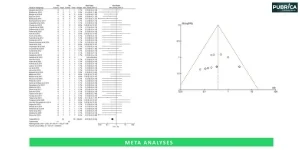
Meta-analysis services assist projects through systematic search, data extraction, statistical calculations, assessment of heterogeneity, preparation of forest plots, and accurate and publication-ready reporting.
The methods used for meta-analysis include fixed effects models, random effects models, calculation of effect sizes, tests of heterogeneity, subgroup analyses, sensitivity analyses, and publication bias methods.