
Targeted literature searches are a fundamental part of writing clinical manuscripts that will meet the standards of high-quality journals and contribute meaningfully to evidence-based practice. When physicians write clinical manuscripts, utilizing a targeted literature search can identify high-quality, relevant, and current evidence. While a general literature review is useful, a targeted literature search is specific to the clinical question and should be completed through frameworks established, such as PICO (Population, Intervention, Comparator, Outcome) and PRISMA [1].
What is Scientific News Reporting and Why Researchers Need It
- Home
- Academy
- Research Impact
- What is Scientific News Reporting and Why Researchers Need It
High-Impact Journals
Interesting topics
What is Scientific News Reporting and Why Researchers Need It
Scientific news reporting translates complex research into engaging stories for the public, focusing on key discoveries, breakthroughs, and implications across all sciences, using clear language and storytelling to explain “what, where, when,” and “why,” while maintaining accuracy and avoiding jargon or patronizing the audience.
Scientific news reporting plays a central role in public understanding of science by ensuring that complex discoveries are presented accurately and accessibly. Scientific research generates new scientific knowledge every day, and unfortunately, many complex discoveries are published only in the limited access of academia. To help create an interface for placing research into the hands of non-scientists and the population, science reporters translate the technical study results into engaging news articles that will inform society (e.g., policymakers, the general public, and scientists from other disciplines). Most simply, scientific news reporting is a form of science communication that distils the results of rigorous research into understandable narratives for a lay audience.[1] This process of translating research for the public is a key component of effective science communication for researchers.
1. Understanding Scientific News Reporting
The interpretation and summarisation of scientific research findings for a public audience is referred to as reporting on science or scientific reporting. Science news reports do this by focusing on the most significant findings, including a brief explanation of the methods used to obtain those results, and by providing background information about the relevance of the research for a broader audience.
This form of science journalism and research dissemination ensures that scientific discoveries reach audiences beyond academic journals. Some characteristics that help make effective scientific news reporting include:
Clear and simple writing | Using plain language to explain findings in as straight forward a manner as possible while maintaining necessary detail.
|
Contextual grounding | The ability to describe how the findings of research fit into the current body of knowledge and/or address issues of societal concern. |
Balance and accuracy | In addition to reporting exciting or sensational results, it is important to report the nuances and limitations of the research. |
Scientific news reporting sits within the broader field of science communication, which has been defined as connecting science and society by informing non‑experts about scientific findings and raising public awareness of science’s relevance. Together, these practices support academic media outreach and responsible news coverage of scientific findings.
2. The Role of Science Communication in Research Visibility
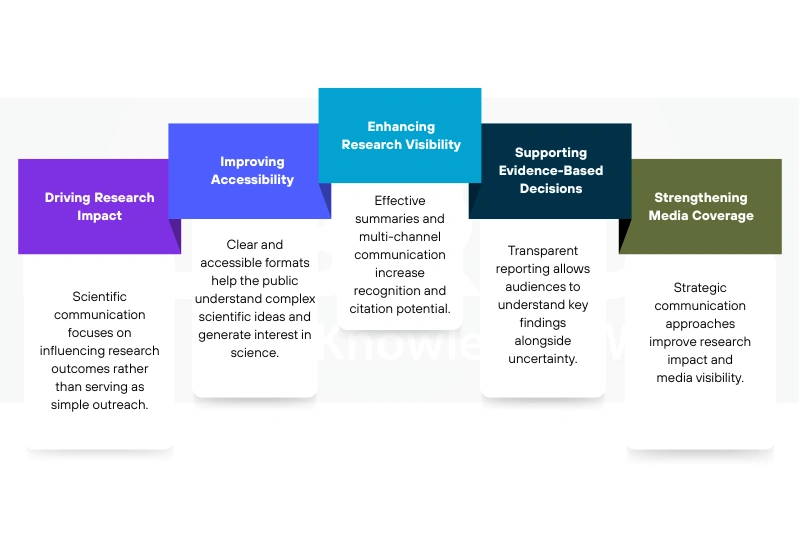
3. Why Researchers Need Scientific News Reporting
Researchers benefit from having scientific news coverage in many different ways:
Enhancing Research Visibility Ability to reach a larger audience (including people who are not researchers), Engage in more online and social discussions regarding research-related issues.
| Facilitating Public Engagement Translating research findings into language that everyone can understand allows the public to see how research relates to their daily lives.
|
Informing Policy and Funding Decisions Clear summaries of research findings help decision makers (e.g., policymakers) make informed decisions about issues that affect society, Communication of scientific findings may increase political support for federal funding for scientific research.
| Building Trust and Credibility Transparent scientific reporting builds trust and credibility by presenting research findings clearly, accurately, and without exaggeration. By acknowledging limitations and uncertainties, it helps prevent misinformation and enables audiences to distinguish solid evidence from speculation. |
Scientific news reporting services help researchers amplify visibility while maintaining scientific integrity.
Beyond individual benefits, science communication also plays an important social role it promotes scientific literacy and encourages curiosity, both essential for informed citizenship and public education. Well-executed research media outreach services strengthen long-term engagement between science and society.
4. Challenges and Ethical Considerations in Reporting
The process of scientific reporting can be fraught with challenges, such as misrepresentation, sensationalism, and distortion of research findings, resulting in misunderstandings by the public and erosion of trust in science.[5] Studies indicate that overstated or incomplete reports may eventually impact health communication; consequently, responsible scientific reporting must address the following issues
- Overemphasizing results and disregarding the limitations of research.
- Balancing between capturing the readers’ interest while remaining accurate
- Reflecting the realities of bias regarding how scientists/researchers are represented in the media.
Research indicates that even when the intent of a news article is good, it may still place too much emphasis on speculation/promises, which creates an unrealistic expectation for the reader.[6] Ethical science news press release writing and academic news writing service models aim to minimize these risks.
5. Best Practices for Effective Scientific News Reporting
Quality scientific news reporting should include:
- Language and narrative structure suited to the target audience.
- Real-world context for the findings (i.e. tie findings to real-world issues).
- Expert review and fact-checking to ensure scientific integrity.
- Visual and summary references of the findings to allow the audience to understand and easily digest the complexity of the data.
The goals of science communication all coincide with these practices: Providing transparency, comprehension, and usefulness for all types of audiences. [7] These principles underpin professional scientific news reporting services and sustainable academic media outreach efforts.
Connect with us to explore how we can support you in maintaining academic integrity and enhancing the visibility of your research across the world!
Conclusion
The scientific news reporting forms a vital connection between the latest research findings and the wider audiences that are not part of academia. Through the conversion of difficult-to-obtain studies into easy-to-read stories, the visibility of the research is boosted, an avenue for informing the public and building trust in science has been created, and as science becomes more prevalent in how our societies make decisions; so too will the need for accurate, yet engaging, reporting. Effective scientific news reporting remains essential for advancing public understanding of science and long-term research dissemination.
Communicate Science Effectively!. From journals to news articles, Pubrica ensures your research is accurately reported and widely understood.[GetExpert Publishing Support] or [Schedule Free Consultation]
References
- Wikipedia contributors. (2026, January 15). Science communication. Wikipedia, The Free Encyclopedia. https://en.wikipedia.org/w
- Lewis, T. (n.d.). 10 engaging examples of science journalism. Shorthand.com. Retrieved January 16, 2026, from https://shorthand.com/the-craft/science-journalism-examples/index.html?
- Tuff, K. (2025, May 21). Why science communication is the most important skill for researchers. Impact Media Lab | For Bigger, Bolder Science. https://www.impactmedialab.com
- Mahr, D., Bussoletti, A., Coenen, C., Comunello, F., Baniukevič, J., & Weinberger, N. (2025). Science journalists and public trust: comparative insights from Germany, Italy, and Lithuania. Journal of Science Communication, 24(05), A01. https://doi.org/10.22323/149220
- Dempster, G., Sutherland, G., & Keogh, L. (2022). Scientific research in news media: a case study of misrepresentation, sensationalism and harmful recommendations. Journal of Science Communication, 21(01), A06. https://doi.org/10.22323/
- Peng, H., Teplitskiy, M., & Jurgens, D. (2024). Author mentions in science news reveal widespread disparities across name-inferred ethnicities. Quantitative Science Studies, 5(2), 351–365. https://doi.org/10.1162
- Lee, S. (n.d.). Science journalism essentials. Number Analytics LLC. Retrieved January 16, 2026, from https://www.numberanalytics.com