Rebuttal Preparation: Strategic Planning for Successful Peer Review Outcomes
- Home
- Academy
- Research Impact
- Rebuttal Preparation: Strategic Planning for Successful Peer Review Outcomes
High-Impact Journals
Interesting topics
Rebuttal Preparation: Strategic Planning for Successful Peer Review Outcomes
Effective rebuttal preparation involves actively listening to identify an opponent’s core premises, researching evidence to counter their claims, and structuring arguments logically. Organize responses by theme, focusing on high-impact, “deal-breaker” points rather than minor details, while maintaining a respectful tone to maximize persuasiveness.
Peer review rebuttal strategies and how to respond to reviewer comments form the foundation of an effective academic revision process, guiding authors through structured peer review response preparation. The act of answering peer reviewer comments is not simply a procedural requirement; it represents a deliberate professional/ or academic practice and can sway the outcome of whether a manuscript will be accepted, further revised, or rejected as a submission. Successfully addressing the critiques creates an opportunity to utilize the author’s academic knowledge, diplomatic communication skills, and professional editorial judgement. Within the broader academic peer review process, a clear response to reviewer comments is essential for ensuring transparency, rigor, and editorial confidence.
1. Why Rebuttal Strategy Matters in Peer Review
Strengthening scientific validity, transparency, and impact are goals of peer review; however, the presence of poorly organized rebuttals continues to be one of the leading causes of post-review rejection even when supported by a strong data precedent [1,2]. Manuscript revision after peer review depends heavily on effectively addressing reviewer feedback in a manner aligned with journal expectations. A well thought out rebuttal will provide authors with an opportunity to:
- Exhibit scientific maturity and open-mindedness to critiques
- Clearly communicate clarification of misconceptions while remaining non-defensive
- Provide the reviewers with revisions that are in compliance with the journal’s predetermined scope of publication and the reviewer’s expectations
- Convey professionalism to editors involved in making a final decision regarding the acceptance of the manuscript [3]
2. Core Principles of an Effective Rebuttal Letter
- Scientific Precision: Each response will provide references to revised analyses, tables and/or more recent literature (as relevant) in support of your position
- Professional Tone: Using a respectful manner promotes collaboration; despite disagreement with reviewer opinions
- Structural Clarity: Using a point-by-point list promotes transparency as well as increases editing management efficiency
A well-structured rebuttal letter for journal submission reflects both scholarly rigor and professional communication standards.[4,5]
What Editors Look for in Rebuttals
Editors prioritize clarity, completeness, and responsiveness over length. A concise but thorough rebuttal often outweighs extensive revisions without explanation.
3. Step-by-Step Rebuttal Planning Framework
The structured rebuttal is organized in a systematic manner; therefore, when responding to reviewer feedback you are using a systematic rather than reactive method. The steps below illustrate a practical workflow for converting the reviewers’ comments into specific improvements on the manuscript:
- Group the reviewer comments based upon their categorization (major, minor, technical).
- Identify a specific action (for example revision, justification, or clarification) for each comment.
- Make any changes to the manuscript before writing the rebuttal.
- Provide the line and page numbers of all changes made to the manuscript.
Check the rebuttal for its tone, consistency, and completeness. [6]
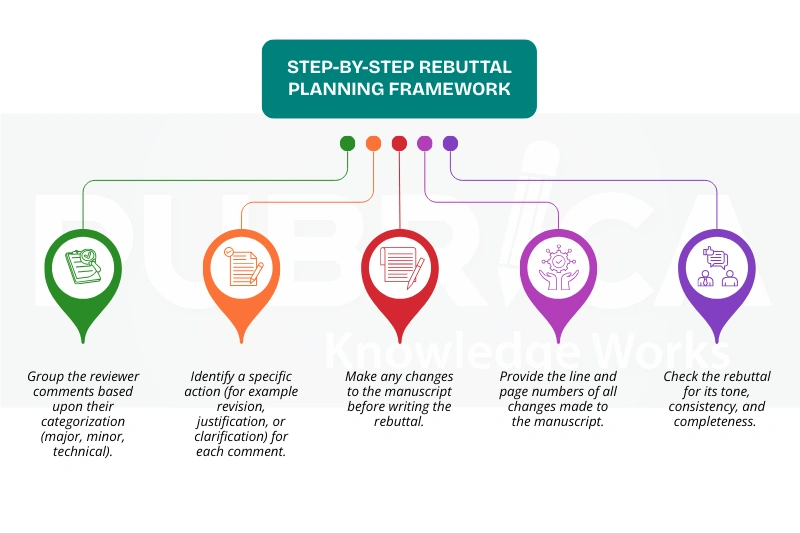
This approach supports effective handling reviewer criticisms while maintaining clarity and consistency throughout the revision process.
4. Common Reviewer Comments and Strategic Responses
There are patterns to how reviewers provide comments, which require you to address those comments with a specific strategy. The table below demonstrates specific examples of reviewer comments along with example strategies that can help you address them when writing your revisions.
Reviewer Concern | Strategic Response |
Methodology unclear | Add schematic, provide citations for justification of design |
Sample size questioned | Provide power analysis or acknowledge as a limitation |
Novelty concerns | Strengthen your discussion and provide additional comparative literature |
Language issues | Provide professional language editing acknowledgment |
Peer review response writing service models often rely on these standardized patterns to ensure comprehensive rebuttal development.
5. Managing Disagreement with Reviewers
If warranted by evidence, one may disagree with a reviewer without being dismissive. Authors should:
- Recognise the viewpoint of the reviewer.
- Support your disagreement with data.
- Propose to revise or clarify in part when possible.
Example for a Constructive Disagreement
“We appreciate the reviewer’s concern regarding confounding variables. While additional stratification was not feasible due to sample size, we have clarified this limitation and cited comparable approaches used in similar studies.”
Professional rebuttal letter editing service support can help authors navigate sensitive disagreements while preserving academic credibility.
6. Rebuttal Writing Do’s and Don’ts
The tone and structure of a rebuttal letter are as critical as the scientific content of the revisions. The following do’s and don’ts highlight best practices that help maintain professionalism and facilitate favourable peer review outcomes.
Do’s | Don’ts |
Use neutral, appreciative language | Use emotional or defensive phrasing |
Reference revised sections clearly | Assume reviewers will search for changes |
Address every comment | Skip or merge unrelated comments |
Manuscript revision and rebuttal support services frequently emphasize these best practices to reduce revision cycles and improve acceptance outcomes.
THE BOTTOM LINE:
Leveraging Rebuttals to Strengthen Manuscript Impact
High-quality rebuttals often result in clearer arguments, improved figures, and stronger discussions, increasing citation potential post-publication [1]. In some cases, reviewers become advocates for acceptance when authors demonstrate thoughtful engagement.
Connect with us to explore how we can support you in maintaining academic integrity and enhancing the visibility of your research across the world!
Conclusion
During rebuttal preparation, you should think of your rebuttal as part of a strategic discussion with the scientific community rather than a simple response. By using structured planning, courteous communication and revising your manuscript based on evidence, authors can greatly increase their chances of receiving better results from the peer review process and having their manuscript accepted for publication. Academic publishing consulting services often integrate peer review response preparation and strategic rebuttal planning to support authors throughout the publication lifecycle.
Need expert help with your rebuttal letter or post–peer review revision? Pubrica supports you with peer review response preparation and editing to improve acceptance outcomes.[Get Expert Publishing Support] or [Schedule a Free Consultation].
References
- Bornmann, L. (2011). Scientific peer review. Annual Review of Information Science and Technology, 45(1), 197–245. https://doi.org/10.1002/aris.2011.1440
- Goodman, S. N., Berlin, J., Fletcher, S. W., & Fletcher, R. H. (1994). Manuscript quality before and after peer review and editing at Annals of Internal Medicine. Annals of internal medicine, 121(1), 11–21. https://doi.org/10.7326/0003-4819-121-1-199407010-00003
- Hames, I. (2014). The changing face of peer review. Science Editing, 1(1), 9–12. https://doi.org/10.6087/kcse.2014.1.9
- van Rooyen, S., Godlee, F., Evans, S., Black, N., & Smith, R. (1999). Effect of open peer review on quality of reviews and on reviewers’ recommendations: a randomised trial. BMJ (Clinical research ed.), 318(7175), 23–27. https://doi.org/10.1136/bmj.318.7175
- Benos, D. J., Kirk, K. L., & Hall, J. E. (2003). How to review a paper. Advances in physiology education, 27(1-4), 47–52. https://doi.org/10.1152/advan.00057
- Lee, C. J., Sugimoto, C. R., Zhang, G., & Cronin, B. (2013). Bias in peer review. Journal of the American Society for Information Science and Technology, 64(1), 2–17. https://doi.org/10.1002/asi.22784