





Targeted literature searches are a fundamental part of writing clinical manuscripts that will meet the standards of high-quality journals and contribute meaningfully to evidence-based practice. When physicians write clinical manuscripts, utilizing a targeted literature search can identify high-quality, relevant, and current evidence. While a general literature review is useful, a targeted literature search is specific to the clinical question and should be completed through frameworks established, such as PICO (Population, Intervention, Comparator, Outcome) and PRISMA [1].
Expert Medico Legal Regulatory Support for Clinical Trials
- Home
- Academy
- Research Impact
- Expert Medico Legal Regulatory Support for Clinical Trials
High-Impact Journals
Interesting topics
Expert Medico Legal Regulatory Support for Clinical Trials
The Medico-legal Regulatory Support service provides expertise in the area of Clinical Trials Regulatory (CTR) and incorporates a legal component to ensure that the design, documentation, and conduct of a Clinical Trial are ethically sound, compliant with local, state, and federal regulatory requirements, as well as legally defensible in a court of law. Medico legal regulatory support for clinical trials plays a critical role in aligning scientific objectives with legal and regulatory expectations across jurisdictions. Medico-legal Regulatory Support is essential in assisting Sponsors and Research Teams in navigating the complexities associated with the regulatory environment, therefore, preventing Sponsors and Research Teams from making mistakes while upholding the rights of research participants throughout the research process. Regulations like Good Clinical Practice (GCP) and the ethical principles of the Declaration of Helsinki guide compliant trial conduct globally.[1] The clinical trial regulatory compliance services help ensure consistent adherence to these global standards throughout the research lifecycle.
1. Core Regulatory & Medico Legal Responsibilities
Ethics committee and IRB approval support is a foundational component of compliant clinical trial initiation. There are many requirements that any stakeholder of a Clinical Trial must fulfil, and among those include:
- The development of compliant Clinical Trial Protocols that will meet regulatory requirements in every region.[2]
- Obtaining ethical approvals and regulatory authorizations prior to the commencement of patient enrolment.
- Ensuring that informed consent is properly documented and legally valid prior to patient enrolment.[3]
- Ongoing monitoring to ensure continuing compliance with all applicable laws.[4]
Non-compliance with any of these requirements can have detrimental effects on the reliability of the data collected, as well as delay the ability for the Sponsor to obtain approval and create a significant amount of exposure to legal liability.[5]
2. Key Regulatory Frameworks & Guidelines
Clinical trials are subject to an elaborate set of international, regional, and ethical guidelines and regulations that govern clinical trials to ensure participant safety, data integrity and legal accountability. Compliance with these guidelines and regulations is not only required from a regulatory standpoint, but it also serves as a medico-legal safeguard for sponsors and investigators Understanding major regulatory bodies and guidelines, in addition to their medico-legal implications, is paramount for the maintenance of trial integrity and the reduction of regulatory and legal risks across multiple jurisdictions, as illustrated in the table below:
Regulatory Body | Key Focus | Medico‑Legal Importance |
International Ethical & Scientific Standards | Protects participant’s rights and assures data integrity | |
FDA (USA) | Regulatory oversight on drug/biologic trials | Obtaining Informed Consent, Reporting Participant Safety, Audit readiness |
EMA (EU) | Unified European trial approvals | Centralized submission and safety updates |
Declaration of Helsinki | Ethical principles for human research | Defines medico‑legal standards for ethical conduct |
ICH-GCP guidelines for clinical trials, along with FDA and EMA regulatory requirements, form the backbone of global regulatory compliance expectations.
3. How Medico Legal & Regulatory Consulting Works
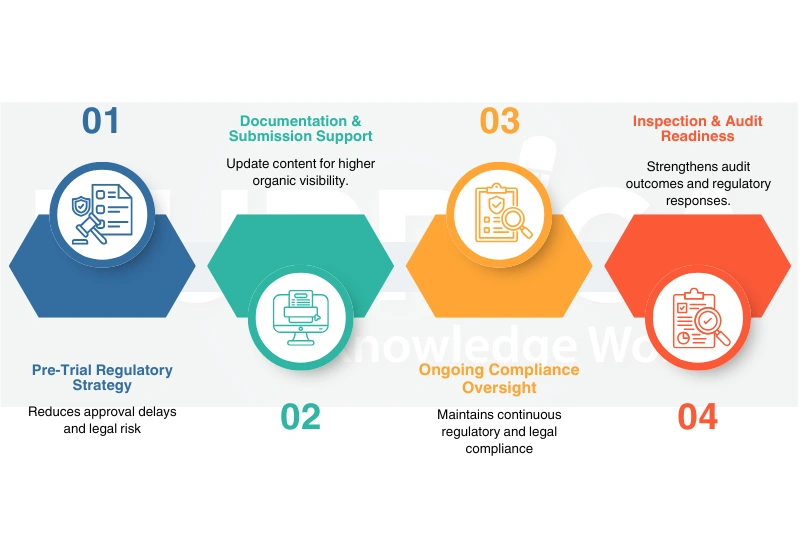
Clinical trial documentation and submissions must be structured to meet both regulatory review standards and medico-legal scrutiny. Regulatory submission support for clinical trials helps ensure accurate, timely, and compliant interactions with regulatory authorities.
4. Medico Legal Benefits of Regulatory Compliance
- Protection of Participants– The ethical and legal protection provide a safe and healthy environment for the rights and welfare of human subjects in the clinic trial.
- Evidence of Documentation -The foundation of regulatory inspections comes from documented, clear, consistent, and traceable records that also enhance the ability to defend legally.[6]
- Faster Approvals- The submission process will be expedited, as errors, corrections, and delays will be reduced due to compliance levels within the submitted documents.
- Data Credibility– The scientific and legally credible evidence is enhanced by ensuring compliance with applicable regulatory standards.
Regulatory medical writing for clinical trials strengthens clarity, consistency, and compliance across all submitted documentation.
Connect with us to explore how we can support you in maintaining academic integrity and enhancing the visibility of your research across the world!
Conclusion
Strengthening Trials with Medico‑Legal Insight: Medico legal regulatory support helps clinical trials be ethically defensible, meet regulation compliance and be legally sound. End-to-end clinical trial regulatory support integrates scientific, ethical, and legal considerations across the entire trial lifecycle. With the integration of the legal aspects of a trial into the overall regulatory strategy, sponsors can ensure the protection of their clinical trial participants, improve the quality and increase the credibility of their data and minimise the legal and opera tional risks associated with conducting a clinical trial. Expert clinical trial regulatory consulting services and medico-legal compliance services for clinical trials play a vital role in sustaining long-term regulatory readiness and legal defensibility.
References
- Clinical trial regulations: Global standards and compliance. (2025, December 13). LegalClarity. https://legalclarity.org/clinical-trial-regulations-global-standards-and-compliance/
- Sharma, M., Grover, M., Sharma, N., Shukla, V. K., & Suryavanshi, S. J. (2025). Comparative Review of Clinical Trial Regulations in Different Countries: Current Scenario and Future Prospect. Reviews on recent clinical trials, https://doi.org/10.2174/0115748
- Clinical research & GCP compliance – FDA guidelines. (n.d.). Fdaguidelines.com. Retrieved January 13, 2026, from https://www.fdaguidelines.com/
- Regulatory compliance in clinical trials: What you need to know. CCRPS Clinical Research Training(2025, April 3). https://ccrps.org/clinical-research-blog/regulatory-compliance-in-clinical-trials-what-you-need-to-know
- Khalil, M. (2025, July 25). Regulatory compliance for clinical trials. J&J Compliance Consulting Group. https://jjccgroup.org/clinical-trial-regulatory-requirements-guide/
- Gill, M. (2023, October 27). Regulatory compliance in clinical research. Withpower.com. https://www.withpower.com/