
Global Accessibility Compliance: Understanding WCAG and International Requirements
- Home
- Academy
- Research Impact
- Global Accessibility Compliance: Understanding WCAG and International Requirements
High-Impact Journals
- What Are Global Accessibility Standards?
- Understanding WCAG: The Global Benchmark for Accessibility
- WCAG Versions and Conformance Levels
- International Accessibility Laws and Regulations
- Why WCAG Compliance Matters for Organizations
- Accessibility Beyond the Web: A Global Perspective
- Best Practices for Meeting Global Accessibility Standards
Interesting topics
Global Accessibility Compliance: Understanding WCAG and International Requirements
Global accessibility compliance is primarily anchored in the Web Content Accessibility Guidelines (WCAG), which serve as the technical benchmark for nearly all international digital accessibility laws. Global Accessibility Compliance requires adhering to the Web Content Accessibility Guidelines (WCAG) to ensure digital content is Perceivable, Operable, Understandable, and Robust (POUR).
Accessibility has moved from a niche compliance area to a global imperative for human rights, digital inclusion, and sustainable design. The continued growth of governments, organizations, and platforms into the digital realm makes it essential for all website, application, and digital content to be accessible to all users, including those with disabilities. This guide is designed to give an overview of WCAG guidelines, international accessibility standards, and how organizations can align with global requirements.[1] Organizations increasingly rely on WCAG accessibility compliance services to operationalize these standards at scale.
Web Accessibility Standards (WCAG) form the foundation for Digital accessibility laws and guidelines across multiple jurisdictions. WCAG compliance requirements are closely aligned with the POUR principles of accessibility to ensure consistent implementation across digital platforms.
1. What Are Global Accessibility Standards?
Global Accessibility Standards are technical guidelines and frameworks that provide accessibility to Technology for all individuals with diverse abilities regardless of their visual, auditory, cognitive, and physical impairments. The goal of these standards is to promote equitable access to digital content while reducing digital exclusion and encouraging inclusive innovation.
International accessibility standards often intersect with ISO accessibility standards to support consistent global implementation. Internationally, accessibility standards can be regulated through laws at the national level, as well as through organizational compliance policies and the procurement of provide high-quality products or services to their country or area.[2]
Accessibility improves the clarity, consistency, and technical robustness of digital content, ensuring reliable access across assistive technologies, devices, and usage contexts.
2. Understanding WCAG: The Global Benchmark for Accessibility
The WCAG (Web Content Accessibility Guidelines) is a world standard for accessibility that was created by the W3C (World Wide Web Consortium). The WCAG relates to any website, mobile application, PDF file, multimedia type file (i.e. audio or video) and any new type of digital technology that is created. Web accessibility guidelines WCAG 2.2 further extend these requirements to address newer interaction patterns and authentication methods.
The WCAG is based upon four principles (known as the POUR principles) which form the basis of the guidelines themselves. The four principles are:
- Perceivable: all information presented on the web must be presented in a way that can be perceived by all users
- Operable: the user interface components of the web site must be able to be used by all users using multiple input methods (i.e. keyboard, mouse, touch screen, etc.)
- Understandable: the content and navigation of a web site must be clear and predictable
- Robust: All web content must be compatible with all assistive technology. [3]
3. WCAG Versions and Conformance Levels
WCAG has been revised over the years to reflect new technology developments and a greater diversity of disabilities [4]. Below is an overview of the three different WCAG versions and what they focused on
| WCAG Version | Year Released | Key Focus |
| WCAG 2.0 | 2008 | Basic accessibility principles for websites |
| WCAG 2.1 | 2018 | Mobile accessibility, people with poor vision, and people with cognitive challenges |
| WCAG 2.2 | 2023 | Focus on visible results, “drag-and-drop,” and authentication methods |
| WCAG 3.0 (Draft) | In progress | Outcome-based standards and flexible scoring methods |
WCAG conformance is measured at three levels:
- Level A – Minimum accessibility
- Level AA – Legal and regulatory standard in most countries
- Level AAA – Enhanced accessibility (aspirational)
These POUR principles of accessibility are central to evaluating WCAG conformance levels. WCAG conformance levels are commonly assessed through Enterprise accessibility audit solutions to ensure regulatory readiness.
4. International Accessibility Laws and Regulations
While WCAG provides the technical foundation, countries adopt and enforce accessibility through legal frameworks. [5] Key International Accessibility Requirements are as follows:
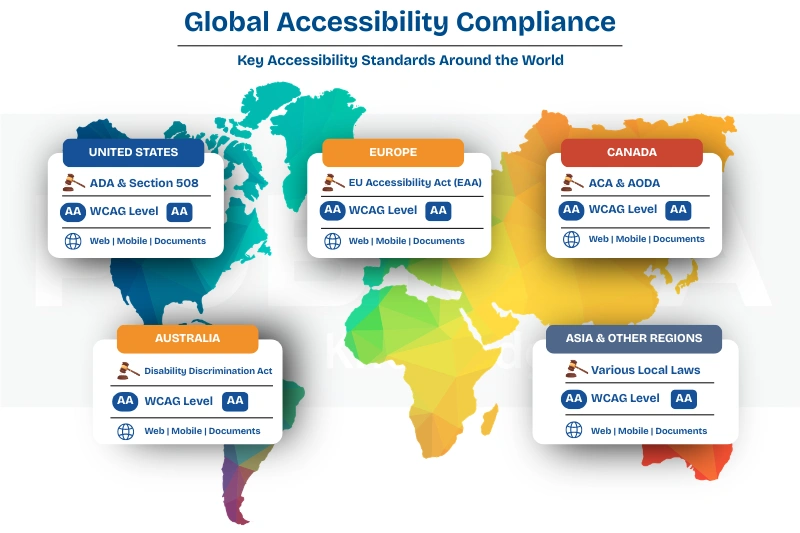
| Region/Country | Regulation | WCAG Alignment |
| United States | ADA, Section 508 | WCAG 2.0 / 2.1 AA |
| European Union | European Accessibility Act (EAA) | WCAG 2.1 AA |
| United Kingdom | Equality Act 2010 | WCAG 2.1 AA |
| Canada | Accessible Canada Act (ACA) | WCAG-based |
| Australia | Disability Discrimination Act | WCAG 2.1 AA |
| India | Rights of Persons with Disabilities Act | WCAG referenced |
Digital accessibility laws and guidelines across regions frequently reference WCAG compliance requirements as their technical baseline. Under the EU Web Accessibility Directive, public sector websites must publish an accessibility statement and provide feedback mechanisms for users with disabilities.
5. Why WCAG Compliance Matters for Organisations
There are many measurable advantages of adhering to international standards of accessibility and WCAG compliance, including:
- Reduction in legal risk through compliance with regulations
- Ability to reach a larger audience, including the over one billion disabled people worldwide
- Better SEO performance and therefore more search-engine friendly websites
- Increased brand loyalty and ESG alignment.
Studies show that accessibility improvements often enhance overall user experience and conversion rates for all users, not just those with disabilities.
Many organisations engage WCAG remediation services to address accessibility gaps identified during compliance audits.
6. Accessibility Beyond the Web: A Global Perspective
Today, accessibility guidelines apply not just to conventional websites, but also extend to:
- Mobile applications
- E-Learning platforms
- Digital health systems
- E-commerce and financial services
- AI-driven interfaces and chatbots
Moreover, worldwide organisations are placing greater importance on inclusive design from the outset, embedding accessibility from the start of product development instead of retrofitting it after development.[6] Digital accessibility consulting for businesses increasingly focuses on embedding accessibility across these emerging digital ecosystems.
7. Best Practices for Meeting Global Accessibility Standards
To achieve international compliance, organisations should:
- Use WCAG 2.1 or 2.2 Level AA as a baseline.
- Perform regular usability testing along with accessibility audits.
- Include users with disabilities in design and testing processes.
- Train content creators and developers about accessibility.
- Keep documentation and accessibility statements updated.
Connect with us to explore how we can support you in maintaining academic integrity and enhancing the visibility of your research across the world!
Conclusion
Global accessibility compliance is now a core requirement for digital organisations worldwide. Aligning with the Web Content Accessibility Guidelines (WCAG) and international regulations helps reduce legal risk while creating robust, future-ready digital experiences. As accessibility requirements continue to evolve, embedding WCAG-aligned practices into design and governance frameworks will be essential for sustained global compliance and inclusive access. Strategic adoption of WCAG accessibility compliance services supports sustained compliance, scalability, and inclusive access across global digital operations.
Achieve Global Accessibility Compliance at Scale!
From WCAG 2.2 alignment to international regulatory readiness, Pubrica supports end-to-end digital accessibility transformation. [Explore Pubrica’s Accessibility Services] or [Schedule a Free Consultation].
References
- Henry, S. L., Abou-Zahra, S., & Brewer, J. (2014). The role of accessibility in a universal web. Proceedings of the 11th Web for All Conference. https://dspace.mit.edu/bitstream
- Iwarsson, S., & Ståhl, A. (2003). Accessibility, usability and universal design–positioning and definition of concepts describing person-environment relationships. Disability and rehabilitation, 25(2), 57–66. https://doi.org/10.1080/dre.25.2.57
- Yesilada, Y., Brajnik, G., Vigo, M., & Harper, S. (2012). Understanding web accessibility and its drivers. Proceedings of the International Cross-Disciplinary Conference on Web Accessibility. https://www.ambuehler.ethz.ch
- Web Content Accessibility Guidelines (WCAG) 2.0. World Wide Web Consortium. https://www.w3.org/TR/WCAG20/
- Lewthwaite S. (2014). Web accessibility standards and disability: developing critical perspectives on accessibility. Disability and rehabilitation, 36(16), 1375–1383. https://doi.org/10.3109/938178
- Seale, J. K. (2013). E-learning and disability in higher education: Accessibility research and practice(2nd ed.). Routledge. https://www.researchgate.net