
- Services
- Discovery & Intelligence Services
- Publication Support Services
- Sample Work

Publication Support Service
- Editing & Translation
-
Editing and Translation Services
- Sample Work

Editing and Translation Service
-
- Research Services
- Sample Work
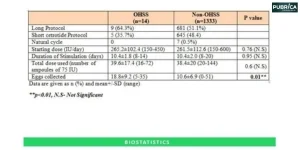
Research Services
- Physician Writing
- Sample Work
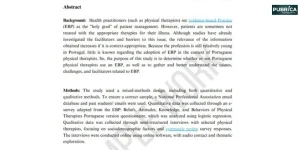
Physician Writing Service
- Statistical Analyses
- Sample Work

Statistical Analyses
- Data Collection
- AI and ML Services
- Sample Work

AI and ML Services
- Medical Writing
- Sample Work
Medical Writing
- Research Impact
- Sample Work

Research Impact
- Medical & Scientific Communication
- Sample Work
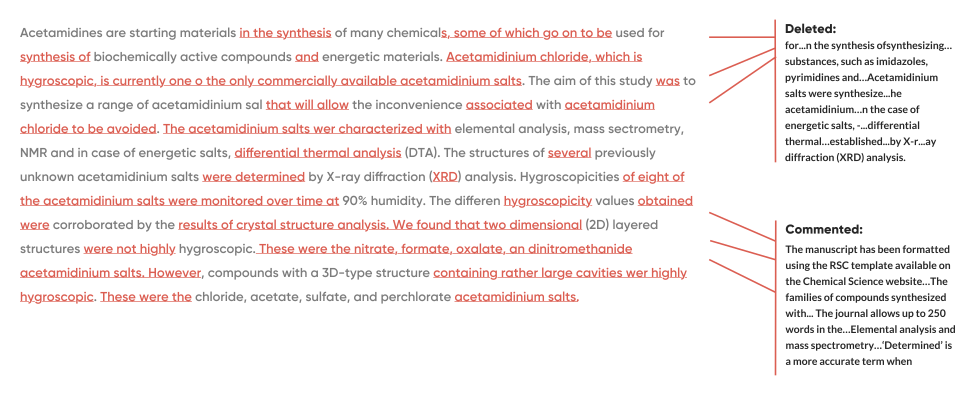
Medical & Scientific Communication
- Medico Legal Services
- Educational Content
- Academic Editorial Services
- Sample Work
Academic Editorial Services
- Educational Editorial Service
-
Education Editorial Services
- Sample Work
Education Editorial Services
-
- Industries
- Subjects
- About Us
- Academy
- Insights
- Contact Us
A Comparative Analysis of Systematic Reviews and Meta-Analyses in Biomedical Research
- Home
- Academy
- Systematic review
- A Comparative Analysis of Systematic Reviews and Meta-Analyses in Biomedical Research
High-Impact Journals
Interesting topics
A Comparative Analysis of Systematic Reviews and Meta-Analyses in Biomedical Research
Table of Contents
1. Understanding Systematic Reviews
2. Understanding Meta-Analyses
3. Key Differences Between Systematic Reviews and Meta-Analyses
4. Methodological Frameworks in Biomedical Research
5. Strengths and Limitations
6. Practical Applications in Biomedical Sciences
7. Applications in Biomedical Research
8. Conclusion
Evidence-based practice in the biomedical sciences relies on the integration of scientific knowledge already present. Two of the more stringent methods for integrating such evidence are systematic reviews in biomedical research and meta-analyses in biomedical research. Both these techniques are sometimes performed in tandem; however, they have different roles. While a systematic review and meta-analysis offer a detailed account of previous scientific investigations about a particular issue, a meta-analysis makes use of statistical analysis to integrate information obtained through different studies. [1]
1. Understanding Systematic Reviews
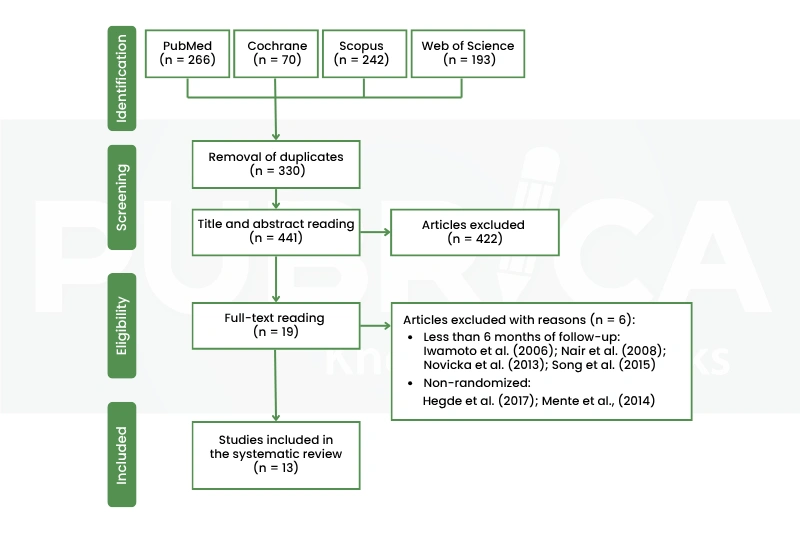
The systematic review is an evidence-based process through which a series of steps are taken to identify, evaluate, and synthesise all studies relating to a particular research problem. A systematic evidence review involves following certain procedures and techniques that eliminate any bias in the process. [2]
Key features of systematic reviews are:
- A research question that is clearly stated (mostly PICO)
- Literature search across different databases
- Inclusion/Exclusion Criteria
- Evaluation of the quality of studies
- Synthesis of results.
2. Understanding Meta-Analyses
A meta-analysis is an advanced form of a systematic review where statistics are used to combine evidence from different studies to generate one estimation of effect size. [3]
Essential features consist of:
- Choosing similar studies
- Drawing out numeric information
- Application of statistical models (fixed effect model or random effects model)
- Generating pooled estimates
- Creating forest plots
Meta-analyses have greater statistical power compared to separate studies.
3. Key Differences Between Systematic Reviews and Meta-Analyses
Aspect | Systematic Review | Meta-Analysis |
Purpose | Summarises existing research | Combines statistical data |
Approach | Qualitative or narrative | Quantitative |
Data Handling | Descriptive synthesis | Statistical aggregation |
Requirement | Can exist alone | Requires systematic review |
Output | Thematic insights | Pooled effect size |
While all meta-analyses are based on systematic reviews, not all systematic reviews include meta-analysis due to variability in data.
4. Methodological Frameworks in Biomedical Research
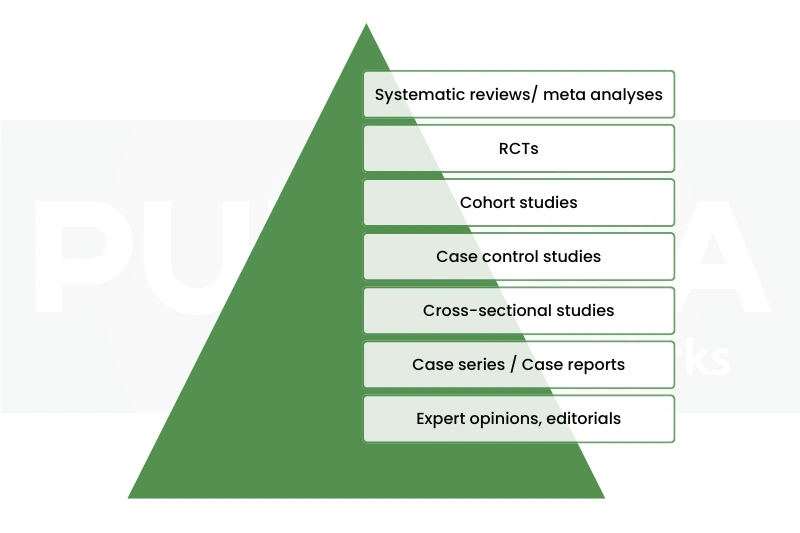
Both approaches employ frameworks that help achieve the validity and reliability of the results. Popular frameworks are: [4]
- PRISMA (Preferred Reporting Items for Systematic Reviews and Meta-Analyses)
- Handbook of Cochrane
- PROSPERO protocol registration
The process involves such steps as:
- Delineating the research question
- Performing literature review
- Selection of studies
- Evaluation of quality and possible biases
Finding synthesis
Frameworks guarantee standardised reporting of results.
5. Strengths and Limitations
Strengths | Limitations |
|
|
Understanding these limitations is essential for interpreting results accurately.
6. Practical Applications in Biomedical Sciences
One of the important uses for systematic reviews and meta-analyses is to support: [5]
- Clinical guideline development
- Public health policy formulation
- Evaluation of treatment efficacy (effectiveness)
- Drug development/approval
Systematic reviews and meta-analyses are widely used in evidence-based medicine, guiding clinical practice and healthcare decisions.
7. Applications in Biomedical Research
Systematic reviews and meta-analyses play a crucial role in: [6]
- Clinical decision-making: Informing treatment guidelines
- Public health policy: Supporting evidence-based interventions
- Drug development: Evaluating efficacy and safety
- Healthcare research: Identifying knowledge gaps
These methods ensure that decisions are based on a comprehensive and critically appraised body of evidence.
Connect with us to explore how we can support you in maintaining academic integrity and enhancing the visibility of your research across the world!
Conclusion
A combination of systematic review and meta-analysis is an important aspect of biomedical research. A systematic review provides an overview of available scientific literature, while meta-analysis adds statistical analysis to enhance the findings of research. Both tools are essential in ensuring the credibility of findings from research, but they depend largely on proper methods of data analysis, among others.
A Comparative Analysis of Systematic Reviews and Meta-Analyses in Biomedical Research. Our Pubrica consultants are here to guide you. [Get Expert Publishing Support] or [Schedule a Free Consultation]
References
- Calderon Martinez, E., Ghattas Hasbun, P. E., Salolin Vargas, V. P., García-González, O. Y., Fermin Madera, M. D., Rueda Capistrán, D. E., Campos Carmona, T., Sanchez Cruz, C., & Teran Hooper, C. (2025). A comprehensive guide to conduct a systematic review and meta-analysis in medical research. Medicine, 104(33), e41868. https://doi.org/10.1097/MD.0000000
- Al-Khabori, M., & Rasool, W. (2022). Introduction to Systematic Reviews and Meta-analyses of Therapeutic Studies. Oman medical journal, 37(5), e428. https://doi.org/10.5001/omj.2022.42
- Ahn, E., & Kang, H. (2018). Introduction to systematic review and meta-analysis. Korean journal of anesthesiology, 71(2), 103–112. https://doi.org/10.4097/kjae.2018.71
- Dusin, J., Melanson, A., & Mische-Lawson, L. (2023). Evidence-based practice models and frameworks in the healthcare setting: a scoping review. BMJ open, 13(5), e071188. https://doi.org/10.1136/bmjopen-2022-071188
- Abu-El-Ruz, R., Hasan, A., Hijazi, D., Masoud, O., Abdallah, A. M., Zughaier, S. M., & Al-Asmakh, M. (2025). Artificial Intelligence in Biomedical Sciences: A Scoping Review. British journal of biomedical science, 82, 14362. https://doi.org/10.3389/bjbs.2025.14
- Luo, J., Wu, M., Gopukumar, D., & Zhao, Y. (2016). Big Data Application in Biomedical Research and Health Care: A Literature Review. Biomedical informatics insights, 8, 1–10. https://doi.org/10.4137/BII.S31559