What Are the Different Types of Scientific Research?
- Home
- Academy
- Research Services
- What Are the Different Types of Scientific Research?
High-Impact Journals
- Foundations of Scientific Research
- Classification Based on Research Purpose
- Classification Based on Research Approach
- Classification Based on Research Design
- Classification Based on Data Source
- Advanced Methodological Classifications
- Emerging and Interdisciplinary Research Approaches
- Ethical and Epistemological Considerations in Scientific Research
- Conclusion
Interesting topics
What Are the Different Types of Scientific Research?
1. Foundations of Scientific Research
2. Classification Based on Research Purpose
3. Classification Based on Research Approach
4. Classification Based on Research Design
5. Classification Based on Data Source
6. Advanced Methodological Classifications
7. Emerging and Interdisciplinary Research Approaches
8. Ethical and Epistemological Considerations in Scientific Research
9. Conclusion
Scientific research is a broad category of research techniques used for the creation of accurate knowledge, verification of theories, addressing real-world problems, and enhancing innovative techniques. Knowledge of the different types of scientific research, scientific research methods, and research methodology is a fundamental prerequisite for further academic [1]
learning in the field. Therefore, this overview discusses the major types of research in terms of their purpose, approach, design, data source, and emerging techniques, in addition to addressing the ethical and epistemological considerations. These classifications are also central to modern scientific research services and research methodology consulting practices. [2]
1. Foundations of Scientific Research
Scientific study is underpinned by philosophical theories of reality (ontology), knowledge (epistemology), and scientific method (methodology). A positivistic approach believes that there is an objective reality that may be measured by observation, while interpretivist theory focuses on social construction. Critical realism is a combination of objective reality and subjective interpretation, and pragmatic theory focuses on results. These philosophical foundations guide the selection of appropriate research methodology and scientific research methods. [3]
The basic purposes of scientific study are explanation (the identification of causal relationships), prediction (the prediction of outcomes), exploration (the investigation of under-researched areas), and theory development (the creation of conceptual models). Understanding these purposes helps define the appropriate types of scientific research.
2. Classification Based on Research Purpose
Research can be categorised according to its primary aim.
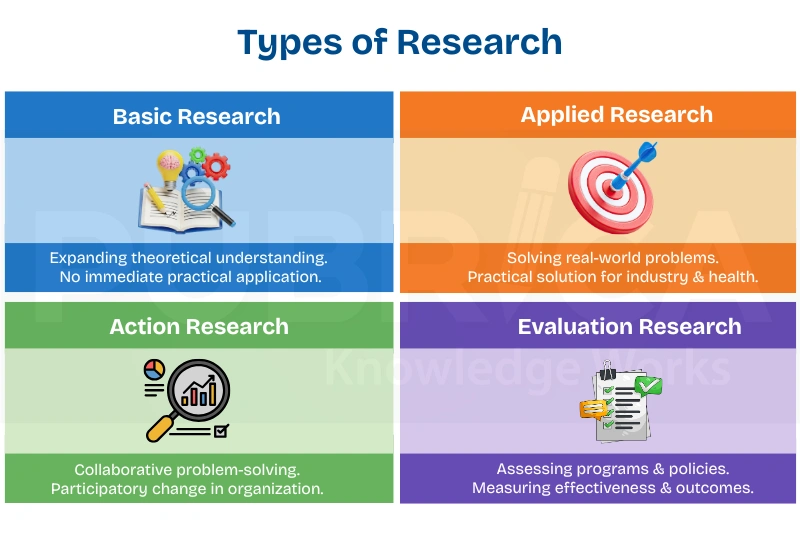
The distinction between basic and applied research is increasingly fluid, particularly in interdisciplinary contexts. Both forms are essential components of scientific research services, where theoretical advancement and practical problem-solving coexist within broader research methodology frameworks.
3. Classification Based on Research Approach
Research methods in science may be categorised as quantitative, qualitative, or mixed methods. These distinctions are central to discussions of quantitative vs qualitative research within contemporary research methodology. [4]
Quantitative Research | uses data that is quantitative in nature, along with statistical methods and hypotheses. It uses deductive methods, surveys, and experiments. |
Qualitative Research | uses interviews, observations, and texts to explore meanings and contexts. Qualitative Research uses inductive and interpretive methods. |
Mixed Methods Research | combines quantitative and qualitative methods in a single study. It may use sequential or concurrent mixed methods, which may be used separately or together. |
Each of these methods has its own assumptions about knowledge and validity.
4. Classification Based on Research Design
Research design is defined as a structural framework that guides research. Effective research design is a key element of strong research methodology and is often supported by research management software in contemporary academic environments.
- Quasi-Experimental Research does not use random assignment but attempts to find causation. [5]
- Descriptive Research seeks to systematically identify characteristics of a population or phenomena using surveys. [6]
- Correlational Research seeks to identify relationships between variables.
- Cross-Sectional Research collects data from a single point in time, while Longitudinal Research collects data from a prolonged period.[7]
5. Classification Based on Data Source
Scientific research can also be grouped in terms of the data used. [8]
- In Primary Research, data is collected through experiments, surveys, interviews, etc.
- Secondary Research, on the other hand, deals with the study of already collected data.
- Systematic Reviews combine the results through a set of rules to avoid bias, while Meta-Analysis uses statistical methods to combine the results of multiple studies.
6. Advanced Methodological Classifications
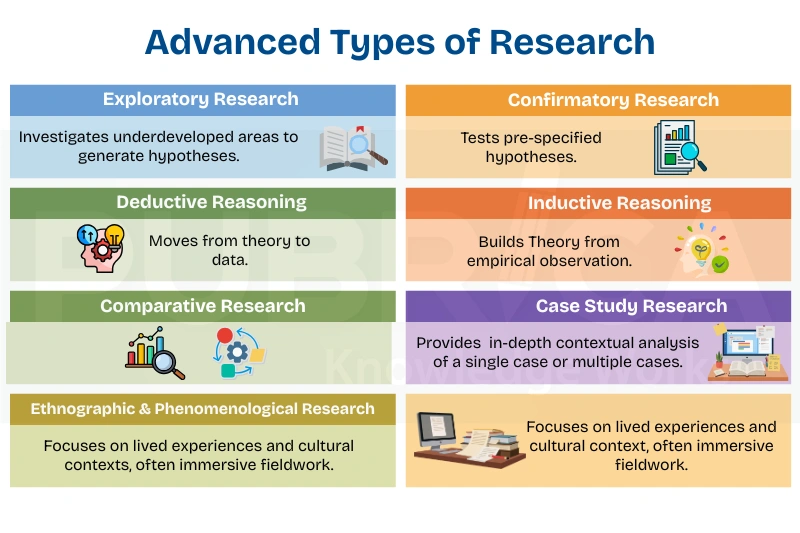
At advanced academic levels, research is further differentiated by reasoning strategies and analytical orientation. [9]
7. Emerging and Interdisciplinary Research Approaches
Current scientific research involves more technology and interdisciplinarity.
- Computational Research makes use of big data analytics, machine learning, and simulation modelling.
- Interdisciplinary Research involves combining theories and methods from various disciplines to deal with complex societal issues.
- Transdisciplinary Research involves going beyond academia to incorporate practitioners and stakeholders.
- The above are all examples of how scientific research has had to change due to global challenges.
The above are all examples of how types of scientific research have evolved due to global challenges. These developments increasingly rely on advanced research management software and integrated scientific research services to coordinate complex projects.
8. Ethical and Epistemological Considerations in Scientific Research
Ethical considerations are fundamental to all types of research. Ethical considerations include issues of consent, confidentiality, data protection, and avoidance of harm. Some guidelines regulate how data is protected, especially with the introduction of the General Data Protection Regulation (GDPR) in European nations.[10]
Epistemological quality is determined by validity, reliability, trustworthiness, and reproducibility. Quantitative research focuses on issues of internal and external validity, while qualitative research focuses on issues of credibility, transferability, and reflexivity. These distinctions are central to discussions of quantitative vs qualitative research within broader scientific research methods.
Reproducibility and transparency are now major issues that bring epistemology and other fields together, particularly in technology-supported scientific research services.
Connect with us to explore how we can support you in maintaining academic integrity and enhancing the visibility of your research across the world!
Conclusion
The nature of scientific research is multidimensional, as it is affected by philosophical paradigms, methodological frameworks, and ethical considerations. The basis for classifying research as being dependent on purpose, approach, design, and source indicates that research involves several strategic considerations that are essential for credible research outcomes. A strong understanding of types of scientific research, research methodology, and scientific research methods enhances scholarly judgment and supports the effective use of research management software and professional research methodology consulting services in modern academic practice.
What Are the Different Types of Scientific Research? Our Pubrica consultants are here to guide you. [Get Expert Publishing Support] or [Schedule a Free Consultation]
Frequently asked questions
1. What are the main types of scientific research methods used in business?
The main types are quantitative research (numerical data and statistics), qualitative research (interviews and insights), mixed methods (combining both), experimental research (testing cause and effect), and case studies (in-depth analysis).
2. What is the difference between applied and basic research in industry?
Basic research develops theory and knowledge without immediate use, while applied research solves specific business problems and improves products or processes.
3. How do qualitative and quantitative research impact business decisions?
Quantitative research provides measurable data for objective decisions, while qualitative research explains customer behaviour and motivations. Together, they improve strategic accuracy.
4. What research methodology is best for corporate projects?
It depends on the goal, but mixed methods are often best because they combine statistical evidence with deeper insights.
5. What services do professional research organisations offer?
They provide market research, data analysis, surveys, feasibility studies, evaluation research, and strategic consulting to support data-driven decisions.
References
- Çaparlar, C. Ö., & Dönmez, A. (2016). What is Scientific Research and How Can it be Done?. Turkish journal of anaesthesiology and reanimation, 44(4), 212–218. https://doi.org/10.5152/TJAR.2016
- Röhrig, B., du Prel, J. B., Wachtlin, D., & Blettner, M. (2009). Types of study in medical research: part 3 of a series on evaluation of scientific publications. Deutsches Arzteblatt international, 106(15), 262–268. https://doi.org/10.3238/arztebl.2009
- Distel, A. P., Grimpe, C., & Poetz, M. (2026). From evidence to impact: The use of scientific research in policy documents. Research Policy, 55(3), 105426. https://doi.org/10.1016/j.respol.2026
- Hsieh, H. F., & Shannon, S. E. (2005). Three approaches to qualitative content analysis. Qualitative health research, 15(9), 1277–1288. https://doi.org/10.1177/10497323052
- Schweizer, M. L., Braun, B. I., & Milstone, A. M. (2016). Research Methods in Healthcare Epidemiology and Antimicrobial Stewardship-Quasi-Experimental Designs. Infection control and hospital epidemiology, 37(10), 1135–1140. https://doi.org/10.1017/ice.2016.117
- Aggarwal, R., & Ranganathan, P. (2019). Study designs: Part 2 – Descriptive studies. Perspectives in clinical research, 10(1), 34–36. https://doi.org/10.4103/picr.PICR_154
- Wang, X., & Cheng, Z. (2020). Cross-Sectional Studies: Strengths, Weaknesses, and Recommendations. Chest, 158(1S), S65–S71. https://doi.org/10.1016/j.chest.2020
- Gliklich RE, Dreyer NA, Leavy MB, editors. Registries for Evaluating Patient Outcomes: A User’s Guide [Internet]. 3rd edition. Rockville (MD): Agency for Healthcare Research and Quality (US); 2014 Apr. 6, Data Sources for Registries. Available from: https://www.ncbi.nlm.nih.gov/books
- Bennett WL, Cheskin LJ, Wilson RF, et al. Methods for Evaluating Natural Experiments in Obesity: Systematic Evidence Review [Internet]. Rockville (MD): Agency for Healthcare Research and Quality (US); 2017 Dec. (Comparative Effectiveness Reviews, No. 204.) Key Question 6, Methodological Advances. Available from: https://www.ncbi.nlm.nih.gov/books
- Muthuswamy V. (2013). Ethical issues in clinical research. Perspectives in clinical research, 4(1), 9–13. https://doi.org/10.4103/2229-3485.106369