- Services
- Discovery & Intelligence Services
- Publication Support Services
- Sample Work
Publication Support Service
- Editing & Translation
-
Editing and Translation Services
- Sample Work
Editing and Translation Service
-
- Research Services
- Sample Work
Research Services
- Physician Writing
- Sample Work
Physician Writing Service
- Statistical Analyses
- Sample Work
Statistical Analyses
- Data Collection
- AI and ML Services
- Sample Work

AI and ML Services
- Medical Writing
- Sample Work
Medical Writing
- Research Impact
- Sample Work
Research Impact
- Medical & Scientific Communication
- Sample Work
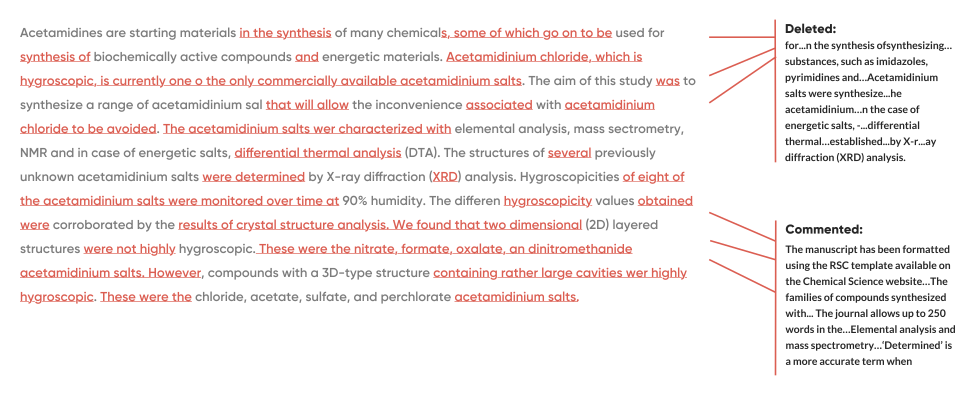
Medical & Scientific Communication
- Medico Legal Services
- Educational Content
- Academic Editorial Services
- Sample Work
Academic Editorial Services
- Educational Editorial Service
-
Education Editorial Services
- Sample Work
Education Editorial Services
-
- Industries
- Subjects
- About Us
- Academy
- Insights
- Contact Us
Targeted literature searches are a fundamental part of writing clinical manuscripts that will meet the standards of high-quality journals and contribute meaningfully to evidence-based practice. When physicians write clinical manuscripts, utilizing a targeted literature search can identify high-quality, relevant, and current evidence. While a general literature review is useful, a targeted literature search is specific to the clinical question and should be completed through frameworks established, such as PICO (Population, Intervention, Comparator, Outcome) and PRISMA [1].
How to Increase Health Literacy in Patient Outcomes with Medical Communications
- Home
- Academy
- Research Impact
- How to Increase Health Literacy in Patient Outcomes with Medical Communications
High-Impact Journals
Interesting topics
How to Increase Health Literacy in Patient Outcomes with Medical Communications
Health literacy is defined as the skills of an individual to obtain, understand, evaluate, and use health information to make appropriate health decisions. Low health literacy is a significant public health issue and has negative implications for patient outcomes, healthcare costs, and overall adherence to treatment. Strong medical communication, including marketing communication, is essential for bridging the gap between complicated medical information and the patient’s understanding of that information.[1,2]
Efforts to improve and increase patient health literacy are therefore critical to better healthcare delivery and patient health outcomes.
1. The Health Literacy Problem
Almost 90% of adults in the United States face health literacy challenges. This disproportionately affects marginalized populations, especially Medicaid members. Low health literacy may worsen health outcomes, strain the healthcare system, and incur additional costs. Understanding health literacy’s impact on outcomes allows policymakers and clinicians to design better education and communication initiatives for diverse populations.
1.1. Key Issues in Health Literacy
Issue | Description | Impact on Patient Outcomes |
Complexity of Medical Information | Patients often receive information in technical language or dense formats | Misunderstanding prescriptions, dosage errors, and reduced adherence |
Limited Access to Reliable Information | Many patients rely on the internet or non-credible sources | Misinformation, delayed treatment, and poor health decisions |
Cultural and Linguistic Barriers | Medical materials not adapted to local languages or cultural contexts | Reduced comprehension, reluctance to seek care |
Socioeconomic Factors | Lower income and education levels correlate with lower health literacy | Poorer disease management, higher hospitalizations |
Each of these key issues demonstrates how patient outcomes and health communication are deeply connected to literacy, education, and accessibility.
2. The Role of Medical Communications in Enhancing Health Literacy
Medical communications, including leadership content and CME (Continuing Medical Education) materials, are essential for enhancing health literacy by providing health information that is more accessible, understandable, and actionable for individuals. Health consumers may feel more empowered to take control of their health with effective communications. [3]
Strong medical communications strategies play a key role in health literacy and patient education, ensuring that patients are informed, engaged, and confident in their healthcare decisions.
3. Key Strategies to Enhance Health Literacy Through Medical Communications
Strategy | Description | Example |
Use Plain Language | Simplify medical terminology to ensure clarity. | Replace “hypertension” with “high blood pressure.” |
Employ Visual Aids | Utilize charts, diagrams, and images to illustrate concepts. | Use a diagram to show how to take medication correctly. |
Provide Multilingual Materials | Offer health information in multiple languages to cater to diverse populations. | Provide brochures in English, Spanish, and other prevalent languages. |
Implement the Teach-Back Method | Ask patients to repeat information in their own words to confirm understanding. | After explaining a treatment plan, ask the patient to describe how they will follow it. |
Leverage Digital Tools | Use mobile apps and websites to disseminate health information and reminders. | Develop an app that sends medication reminders and educational content. |
3.1. Simplifying Medical Language
- Use straightforward language instead of jargon.
- Use short sentences and clear headings and other cues to set readers up for understanding the text.
- Consider other means of presenting text in addition to graphics.
Example Table: Plain vs. Medical Language
Medical Term | Plain Language Alternative |
Hypertension | High blood pressure |
Myocardial infarction | Heart attack |
Anticoagulant | Blood thinner |
Polypharmacy | Taking multiple medications |
3.2. Tailoring Information to Patient Needs
- Carry out evaluations of a person’s literacy.
- Provide resources in multiple formats (e.g., brochures, videos, or apps).
- Provide translated language for non-speakers.
Customizing communication approaches to the patient’s needs supports increasing patient health literacy and enhances patient outcomes and health communication.
3.3. Engaging Patients Through Interactive Communication
- Encourage the patient to ask questions or provide feedback during the appointment.
- Discuss the teach-back method: ask the patients to repeat or paraphrase in their own words what you instructed.
- Use decision aids when you introduce complex options. [4]
3.4. Using Digital Health Tools
- Mobile applications and portals can provide tailored health-related resources.
- Interactive health videos and learning by gamification result in more engaged patients.
- Telehealth consultations can allow you to clarify and understand in real time.
4. Evidence of Impact on Patient Outcomes
Studies show that enhancing health literacy through effective provider-patient communication improves patient outcomes: [5]
- Medication Adherence: Clear instructions and pictures can improve adherence by 30–40%.
- Chronic Disease Management: Patients using customized educational materials achieved better glycaemic and blood pressure control.
- Preventive Health Uptake: Health literacy interventions increased rates of vaccine administration and cancer screening adherence.
- Reduced Hospital Readmissions and Emergency Visits: Improved communication contributes to a reduction in hospital readmissions and emergency visits.
These findings underscore the health literacy impact on outcomes and demonstrate how health literacy improvement methods contribute to measurable changes in patient well-being.
Connect with us to explore how we can support you in maintaining academic integrity and enhancing the visibility of your research across the world!
Conclusion
Health literacy is essential in patient-centered care and has a direct role in adherence, engagement, and outcomes. Clear, tailored, and culturally sensitive medical communication can give patients the ability to make informed health decisions. Healthcare organizations can implement evidence-based medical communications strategies to narrow the gap between complex medical information and patient understanding, improving health economics and overall outcomes.
How to Increase Health Literacy in Patient Outcomes with Medical Communications. Our Pubrica consultants are here to guide you. [Get Expert Publishing Support] or [Schedule a Free Consultation]
References
- Fitzpatrick P. J. (2023). Improving health literacy using the power of digital communications to achieve better health outcomes for patients and practitioners. Frontiers in digital health, 5, 1264780. https://doi.org/10.3389/fdgth.2023.1264780
- Wynia, M. K., & Osborn, C. Y. (2010). Health literacy and communication quality in health care organizations. Journal of Health Communication, 15 Suppl 2(Suppl 2), 102–115. https://doi.org/10.1080/10810730.2010.499981
- Caeiros, P., Ferreira, P. P., Chen-Xu, J., Francisco, R., & de Arriaga, M. T. (2024). From Health Communication to Health Literacy: A Comprehensive Analysis of Relevance and Strategies. Portuguese journal of public health, 42(2), 159–164. https://doi.org/10.1159/000537870
- D’Agostino, T. A., Atkinson, T. M., Latella, L. E., Rogers, M., Morrissey, D., DeRosa, A. P., & Parker, P. A. (2017). Promoting patient participation in healthcare interactions through communication skills training: A systematic review. Patient education and counseling, 100(7), 1247–1257. https://doi.org/10.1016/j.pec.2017.02.016
- Connor, L., Dean, J., McNett, M., Tydings, D. M., Shrout, A., Gorsuch, P. F., Hole, A., Moore, L., Brown, R., Melnyk, B. M., & Gallagher-Ford, L. (2023). Evidence-based practice improves patient outcomes and healthcare system return on investment: Findings from a scoping review. Worldviews on evidence-based nursing, 20(1), 6–15. https://doi.org/10.1111/wvn.12621