- Services
- Discovery & Intelligence Services
- Publication Support Services
- Sample Work
Publication Support Service
- Editing & Translation
-
Editing and Translation Services
- Sample Work
Editing and Translation Service
-
- Research Services
- Sample Work
Research Services
- Physician Writing
- Sample Work
Physician Writing Service
- Statistical Analyses
- Sample Work
Statistical Analyses
- Data Collection
- AI and ML Services
- Sample Work
AI and ML Services
- Medical Writing
- Sample Work
Medical Writing
- Research Impact
- Sample Work
Research Impact
- Medical & Scientific Communication
- Sample Work
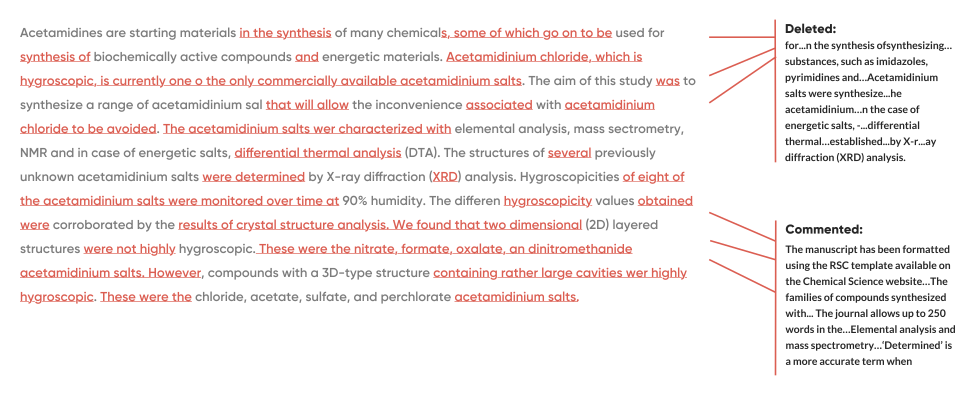
Medical & Scientific Communication
- Medico Legal Services
- Educational Content
- Academic Editorial Services
- Sample Work
Academic Editorial Services
- Educational Editorial Service
-
Education Editorial Services
- Sample Work
Education Editorial Services
-
- Industries
- Subjects
- About Us
- Academy
- Insights
- Contact Us
How to Create Effective Patient Education Content: A Complete Guide
- Home
- Academy
- Poster Presentation
- How to Create Effective Patient Education Content: A Complete Guide
Research Impact
- Understand Your Patient Audience
- Define Clear Educational Objectives
- Use Plain Language and Avoid Medical Jargon
- Structure Content for Easy Scanning
- Ensure Cultural Sensitivity and Inclusivity
- Encourage Action and Self-Management
- Use Tables to Simplify Complex Information
- Test, Review, and Update Content Regularly
- Development Workflow
Interesting topics
How to Create Effective Patient Education Content: A Complete Guide
1. Understand Your Patient Audience
2. Define Clear Educational Objectives
3. Use Plain Language and Avoid Medical Jargon
4. Structure Content for Easy Scanning
5. Ensure Cultural Sensitivity and Inclusivity
6. Encourage Action and Self-Management
7. Use Tables to Simplify Complex Information
8. Test, Review, and Update Content Regularly
9. Development Workflow
Creating effective patient education content is a critical component of healthcare that improves patient outcomes, increases adherence to treatment plans, and reduces readmissions. It requires a patient-centered approach that prioritizes clarity, simplicity, and actionable information.[1]
Patient education content is a core pillar of an effective healthcare content strategy focused on patient understanding and outcomes. Patient education content provides patients and families with actionable, evidence-based information to make informed health decisions, improve self-care, and manage conditions. Effective materials use plain language, actionable steps, and clear visuals to explain diagnoses, treatments, and warning signs. Key topics include medication management, lifestyle adjustments, disease processes, and preventive care. [2] Educational patient resources follow established patient education best practices to support health literacy improvement. This guide provides the best way to create effective, evidence-based, and patient-centered educational resources.
1. Understand Your Patient Audience
To effectively educate patients, it is important to understand your target audience’s demographics, as well as their literacy, cultural background, and beliefs about health.[3] Understanding audience needs strengthens patient engagement strategies and improves teaching strategies for patients. Considerations include:
- Age, Language, and cultural sensitivity
- Health Literacy and Numeracy Levels
- Emotional State & Disease Burden
Design Tip:
“One size fits all” content often fails—personalization improves comprehension and trust.
2. Define Clear Educational Objectives
Everything created for patient education purposes must have a distinct purpose such as; to increase awareness of diseases, provide insight into procedures etc. to assist patients in managing their own health [3]. Below are some questions you can consider when creating patient educational materials.
- What do we want our patients to understand after reading our material?
- What action can they follow through on?
3. Use Plain Language and Avoid Medical Jargon
Patients may have difficulty understanding complex medical terms. Using simple language will help them to understand and remember the information [4]. There are some guidelines to increase clarity to patients.
- Use short sentences
- Explain any medical terminology you cannot avoid
- Aim for a 6th–8th grade reading level
Plain-language principles are fundamental to medical content writing services focused on patient comprehension.
4. Structure Content for Easy Scanning
To enhance usability and engagement, patient documents should be designed to allow patients to read them quickly and efficiently. Here are three suggestions for creating ‘scannable layouts’:
- Use clear headings and subheadings
- Use bullet points and numbered lists
- Use colour and other visual cues to highlight important points
Well-structured layouts improve usability across educational patient resources in both print and digital formats.
Design Tip:
Visuals significantly improve comprehension, especially for complex health concepts [5].
5. Ensure Cultural Sensitivity and Inclusivity
Culture-specific resources increase patient fidelity/resourcefulness. All-inclusive resources need to have:
- Neutral or respectful vocabulary
- Find imagery that depicts a representative group of races in the photos, illustrations, and graphic art
- Recognize traditional healers or healthcare according to the culture of the community
Inclusive design enhances patient engagement strategies and supports effective healthcare marketing solutions.
6. Encourage Action and Self-Management
Patients will be inspired by effective content to make positive health changes.
Educational Goal | Recommended Content Approach |
Disease awareness | Easy to read (simple text, easy to follow pictures) |
Adherence to treatment | Step-by-step instructions |
Change in Lifestyle | Reminder and checklist |
Shared decision-making | Pros vs cons tables |
Action-driven formats reflect patient education best practices and practical patient counselling techniques.
7. Use Tables to Simplify Complex Information
Patients can rapidly evaluate their choices and identify the critical differences in the options available to them with the use of tables.
Example – Medication Instructions Table
Aspect | What Patients Should Know |
Dosage | How much to take at a time, and how many times each day |
Timing | When to take the medication, with/without food? |
Side effects | Common side effects to expect; when do I need to call a doctor? |
Missed dose | What do I need to do about taking a missed dose or skipping a missed dose? |
Tables are widely used in patient education software to simplify complex health information.
8. Test, Review, and Update Content Regularly
Patient education resources must be assessed periodically for their clarity, relevance, and accuracy. Methods of validation for patient education materials are as follows: •
- Feedback from patients
- Reviews performed by clinicians
- Readability evaluation instrument
The Patient Education Materials Assessment Tool (PEMAT) is used to evaluate understandability and actionability, alongside readability scores, clinician review, and patient testing to ensure content quality.[7]
Regular validation is essential for maintaining high-quality patient education content services.
Credibility Check
Transparent assumptions, sensitivity analyses, and stakeholder engagement are essential to ensure that economic evidence remains trustworthy and policy-relevant
9. Development Workflow
The following sequence lists the key stages in the process of developing and delivering patient-centred health content.
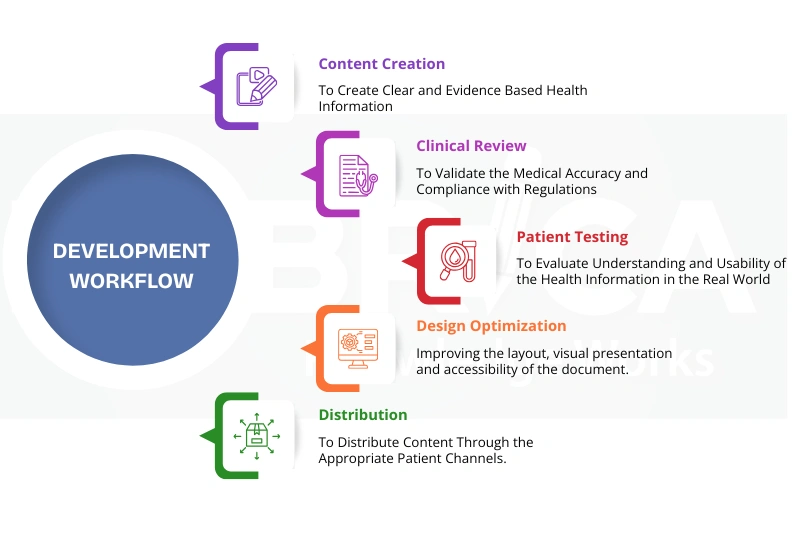
This workflow supports scalable delivery through healthcare content strategy.
Connect with us to explore how we can support you in maintaining academic integrity and enhancing the visibility of your research across the world!
Conclusion
To create effective patient education materials, you need to balance three things: factual medical content, clear communication, and creative design. Patient education will help to provide medical empowerment through implementing plain language, images, organization of the information logically, and scientifically based content to increase patient outcomes and trust. A coordinated approach combining patient education content and healthcare marketing solutions helps organizations deliver consistent, patient-focused education at scale.
Clarity is care! Build patient education content that truly connects with Pubrica.[Get Expert Publishing Support] or [Schedule a Free Consulation].
References
- Pascal, R. (2024, November 18). How to write patient education materials. The Write RN. https://www.thewritern.com/post/how-to-write-patient-education-materials
- Bhattad, P. B., & Pacifico, L. (2022). Empowering Patients: Promoting Patient Education and Health Literacy. Cureus, 14(7), e27336. https://doi.org/10.7759/cureus.27336
- Nutbeam, D. (2000). Health literacy as a public health goal: a challenge for contemporary health education and communication strategies into the 21st century. Health Promotion International, 15(3), 259–267. https://doi.org/10.1093/heapro/15.3.259
- Rao, P. R. (2007). Health literacy: The cornerstone of patient safety. ASHA Leader, 12(6), 8–21. https://doi.org/10.1044/leader.ftr1.12062
- Houts, P. S., Doak, C. C., Doak, L. G., & Loscalzo, M. J. (2006). The role of pictures in improving health communication: a review of research on attention, comprehension, recall, and adherence. Patient education and counseling, 61(2), 173–190. https://doi.org/10.1016/j.pec.2005.05
- Institute of Medicine (US) Committee on Health Literacy, Nielsen-Bohlman, L., Panzer, A. M., & Kindig, D. A. (Eds.). (2004). Health Literacy: A Prescription to End Confusion. National Academies Press (US). https://doi.org/10.17226/10883
- Shoemaker, S. J., Wolf, M. S., & Brach, C. (2014). Development of the Patient Education Materials Assessment Tool (PEMAT): a new measure of understandability and actionability for print and audiovisual patient information. Patient education and counselling, 96(3), 395–403. https://doi.org/10.1016/j.pec.2014.05.027