
- Services
- Discovery & Intelligence Services
- Publication Support Services
- Sample Work

Publication Support Service
- Editing & Translation
-
Editing and Translation Services
- Sample Work

Editing and Translation Service
-
- Research Services
- Sample Work
Research Services
- Physician Writing
- Sample Work
Physician Writing Service
- Statistical Analyses
- Sample Work

Statistical Analyses
- Data Collection
- AI and ML Services
- Sample Work

AI and ML Services
- Medical Writing
- Sample Work
Medical Writing
- Research Impact
- Sample Work
Research Impact
- Medical & Scientific Communication
- Sample Work
Medical & Scientific Communication
- Medico Legal Services
- Educational Content
- Academic Editorial Services
- Sample Work
Academic Editorial Services
- Educational Editorial Service
-
Education Editorial Services
- Sample Work
Education Editorial Services
-
- Industries
- Subjects
- About Us
- Academy
- Insights
- Contact Us
What is Meta-Analysis? Definition, Research, Examples
- Home
- Academy
- Meta Analysis
- What is Meta-Analysis? Definition, Research, Examples
High-Impact Journals
Interesting topics
What is Meta-Analysis? Definition, Research, Examples
In the modern scientific community, especially in areas like medicine, psychology, education, and the social sciences, the ability to synthesise the results of many individual studies is crucial for any conclusions that can be made. Perhaps the most powerful tool that scientists have created for this purpose is the technique known as meta-analysis in research. While the overall field of statistics is the overarching discipline, the practice of evidence-based medicine is closely related to the use of the technique known as meta-analysis.[1]
1. Definition of Meta-Analysis
Meta-analysis is a statistical method used to aggregate and analyse data from various independent research studies that have been conducted to answer a similar research question. This meta-analysis definition and examples approach was first coined by Gene V. Glass in 1976. He defined it as “the analysis of analyses.” Unlike other literature reviews that provide a qualitative approach to analysing research findings, the meta-analysis study method uses mathematical instruments to compute the overall effect size. This approach provides a more objective approach compared to other literature reviews. In essence, the process of meta-analysis involves converting the results of various research findings into a similar format. This helps to eliminate uncertainty. [2]
2. Conceptual Foundations and Research Context
This is usually done through a systematic review. It is a process of identifying, evaluating, and synthesising research literature. It is a widely accepted approach for use in clinical trials, policy studies, and the social sciences, where studies often produce conflicting results, making meta-analysis in research highly valuable.[3]
One of the concepts of meta-analysis is the effect size. It is a quantitative measure of the strength of a relationship or a difference found by a particular study. It can take many forms, such as Cohen’s d, odds ratio, correlation coefficient, and many more. By calculating the effect sizes of several studies, a researcher can identify whether a certain effect exists or not.
Another concept of meta-analysis is heterogeneity. It is a quantitative reflection of the variation found between studies. It is often assessed by a statistical test called the Q-test and the I²-statistic. It determines whether the variation is a result of random changes or other variables such as methodologies, sample populations, and tools.
3. Methodological Process of Meta-Analysis
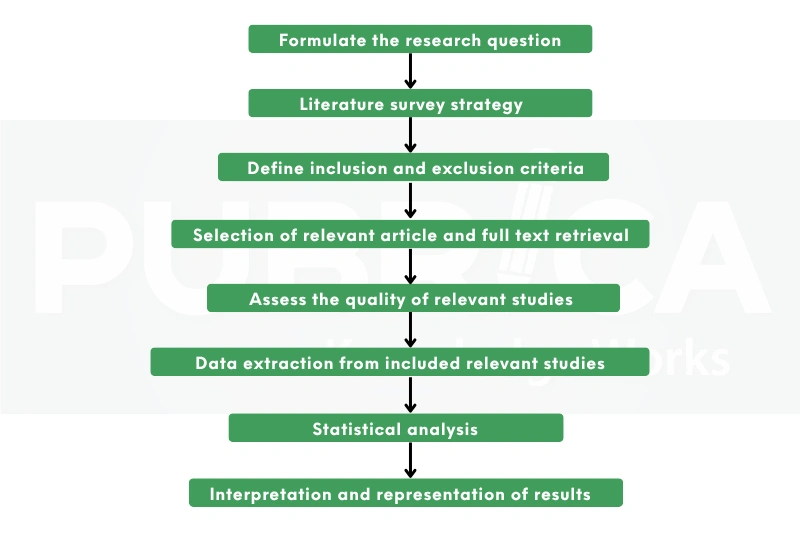
The process of carrying out a meta-analysis study involves a specific and transparent sequence of steps. First, the research question must be identified. The criteria of inclusion and exclusion must be defined. The next step involves carrying out an extensive literature search. This involves searching through various databases like PubMed, Scopus, and Web of Science. [4]
After identifying the relevant literature, the process of data extraction begins. This involves extracting relevant information like sample sizes, methodology, and statistical results. The data obtained through extraction are standardised into effect sizes. Statistical models are used to combine the results. The two basic models used are the fixed-effects model and the random-effects model. The results are also presented in a visual format using a forest plot.
The results also must be examined for publication bias. This involves using funnel plots to see if there was underreporting of studies with non-significant results.
4. Applications of Meta-Analysis in Research
Meta-analysis has revolutionised the way evidence is interpreted across different fields of study. In the medical field, it has been widely used, providing many meta-analyses in medical research examples to determine the efficacy of different treatments by analysing results from clinical trials. For instance, it has been used to determine whether a new drug has a significant effect in reducing mortality rates compared to existing drugs.
In the psychological field, it has been used to determine behavioural patterns or results of different treatments. In the education field, it has been used to determine the impact of different teaching strategies on diverse populations. In public policy research, it has also been used to determine the efficacy of different social programs.[5]
One of the most notable uses of meta-analysis in research was during the COVID-19 pandemic when it was used to determine the efficacy of different vaccines and treatments by analysing global results.
5. Illustrative Examples

For instance, if there are various studies done to determine the efficacy of a new educational program in improving student performance, and the individual studies show different results due to various reasons such as sample size or location of the study, the meta-analysis definition and examples approach provides a general effect size to show whether the intervention is effective or not.
In the health sector, for instance, meta-analysis is used to compare the effectiveness of various treatments for various health conditions such as diabetes and hypertension. These are practical meta-analysis in medical research examples, where it is possible to determine which treatment is best and provides the best outcomes while posing the least risks to patients.
6. Example Table: Simplified Meta-Analysis Data
The process of peer review, an essential part of publication in academia, is in the process of change. This is because AI is now being utilised in the process of peer review in the following ways: assisting reviewers in the process of summarising the articles, pointing out errors in the articles, and even in decision-making itself—further illustrating artificial intelligence in research.[7]
However, there is a possibility of over-reliance on AI in the process of peer review, which is one of the emerging challenges of AI in research, as it may overlook the nuances of arguments and ideas presented in the articles.
Study ID | Sample Size | Effect Size (d) | Weight (%) |
Study A | 120 | 0.45 | 25% |
Study B | 200 | 0.30 | 35% |
Study C | 150 | 0.50 | 20% |
Study D | 180 | 0.40 | 20% |
In this meta-analysis study, each study contributes to the overall result based on its weight, which is typically determined by sample size and variance. The combined effect size provides a more reliable estimate than any single study alone.
7. Strengths and Limitations
The advantages of meta-analysis in research are many. It has increased statistical power and precision. It can also detect patterns. However, there are some limitations to meta-analyses. Firstly, the quality of a meta-analysis is largely dependent on the quality of the individual studies. There are biases that may arise from the studies. [6]
Secondly, there is the issue of heterogeneity. If there are large differences between studies, then a meta-analysis study may not be able to draw a clear inference.
Connect with us to explore how we can support you in maintaining academic integrity and enhancing the visibility of your research across the world!
Conclusion
Meta-analysis is recognised as a pillar of contemporary research synthesis, and it plays a crucial role in helping the academic community transcend individual research findings and arrive at a more comprehensive knowledge of the subject. With the ever-increasing volume of literature in the field of science, the role of meta-analysis in research is expected to endure as an essential instrument for decision-making in various fields of science.
Meta-Analysis: Definition, Research Process, Examples and Applications. Our Pubrica consultants are here to guide you. [Get Expert Publishing Support] or [Schedule a Free Consultation]
References
- Ahn, E., & Kang, H. (2018). Introduction to systematic review and meta-analysis. Korean journal of anesthesiology, 71(2), 103–112. https://doi.org/10.4097/kjae.2018.71
- Berman, N. G., & Parker, R. A. (2002). Meta-analysis: neither quick nor easy. BMC medical research methodology, 2, 10. https://doi.org/10.1186/1471-2288-2-10
- Banzi, R., Moja, L., Pistotti, V., Facchini, A., & Liberati, A. (2011). Conceptual frameworks and empirical approaches used to assess the impact of health research: an overview of reviews. Health research policy and systems, 9, 26. https://doi.org/10.1186/1478-4505-9-26
- Calderon Martinez, E., Ghattas Hasbun, P. E., Salolin Vargas, V. P., García-González, O. Y., Fermin Madera, M. D., Rueda Capistrán, D. E., Campos Carmona, T., Sanchez Cruz, C., & Teran Hooper, C. (2025). A comprehensive guide to conduct a systematic review and meta-analysis in medical research. Medicine, 104(33), e41868. https://doi.org/10.1097/MD.0000000
- DerSimonian, R., & Laird, N. (2015). Meta-analysis in clinical trials revisited. Contemporary clinical trials, 45(Pt A), 139–145. https://doi.org/10.1016/j.cct.2015.09
- Nissen, T., & Wynn, R. (2014). The clinical case report: a review of its merits and limitations. BMC research notes, 7, 264. https://doi.org/10.1186/1756-0500-7-264